
宿主特异性的,并且存在于来自中欧的庇护所犬只中。
Host-specific , and in shelter dogs from central Europe.
作者信息
Szydłowicz Magdalena, Zajączkowska Żaneta, Lewicka Antonina, Łukianowski Błażej, Kamiński Mateusz, Holubová Nikola, Sak Bohumil, Kváč Martin, Kicia Marta
机构信息
Department of Biology and Medical Parasitology, Wroclaw Medical University, Wroclaw, Poland.
Department of Pathomorphology, 4th Military Clinical Hospital, Wroclaw, Poland.
出版信息
Parasitology. 2024 Apr;151(4):351-362. doi: 10.1017/S003118202400009X. Epub 2024 Feb 2.
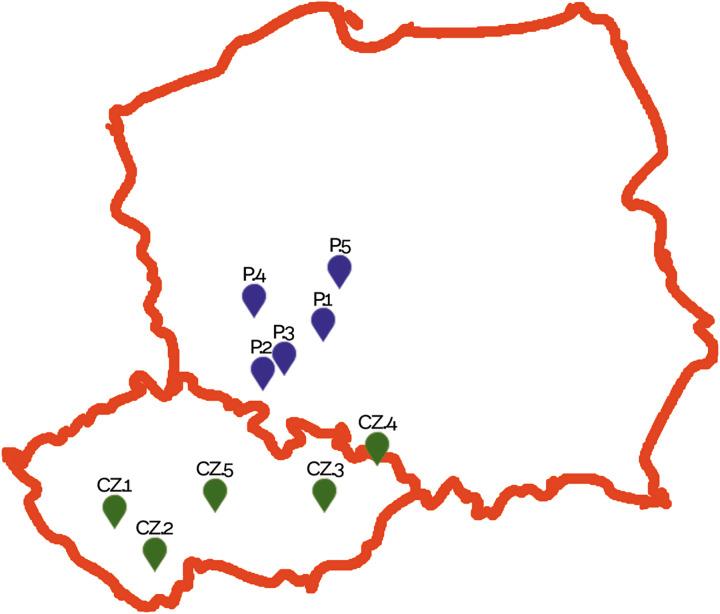
spp., and microsporidia are unicellular opportunistic pathogens that can cause gastrointestinal infections in both animals and humans. Since companion animals may serve as a source of infection, the aim of the present screening study was to analyse the prevalence of these intestinal protists in fecal samples collected from dogs living in 10 animal shelters in central Europe (101 dogs from Poland and 86 from the Czech Republic), combined with molecular subtyping of the detected organisms in order to assess their genetic diversity. Genus-specific polymerase chain reactions were performed to detect DNA of the tested species and to conduct molecular subtyping in collected samples, followed by statistical evaluation of the data obtained (using or Fisher's tests). The observed prevalence was 15.5, 10.2, 1 and 1% for , , spp. and , respectively. Molecular evaluation has revealed the predominance of dog-specific genotypes ( XXe1 subtype; assemblages C and D; genotype II; genotypes D and PtEbIX), suggesting that shelter dogs do not pose a high risk of human transmission. Interestingly, the percentage distribution of the detected pathogens differed between both countries and individual shelters, suggesting that the risk of infection may be associated with conditions typical of a given location.
等孢球虫属和微孢子虫是单细胞机会性病原体,可在动物和人类中引起胃肠道感染。由于伴侣动物可能是感染源,本筛查研究的目的是分析从生活在中欧10个动物收容所的犬只(101只来自波兰,86只来自捷克共和国)采集的粪便样本中这些肠道原生生物的流行情况,并对检测到的生物体进行分子亚型分析,以评估其遗传多样性。进行属特异性聚合酶链反应以检测受试物种的DNA,并对采集的样本进行分子亚型分析,随后对获得的数据进行统计评估(使用检验或费舍尔检验)。观察到的等孢球虫属、隐孢子虫属、贾第虫属和微孢子虫的流行率分别为15.5%、10.2%、1%和1%。分子评估显示犬特异性基因型占主导地位(等孢球虫XXe1亚型;隐孢子虫组合C和D;贾第虫基因型II;微孢子虫基因型D和PtEbIX),这表明收容所的犬只不会构成高人类传播风险。有趣的是,检测到的病原体的百分比分布在两个国家和各个收容所之间有所不同,这表明感染风险可能与特定地点的典型条件有关。




 Zotero 插件