
利用高速原子力显微镜进行单分子成像的小鼠脑细胞核的高效分离与纯化方法。
An Efficient Method for Isolating and Purifying Nuclei from Mice Brain for Single-Molecule Imaging Using High-Speed Atomic Force Microscopy.
机构信息
Division of Nano Life Science, Graduate School of Frontier Science Initiative, Kanazawa University, Kanazawa 920-1192, Japan.
WPI Nano Life Science Institute (WPI-NanoLSI), Kanazawa University, Kanazawa 920-1192, Japan.
出版信息
Cells. 2024 Feb 2;13(3):279. doi: 10.3390/cells13030279.
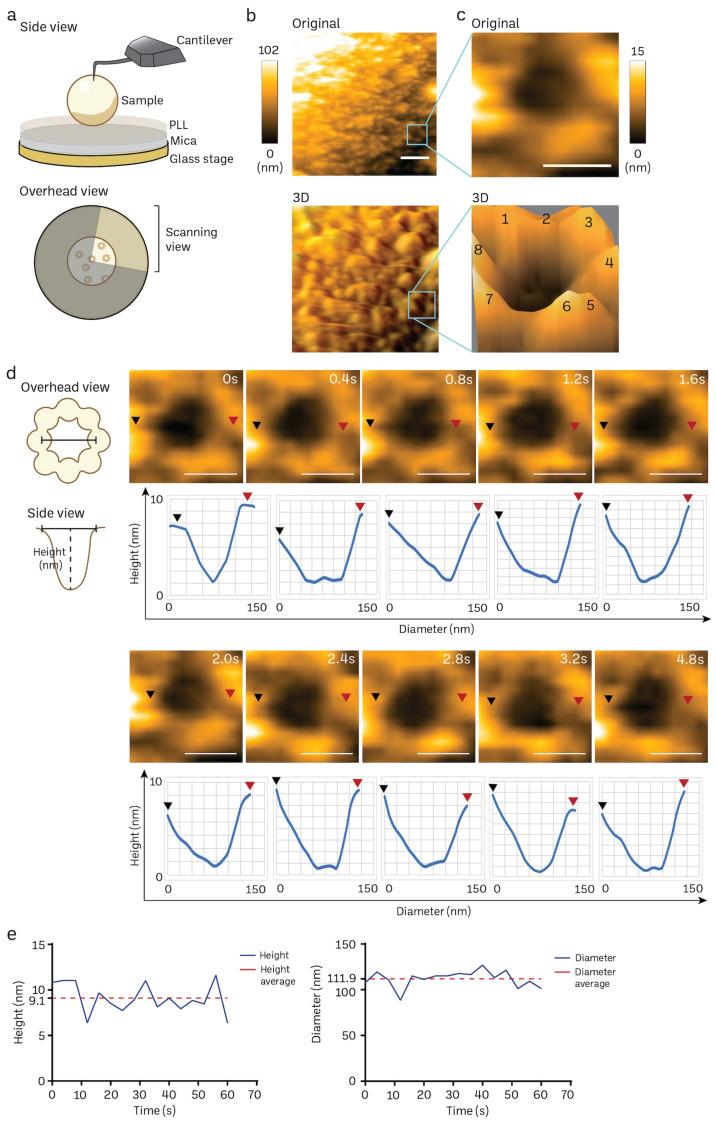
Nuclear pore complexes (NPCs) on the nuclear membrane surface have a crucial function in controlling the movement of small molecules and macromolecules between the cell nucleus and cytoplasm through their intricate core channel resembling a spiderweb with several layers. Currently, there are few methods available to accurately measure the dynamics of nuclear pores on the nuclear membranes at the nanoscale. The limitation of traditional optical imaging is due to diffraction, which prevents achieving the required resolution for observing a diverse array of organelles and proteins within cells. Super-resolution techniques have effectively addressed this constraint by enabling the observation of subcellular components on the nanoscale. Nevertheless, it is crucial to acknowledge that these methods often need the use of fixed samples. This also raises the question of how closely a static image represents the real intracellular dynamic system. High-speed atomic force microscopy (HS-AFM) is a unique technique used in the field of dynamic structural biology, enabling the study of individual molecules in motion close to their native states. Establishing a reliable and repeatable technique for imaging mammalian tissue at the nanoscale using HS-AFM remains challenging due to inadequate sample preparation. This study presents the rapid strainer microfiltration (RSM) protocol for directly preparing high-quality nuclei from the mouse brain. Subsequently, we promptly utilize HS-AFM real-time imaging and cinematography approaches to record the spatiotemporal of nuclear pore nano-dynamics from the mouse brain.
核孔复合物(NPCs)位于核膜表面,通过其类似蜘蛛网的多层核心通道,在控制小分子和大分子在细胞核和细胞质之间的运动方面起着至关重要的作用。目前,很少有方法可以在纳米尺度上准确测量核膜上核孔的动力学。传统光学成像的局限性在于衍射,这限制了达到观察细胞内各种细胞器和蛋白质所需的分辨率。超分辨率技术通过在纳米尺度上观察亚细胞成分有效地解决了这一限制。然而,必须认识到,这些方法通常需要使用固定样本。这也引发了一个问题,即静态图像在多大程度上代表了真实的细胞内动态系统。高速原子力显微镜(HS-AFM)是动态结构生物学领域中使用的一种独特技术,可用于研究接近其自然状态的运动中的单个分子。由于样品制备不足,使用 HS-AFM 对哺乳动物组织进行纳米尺度成像的可靠且可重复的技术仍然具有挑战性。本研究提出了快速滤网微过滤(RSM)方案,用于直接从老鼠大脑中制备高质量的核。随后,我们立即利用 HS-AFM 实时成像和电影摄影方法来记录来自老鼠大脑的核孔纳米动力学的时空变化。


 Zotero 插件