
调查 COVID-19 降级后 2016 年 9 月至 2021 年 6 月期间加泰罗尼亚呼吸道病原体的流行病学分布(时间和强度):区域监测数据分析。
Investigating epidemiological distribution (temporality and intensity) of respiratory pathogens following COVID-19 de-escalation process in Catalonia, September 2016-June 2021: Analysis of regional surveillance data.
机构信息
Sub-Directorate General of Surveillance and Response to Public Health Emergencies, Public Health Agency of Catalonia, Generalitat of Catalonia, Barcelona, Spain.
Research Support Unit of Central Catalonia, University Institute for Research in Primary Health Care Jordi Gol i Gurina, Sant Fruitós de Bages, Spain.
出版信息
PLoS One. 2024 Feb 9;19(2):e0285892. doi: 10.1371/journal.pone.0285892. eCollection 2024.
BACKGROUND
Following the low incidence rates of non-SARS-CoV-2 respiratory viruses registered during the strict lockdown enforced in the pandemic, a resurgence of several endemic viruses in Catalonia (Spain) was noted during the early summer of 2021.
OBJECTIVES
In this study, we investigated whether the circulation of non-SARS-CoV-2 respiratory viruses in Catalonia, assessed by Microbiological Reporting System of Catalonia (MRSC) and the Epidemiological Surveillance Network of Catalonia, was affected by the strict lockdown measures, as well as, the implication of the Coronavirus Disease 19 (COVID-19) de-escalation process in the late season outbreaks registered during the 2020-2021 season.
STUDY DESIGN
A retrospective comparison of epidemic patterns in the respiratory viruses' incidence, using regional public health surveillance data from MRSC, was performed between weeks 26/2016 to week 27/2021. Data were expressed as the weekly total number of test positivity for individual viruses. A segmented negative binomial regression model was conducted, with two parameters included (level and trend) for each segment of the time series (2020 pre-lockdown, 2020 post-lockdown and 2021). Results were reported as a unit changed in the strict lockdown.
RESULTS
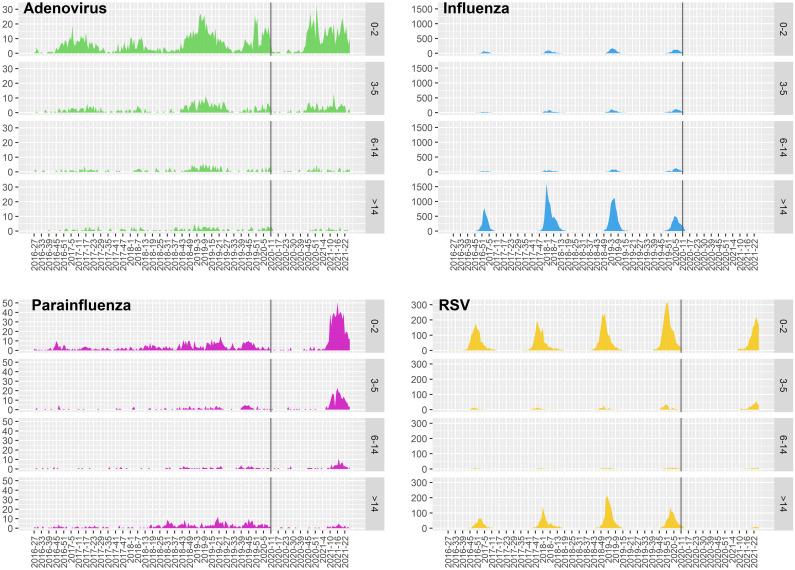
A total of 51588 confirmed cases of the different respiratory viruses were included in the analysis, the majority were influenza cases (63.7%). An immediate reduction in the weekly number of cases was observed in 2020 after the COVID-19 outbreak for human adenovirus virus (HAdV) (β2 = -2.606; P <0.01), human parainfluenza virus (HPIV) (β2 = -3.023; P <0.01), influenza virus (IFV) (β2 = -1.259; P <0.01), but not for respiratory syncytial virus (RSV), where the number of cases remained unchanged. During 2020, a significant negative trend was found for RSV (β3 = -0.170, P <0.01), and a positive trend for HAdV (β3 = 0.075, P <0.01). During 2021, a significant reduction in the weekly number of cases was also observed for all respiratory viruses, and a borderline non-significant reduction for HPIV (β3 = -0.027; P = 0.086). Moreover, significant positive trends were found for each viral pathogen, except for influenza during 2020-2021 season, where cases remained close to zero. The respiratory viruses increased activity and their late season epidemic start particularly affected children under 6 years old.
CONCLUSIONS
Our data not only provides evidence that occurrence of different respiratory virus infections was affected by the strict lockdown taken against SARS-CoV-2 but it also shows a late resurgence of seasonal respiratory viruses' cases during the 2020-2021 season following the relaxation of COVID-19-targeted non-pharmaceutical interventions.
背景
在大流行期间实施严格封锁后,加泰罗尼亚(西班牙)登记的非 SARS-CoV-2 呼吸道病毒的发病率较低,2021 年初夏注意到几种地方性病毒的再次流行。
目的
在这项研究中,我们通过加泰罗尼亚微生物报告系统(MRSC)和加泰罗尼亚流行病学监测网络评估了非 SARS-CoV-2 呼吸道病毒在加泰罗尼亚的传播情况,这是否受到严格封锁措施的影响,以及 2020-2021 季节中登记的季节后期暴发的 COVID-19 降级过程的影响。
研究设计
使用来自 MRSC 的区域公共卫生监测数据,对 2016 年第 26 周至 2021 年第 27 周期间呼吸道病毒发病率的流行模式进行了回顾性比较。数据表示为每个病毒的每周总检测阳性数。对时间序列的每个部分(2020 年封锁前、2020 年封锁后和 2021 年)进行了包含两个参数(水平和趋势)的分段负二项式回归模型。结果以严格封锁的变化单位报告。
结果
共纳入 51588 例不同呼吸道病毒的确诊病例,其中流感病例居多(63.7%)。在 COVID-19 爆发后,2020 年人类腺病毒(HAdV)(β2 =-2.606;P<0.01)、人类副流感病毒(HPIV)(β2 =-3.023;P<0.01)和流感病毒(IFV)(β2 =-1.259;P<0.01)的每周病例数立即减少,但呼吸道合胞病毒(RSV)的病例数没有变化。2020 年,RSV(β3 =-0.170,P<0.01)呈显著负趋势,HAdV(β3 =0.075,P<0.01)呈显著正趋势。2021 年,所有呼吸道病毒的每周病例数也明显减少,而 HPIV 的减少则接近临界非显著(β3 =-0.027;P=0.086)。此外,除 2020-2021 季节的流感外,每种病毒病原体都发现了显著的阳性趋势,流感病例几乎为零。呼吸道病毒的活动增加,其季节后期的发病开始特别影响 6 岁以下儿童。
结论
我们的数据不仅提供了证据表明不同呼吸道病毒感染的发生受到针对 SARS-CoV-2 的严格封锁措施的影响,还表明在 COVID-19 靶向非药物干预措施放松后,2020-2021 季节季节性呼吸道病毒病例出现后期反弹。

 Zotero 插件