
炎症免疫表型预测免疫检查点抑制剂治疗多种癌症类型的良好临床结局。
Inflamed immune phenotype predicts favorable clinical outcomes of immune checkpoint inhibitor therapy across multiple cancer types.
机构信息
Department of Pathology, Stanford University School of Medicine, Stanford, California, USA
Center for Artificial Intelligence in Medicine & Imaging, Stanford University, Stanford, California, USA.
出版信息
J Immunother Cancer. 2024 Feb 14;12(2):e008339. doi: 10.1136/jitc-2023-008339.
BACKGROUND
The inflamed immune phenotype (IIP), defined by enrichment of tumor-infiltrating lymphocytes (TILs) within intratumoral areas, is a promising tumor-agnostic biomarker of response to immune checkpoint inhibitor (ICI) therapy. However, it is challenging to define the IIP in an objective and reproducible manner during manual histopathologic examination. Here, we investigate artificial intelligence (AI)-based immune phenotypes capable of predicting ICI clinical outcomes in multiple solid tumor types.
METHODS
Lunit SCOPE IO is a deep learning model which determines the immune phenotype of the tumor microenvironment based on TIL analysis. We evaluated the correlation between the IIP and ICI treatment outcomes in terms of objective response rates (ORR), progression-free survival (PFS), and overall survival (OS) in a cohort of 1,806 ICI-treated patients representing over 27 solid tumor types retrospectively collected from multiple institutions.
RESULTS
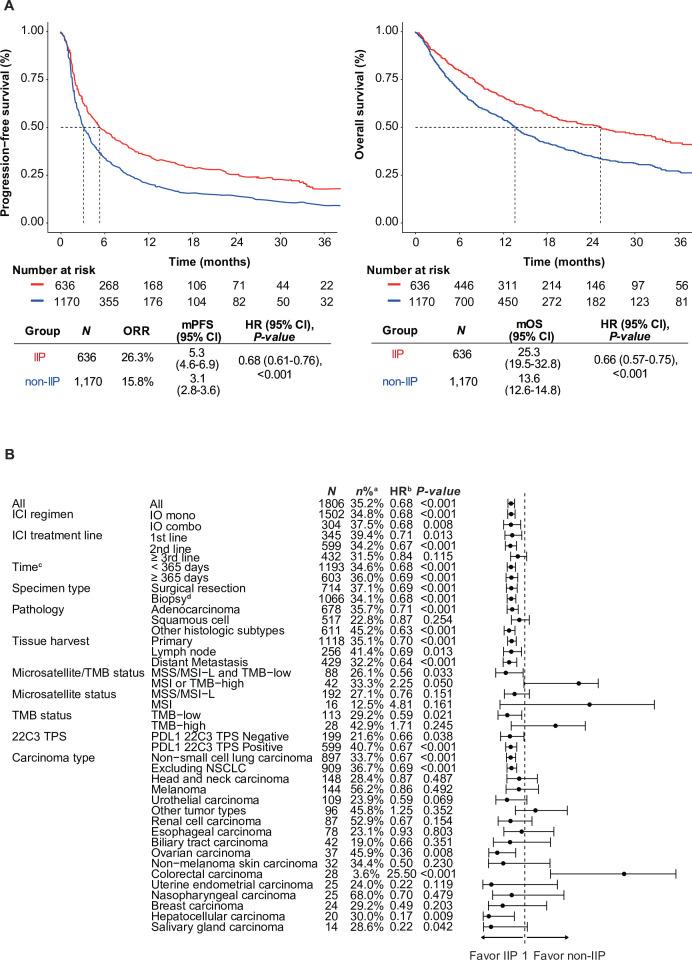
We observed an overall IIP prevalence of 35.2% and significantly more favorable ORRs (26.3% vs 15.8%), PFS (median 5.3 vs 3.1 months, HR 0.68, 95% CI 0.61 to 0.76), and OS (median 25.3 vs 13.6 months, HR 0.66, 95% CI 0.57 to 0.75) after ICI therapy in IIP compared with non-IIP patients, respectively (p<0.001 for all comparisons). On subgroup analysis, the IIP was generally prognostic of favorable PFS across major patient subgroups, with the exception of the microsatellite unstable/mismatch repair deficient subgroup.
CONCLUSION
The AI-based IIP may represent a practical, affordable, clinically actionable, and tumor-agnostic biomarker prognostic of ICI therapy response across diverse tumor types.
背景
浸润性免疫表型(IIP)定义为肿瘤内区域浸润的肿瘤浸润淋巴细胞(TIL)富集,是一种有前途的、与肿瘤无关的免疫检查点抑制剂(ICI)治疗反应的生物标志物。然而,在手动组织病理学检查中,以客观和可重复的方式定义 IIP 具有挑战性。在这里,我们研究了基于人工智能(AI)的免疫表型,这些表型能够预测多种实体瘤类型的 ICI 临床结局。
方法
Lunit SCOPE IO 是一种深度学习模型,它基于 TIL 分析来确定肿瘤微环境的免疫表型。我们评估了 IIP 与 1806 例接受 ICI 治疗的患者队列中 ICI 治疗结果之间的相关性,这些患者代表了来自多个机构的 27 种以上实体瘤类型的回顾性收集,这些患者接受了 ICI 治疗。
结果
我们观察到总体 IIP 患病率为 35.2%,并且在接受 ICI 治疗后,ORR(26.3% 与 15.8%)、PFS(中位 5.3 与 3.1 个月,HR 0.68,95%CI 0.61 至 0.76)和 OS(中位 25.3 与 13.6 个月,HR 0.66,95%CI 0.57 至 0.75)均有显著改善,分别(所有比较 p<0.001)。在亚组分析中,除微卫星不稳定/错配修复缺陷亚组外,IIP 通常对主要患者亚组的有利 PFS 具有预后意义。
结论
基于 AI 的 IIP 可能代表一种实用、负担得起、临床可行且与肿瘤无关的生物标志物,可预测多种肿瘤类型的 ICI 治疗反应。


 Zotero 插件