
SanPy:用于全细胞电流钳记录分析和可视化的软件。
SanPy: Software for the analysis and visualization of whole-cell current-clamp recordings.
机构信息
Department of Physiology & Membrane Biology, University of California-Davis School of Medicine, Davis, California.
Department of Physiology & Membrane Biology, University of California-Davis School of Medicine, Davis, California.
出版信息
Biophys J. 2024 Apr 2;123(7):759-769. doi: 10.1016/j.bpj.2024.02.025. Epub 2024 Feb 27.
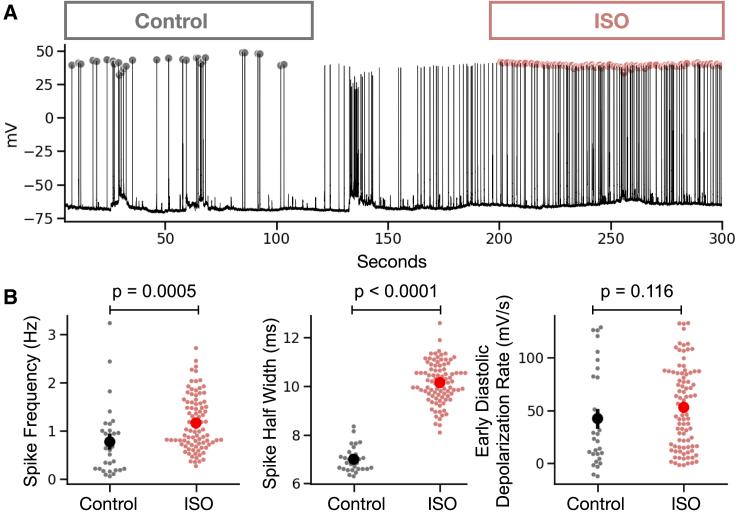
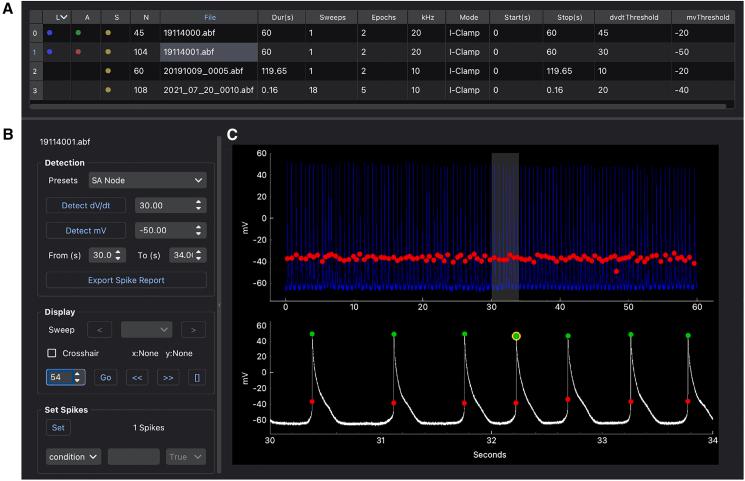
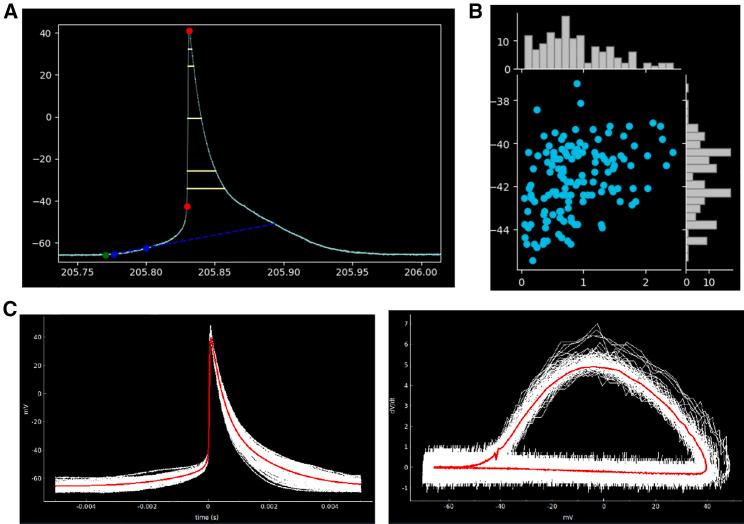
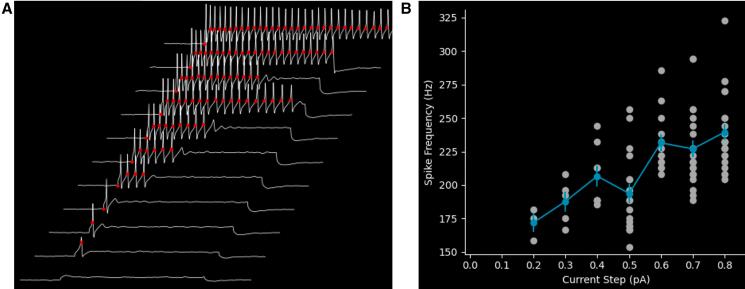
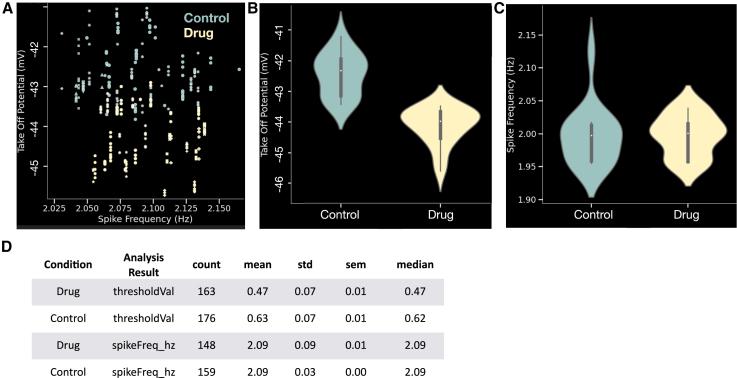
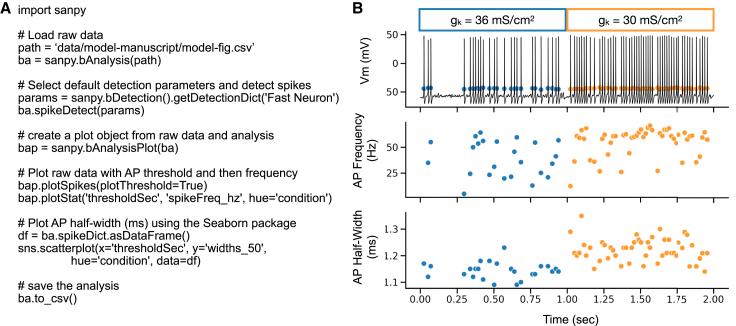
The analysis of action potentials and other membrane voltage fluctuations provides a powerful approach for interrogating the function of excitable cells. However, a major bottleneck in the interpretation of this critical data is the lack of intuitive, agreed-upon software tools for its analysis. Here, we present SanPy, an open-source and freely available software package for the analysis and exploration of whole-cell current-clamp recordings written in Python. SanPy provides a robust computational engine with an application programming interface. Using this, we have developed a cross-platform desktop application with a graphical user interface that does not require programming. SanPy is designed to extract common parameters from action potentials, including threshold time and voltage, peak, half-width, and interval statistics. In addition, several cardiac parameters are measured, including the early diastolic duration and rate. SanPy is built to be fully extensible by providing a plugin architecture for the addition of new file loaders, analysis, and visualizations. A key feature of SanPy is its focus on quality control and data exploration. In the desktop interface, all plots of the data and analysis are linked, allowing simultaneous data visualization from different dimensions with the goal of obtaining ground-truth analysis. We provide documentation for all aspects of SanPy, including several use cases and examples. To test SanPy, we performed analysis on current-clamp recordings from heart and brain cells. Taken together, SanPy is a powerful tool for whole-cell current-clamp analysis and lays the foundation for future extension by the scientific community.
动作电位和其他膜电压波动的分析为研究可兴奋细胞的功能提供了一种强大的方法。然而,在解释这些关键数据时,主要的瓶颈是缺乏直观的、达成共识的软件工具来进行分析。在这里,我们介绍了 SanPy,这是一个用 Python 编写的用于全细胞膜片钳记录分析和探索的开源免费软件包。SanPy 提供了一个带有应用程序编程接口的强大计算引擎。使用这个接口,我们开发了一个具有图形用户界面的跨平台桌面应用程序,它不需要编程。SanPy 旨在从动作电位中提取常见参数,包括阈值时间和电压、峰值、半宽度和间隔统计。此外,还测量了几个心脏参数,包括早期舒张期持续时间和速率。SanPy 通过提供用于添加新文件加载器、分析和可视化的插件架构来实现完全可扩展。SanPy 的一个关键特性是它专注于质量控制和数据探索。在桌面界面中,所有数据和分析的图形都链接在一起,允许从不同维度同时可视化数据,目的是获得真实的分析。我们提供了 SanPy 各个方面的文档,包括几个用例和示例。为了测试 SanPy,我们对来自心脏和脑细胞的膜片钳记录进行了分析。总之,SanPy 是一种强大的全细胞膜片钳分析工具,为科学界未来的扩展奠定了基础。
 Zotero 插件