
BUB1/KIF14 复合物通过诱导染色体不稳定性促进间变性甲状腺癌的进展。
BUB1/KIF14 complex promotes anaplastic thyroid carcinoma progression by inducing chromosome instability.
机构信息
Otolaryngology & Head and Neck Center, Cancer Center, Department of Head and Neck Surgery, Zhejiang Provincial People's Hospital, Affiliated People's Hospital, Hangzhou Medical College, Hangzhou, China.
Center for Clinical Pharmacy, Cancer Center, Department of Pharmacy, Zhejiang Provincial People's Hospital, Affiliated People's Hospital, Hangzhou Medical College, Hangzhou, China.
出版信息
J Cell Mol Med. 2024 Apr;28(7):e18182. doi: 10.1111/jcmm.18182.
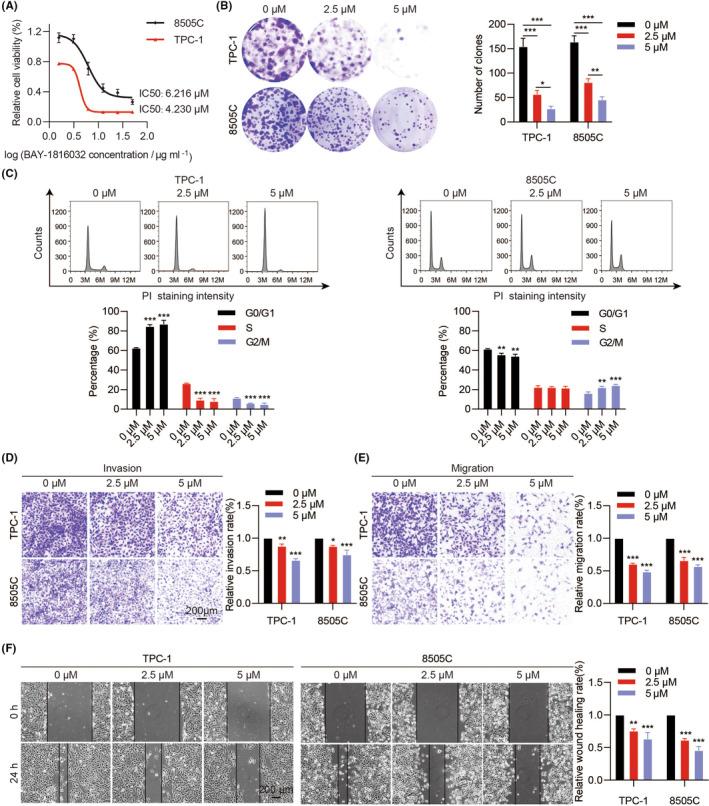
Chromosome instability (CIN) is a common contributor driving the formation and progression of anaplastic thyroid cancer (ATC), but its mechanism remains unclear. The BUB1 mitotic checkpoint serine/threonine kinase (BUB1) is responsible for the alignment of mitotic chromosomes, which has not been thoroughly studied in ATC. Our research demonstrated that BUB1 was remarkably upregulated and closely related to worse progression-free survival. Knockdown of BUB1 attenuated cell viability, invasion, migration and induced cell cycle arrests, whereas overexpression of BUB1 promoted the cell cycle progression of papillary thyroid cancer cells. BUB1 knockdown remarkably repressed tumour growth and tumour formation of nude mice with ATC xenografts and suppressed tumour metastasis in a zebrafish xenograft model. Inhibition of BUB1 by its inhibitor BAY-1816032 also exhibited considerable anti-tumour activity. Further studies showed that enforced expression of BUB1 evoked CIN in ATC cells. BUB1 induced CIN through phosphorylation of KIF14 at serine1292 (Ser ). Overexpression of the KIF14 mutant was unable to facilitate the aggressiveness of ATC cells when compared with that of the wild type. Collectively, these findings demonstrate that the BUB1/KIF14 complex drives the aggressiveness of ATC by inducing CIN.
染色体不稳定性(CIN)是驱动间变性甲状腺癌(ATC)形成和进展的常见因素,但其机制尚不清楚。BUB1 有丝分裂检查点丝氨酸/苏氨酸激酶(BUB1)负责有丝分裂染色体的排列,但其在 ATC 中的研究还不够彻底。我们的研究表明,BUB1 显著上调,与无进展生存期更差密切相关。BUB1 敲低可减弱细胞活力、侵袭和迁移,并诱导细胞周期停滞,而过表达 BUB1 可促进甲状腺乳头状癌细胞的细胞周期进程。BUB1 敲低显著抑制 ATC 裸鼠异种移植瘤的生长和肿瘤形成,并抑制斑马鱼异种移植模型中的肿瘤转移。BUB1 的抑制剂 BAY-1816032 也表现出相当的抗肿瘤活性。进一步的研究表明,BUB1 的强制表达可引发 ATC 细胞中的 CIN。BUB1 通过丝氨酸 1292(Ser )磷酸化 KIF14 诱导 CIN。与野生型相比,过表达 KIF14 突变体不能促进 ATC 细胞的侵袭性。总之,这些发现表明 BUB1/KIF14 复合物通过诱导 CIN 驱动 ATC 的侵袭性。

 Zotero 插件