
蚓螈类两栖动物抗菌肽的多样性和分子进化。
Diversity and Molecular Evolution of Antimicrobial Peptides in Caecilian Amphibians.
机构信息
Department of Biodiversity Ecology and Evolution, Faculty of Biological Sciences, Complutense University of Madrid, 28040 Madrid, Spain.
Natural History Museum, London SW7 5BD, UK.
出版信息
Toxins (Basel). 2024 Mar 14;16(3):150. doi: 10.3390/toxins16030150.
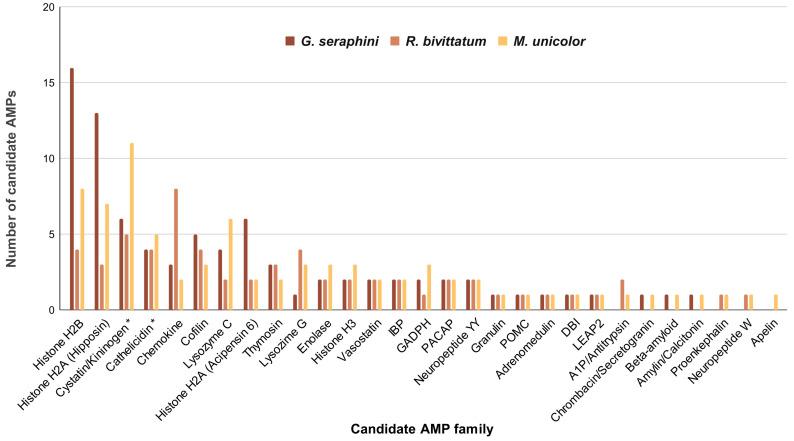
Antimicrobial peptides (AMPs) are key molecules in the innate immune defence of vertebrates with rapid action, broad antimicrobial spectrum, and ability to evade pathogen resistance mechanisms. To date, amphibians are the major group of vertebrates from which most AMPs have been characterised, but most studies have focused on the bioactive skin secretions of anurans (frogs and toads). In this study, we have analysed the complete genomes and/or transcriptomes of eight species of caecilian amphibians (order Gymnophiona) and characterised the diversity, molecular evolution, and antimicrobial potential of the AMP repertoire of this order of amphibians. We have identified 477 candidate AMPs within the studied caecilian genome and transcriptome datasets. These candidates are grouped into 29 AMP families, with four corresponding to peptides primarily exhibiting antimicrobial activity and 25 potentially serving as AMPs in a secondary function, either in their entirety or after cleavage. In silico prediction methods were used to identify 62 of those AMPs as peptides with promising antimicrobial activity potential. Signatures of directional selection were detected for five candidate AMPs, which may indicate adaptation to the different selective pressures imposed by evolutionary arms races with specific pathogens. These findings provide encouraging support for the expectation that caecilians, being one of the least-studied groups of vertebrates, and with ~300 million years of separate evolution, are an underexplored resource of great pharmaceutical potential that could help to contest antibiotic resistance and contribute to biomedical advance.
抗菌肽 (AMPs) 是脊椎动物先天免疫防御的关键分子,具有快速作用、广谱抗菌谱和逃避病原体耐药机制的能力。迄今为止,两栖动物是大多数 AMPs 被描述的主要脊椎动物群体,但大多数研究都集中在无尾两栖动物(青蛙和蟾蜍)的生物活性皮肤分泌物上。在这项研究中,我们分析了 8 种蚓螈两栖动物(蚓螈目)的完整基因组和/或转录组,并对该目两栖动物 AMP 库的多样性、分子进化和抗菌潜力进行了特征分析。我们在研究的蚓螈基因组和转录组数据集内鉴定了 477 种候选 AMP。这些候选者分为 29 种 AMP 家族,其中 4 种对应于主要表现出抗菌活性的肽,而 25 种可能在次要功能中充当 AMP,无论是完整的还是在切割后。使用计算机预测方法鉴定了其中 62 种 AMP 为具有潜在抗菌活性的肽。对 5 种候选 AMP 检测到定向选择的特征,这可能表明它们适应了与特定病原体进行进化军备竞赛所施加的不同选择压力。这些发现为以下期望提供了令人鼓舞的支持,即蚓螈作为研究最少的脊椎动物之一,经过约 3 亿年的独立进化,是一个未充分开发的具有巨大药物潜力的资源,可以帮助对抗抗生素耐药性并为生物医学进步做出贡献。




 Zotero 插件