
两种β冠状病毒实验进化过程中缺陷基因组的积累动态
Accumulation Dynamics of Defective Genomes during Experimental Evolution of Two Betacoronaviruses.
作者信息
Hillung Julia, Olmo-Uceda María J, Muñoz-Sánchez Juan C, Elena Santiago F
机构信息
Instituto de Biología Integrativa de Sistemas (I2SysBio), CSIC-UV, Catedrático Agustín Escardino Benlloch 9, Paterna, 46980 Valencia, Spain.
Santa Fe Institute, 1399 Hyde Park Road, Santa Fe, NM 87501, USA.
出版信息
Viruses. 2024 Apr 20;16(4):644. doi: 10.3390/v16040644.
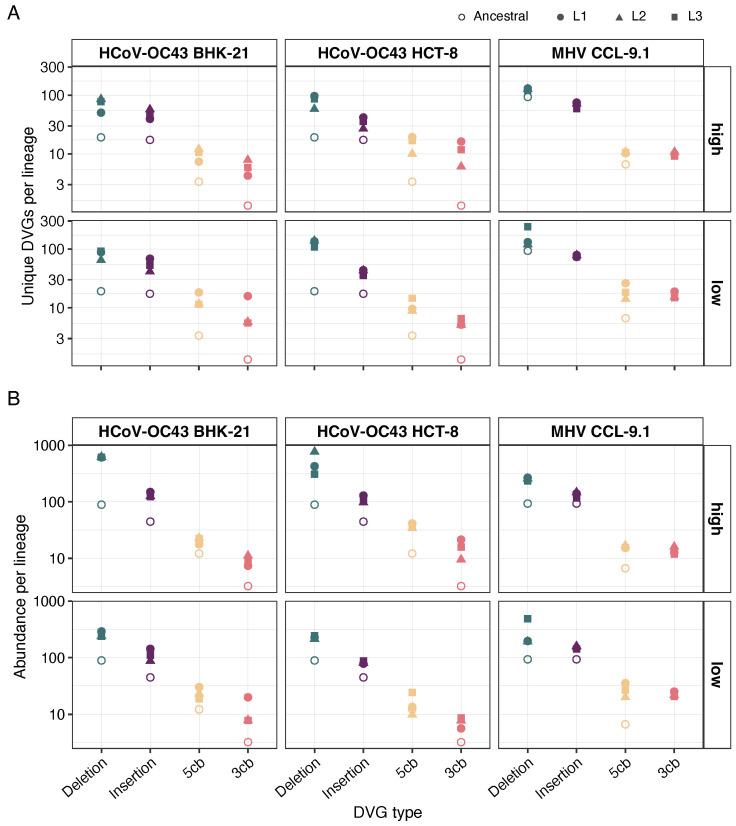
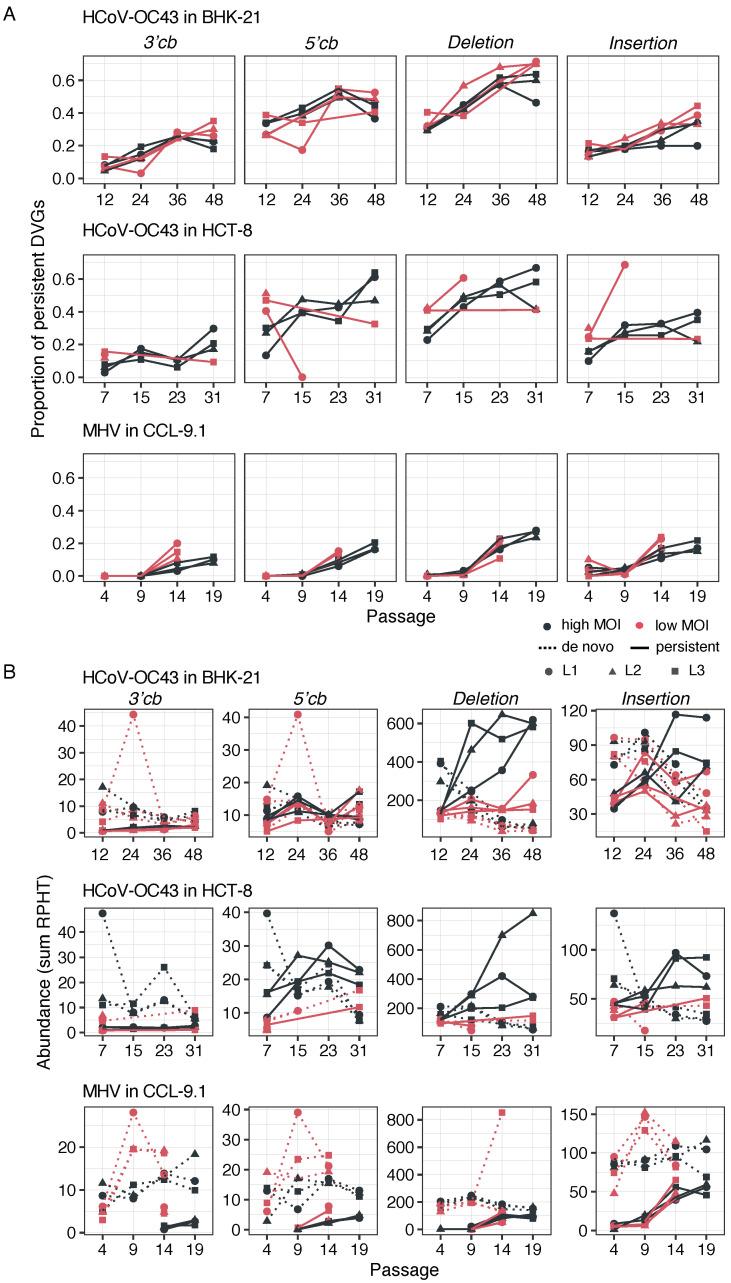
Virus-encoded replicases often generate aberrant RNA genomes, known as defective viral genomes (DVGs). When co-infected with a helper virus providing necessary proteins, DVGs can multiply and spread. While DVGs depend on the helper virus for propagation, they can in some cases disrupt infectious virus replication, impact immune responses, and affect viral persistence or evolution. Understanding the dynamics of DVGs alongside standard viral genomes during infection remains unclear. To address this, we conducted a long-term experimental evolution of two betacoronaviruses, the human coronavirus OC43 (HCoV-OC43) and the murine hepatitis virus (MHV), in cell culture at both high and low multiplicities of infection (MOI). We then performed RNA-seq at regular time intervals, reconstructed DVGs, and analyzed their accumulation dynamics. Our findings indicate that DVGs evolved to exhibit greater diversity and abundance, with deletions and insertions being the most common types. Notably, some high MOI deletions showed very limited temporary existence, while others became prevalent over time. We observed differences in DVG abundance between high and low MOI conditions in HCoV-OC43 samples. The size distribution of HCoV-OC43 genomes with deletions differed between high and low MOI passages. In low MOI lineages, short and long DVGs were the most common, with an additional cluster in high MOI lineages which became more prevalent along evolutionary time. MHV also showed variations in DVG size distribution at different MOI conditions, though they were less pronounced compared to HCoV-OC43, suggesting a more random distribution of DVG sizes. We identified hotspot regions for deletions that evolved at a high MOI, primarily within cistrons encoding structural and accessory proteins. In conclusion, our study illustrates the widespread formation of DVGs during betacoronavirus evolution, influenced by MOI and cell- and virus-specific factors.
病毒编码的复制酶常常产生异常的RNA基因组,即所谓的缺陷病毒基因组(DVGs)。当与提供必要蛋白质的辅助病毒共同感染时,DVGs能够增殖并传播。虽然DVGs的增殖依赖于辅助病毒,但在某些情况下,它们会干扰感染性病毒的复制、影响免疫反应,并影响病毒的持续性或进化。在感染过程中,了解DVGs与标准病毒基因组共同存在的动态变化情况仍不明确。为了解决这个问题,我们在细胞培养中,以高感染复数(MOI)和低感染复数对两种β冠状病毒——人冠状病毒OC43(HCoV-OC43)和鼠肝炎病毒(MHV)进行了长期的实验进化研究。然后,我们在固定的时间间隔进行RNA测序,重建DVGs,并分析它们的积累动态。我们的研究结果表明,DVGs进化后表现出更高的多样性和丰度,缺失和插入是最常见的类型。值得注意的是,一些高MOI条件下的缺失表现出非常有限的短暂存在,而其他缺失则随着时间的推移变得普遍。我们观察到HCoV-OC43样本在高MOI和低MOI条件下DVG丰度存在差异。具有缺失的HCoV-OC43基因组的大小分布在高MOI和低MOI传代之间有所不同。在低MOI谱系中,短DVGs和长DVGs最为常见,而在高MOI谱系中有一个额外的簇,随着进化时间的推移变得更加普遍。MHV在不同MOI条件下的DVG大小分布也表现出差异,不过与HCoV-OC43相比不太明显,这表明DVG大小的分布更为随机。我们确定了在高MOI条件下进化的缺失热点区域,主要位于编码结构蛋白和辅助蛋白的顺反子内。总之,我们的研究表明,在β冠状病毒进化过程中,受MOI以及细胞和病毒特异性因素的影响,DVGs广泛形成。






 Zotero 插件