
利多卡因对不同麻醉方法的乳腺癌术后患者中性粒细胞胞外诱捕和血管生成生物标志物的影响:一项前瞻性随机试验
Lidocaine effects on neutrophil extracellular trapping and angiogenesis biomarkers in postoperative breast cancer patients with different anesthesia methods: a prospective, randomized trial.
作者信息
Zhang Wenjuan, Liu Jiao, Li Xiaohui, Bai Zhixia, Sun Yan, Chen Xuexin
机构信息
School of Clinical Medicine, Ningxia Medical University, No.692 Shengli South Street Xingqing District, Yinchuan, 750004, Ningxia, China.
Department of Anaesthesia and Perioperative Medicine, Cancer Hospital, General Hospital of Ningxia Medical University, No.804 Shengli South Street Xingqing District, Yinchuan, 750004, Ningxia, China.
出版信息
BMC Anesthesiol. 2024 Apr 27;24(1):162. doi: 10.1186/s12871-024-02540-7.
BACKGROUND
Anesthesia techniques and drug selection may influence tumor recurrence and metastasis. Neutrophil extracellular trapping (NETosis), an immunological process, has been linked to an increased susceptibility to metastasis in individuals with tumors. Furthermore, recurrence may be associated with vascular endothelial growth factor A (VEGF-A), a mediator of angiogenesis. This study investigates the impact of lidocaine (combined with sevoflurane or propofol anesthesia ) during breast cancer surgery inhibits the expression of biomarkers associated with metastasis and recurrence (specifically H3Cit, NE, MPO, MMP-9 and VEGF-A).
METHODS
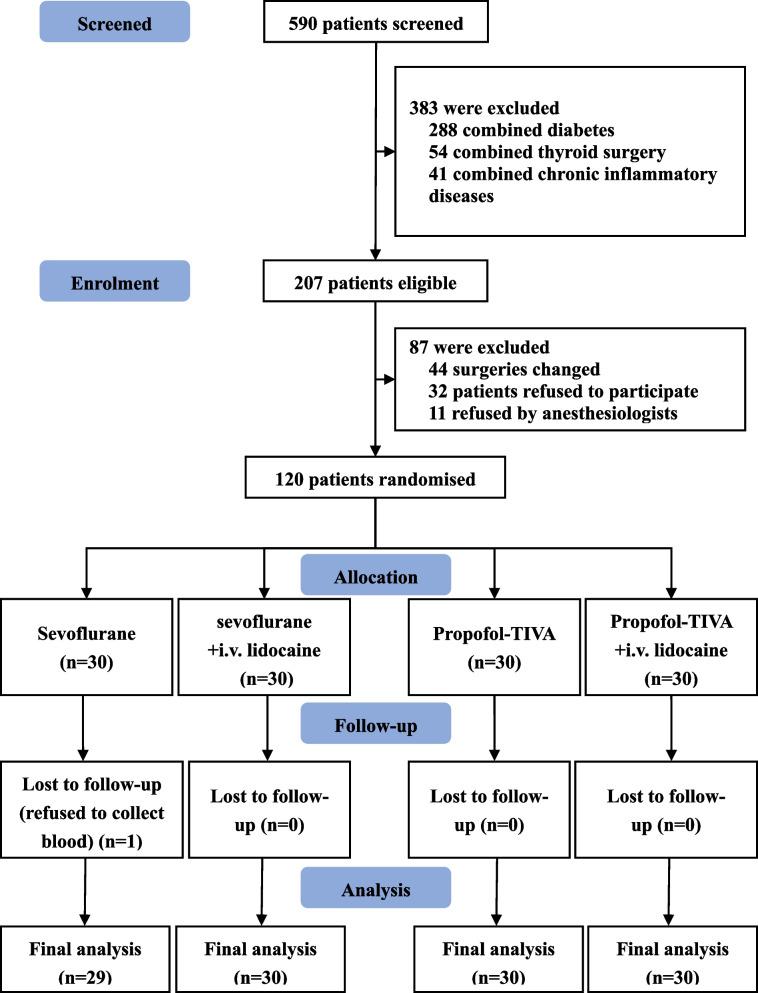
We randomly assigned 120 women undergoing primary or invasive breast tumor resection to receive one of four anesthetics: sevoflurane (S), sevoflurane plus i.v. lidocaine (SL), propofol (P), and propofol plus i.v. lidocaine (PL). Blood samples were collected before induction and 3 h after the operation. Biomarkers associated with NETosis (citrullinated histone H3 [H3Cit], myeloperoxidase [MPO], and neutrophil elastase [NE]) and angiogenesis were quantified using enzyme-linked immunosorbent assays.
RESULTS
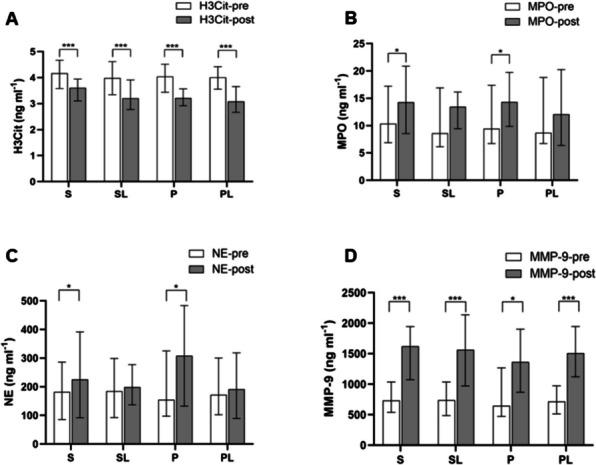
Patient and breast tumor characteristics, along with perioperative management, did not differ between study groups. In intra-group comparisons, S and P groups demonstrated a statistically significant increase in post-operative MPO (S group: 10.39[6.89-17.22] vs. 14.31[8.55-20.87] ng ml-1, P = 0.032; P group: 9.45[6.73-17.37] vs. 14.34[9.87-19.75] ng ml-1, P = 0.035)and NE(S group: 182.70[85.66-285.85] vs. 226.20[91.85-391.65] ng ml-1, P = 0.045; P group: 154.22[97.31-325.30] vs. 308.66[132.36-483.57] ng ml-1, P = 0.037) concentrations compared to pre-operative measurements, whereas SL and PL groups did not display a similar increase. H3Cit, MMP-9, and VEGF-A concentrations were not significantly influenced by the anesthesia techniques and drugs.
CONCLUSIONS
Regardless of the specific technique employed for general anesthesia, there was no increase in the postoperative serum concentrations of MPO and NE after perioperative lidocaine infusion compared to preoperative serum concentrations. This supports the hypothesis that intravenous lidocaine during cancer surgery aimed at achieving a cure may potentially decrease the likelihood of recurrence. Further interpretation and discussion of clinical implications are warranted, emphasizing the significance of these findings in the context of cancer surgery and recurrence prevention.
CLINICAL TRIAL REGISTRATION
ChiCTR2300068563.
背景
麻醉技术和药物选择可能会影响肿瘤复发和转移。中性粒细胞胞外诱捕网形成(NETosis)是一种免疫过程,与肿瘤患者转移易感性增加有关。此外,复发可能与血管内皮生长因子A(VEGF - A)有关,VEGF - A是血管生成的介质。本研究调查乳腺癌手术期间利多卡因(联合七氟醚或丙泊酚麻醉)对与转移和复发相关生物标志物(特别是瓜氨酸化组蛋白H3(H3Cit)、中性粒细胞弹性蛋白酶(NE)、髓过氧化物酶(MPO)、基质金属蛋白酶 - 9(MMP - 9)和VEGF - A)表达的影响。
方法
我们将120例行原发性或浸润性乳腺肿瘤切除术的女性随机分为四组,分别接受以下四种麻醉剂之一:七氟醚(S)、七氟醚加静脉注射利多卡因(SL)、丙泊酚(P)、丙泊酚加静脉注射利多卡因(PL)。在诱导前和术后3小时采集血样。使用酶联免疫吸附测定法定量与NETosis(瓜氨酸化组蛋白H3 [H3Cit]、髓过氧化物酶[MPO]和中性粒细胞弹性蛋白酶[NE])和血管生成相关的生物标志物。
结果
各研究组之间患者和乳腺肿瘤特征以及围手术期管理无差异。在组内比较中,与术前测量值相比,S组和P组术后MPO(S组:10.39[6.89 - 17.22] vs. 14.31[8.55 - 20.87] ng/ml,P = 0.032;P组:9.45[6.73 - 17.37] vs. 14.34[9.87 - 19.75] ng/ml,P = 0.035)和NE(S组:182.70[85.66 - 285.85] vs. 226.20[91.85 - 391.65] ng/ml,P = 0.045;P组:154.22[97.31 - 325.30] vs. 308.66[132.36 - 483.57] ng/ml,P = 0.037)浓度有统计学显著升高,而SL组和PL组未出现类似升高。H3Cit、MMP - 9和VEGF - A浓度未受麻醉技术和药物的显著影响。
结论
无论采用何种全身麻醉具体技术,围手术期输注利多卡因后,术后血清MPO和NE浓度与术前血清浓度相比均未升高。这支持了以下假设:旨在实现治愈的癌症手术期间静脉注射利多卡因可能会降低复发的可能性。有必要对临床意义进行进一步解读和讨论,强调这些发现在癌症手术和预防复发背景下的重要性。
临床试验注册号
ChiCTR2300068563。
 Zotero 插件