
评估智商与来自大脑、脑脊液和血浆的多组织蛋白质组之间的关联。
Evaluating the associations between intelligence quotient and multi-tissue proteome from the brain, CSF and plasma.
作者信息
Shi Sirong, Chen Yujing, Chu Xiaoge, Shi Panxing, Wang Bingyi, Cai Qingqing, He Dan, Zhang Na, Qin Xiaoyue, Wei Wenming, Zhao Yijing, Jia Yumeng, Zhang Feng, Wen Yan
机构信息
NHC Key Laboratory of Environment and Endemic Diseases, School of Public Health, Health Science Center, Xi'an Jiaotong University, Xi'an, Shaanxi, 710061, China.
出版信息
Brain Commun. 2024 Jun 26;6(4):fcae207. doi: 10.1093/braincomms/fcae207. eCollection 2024.
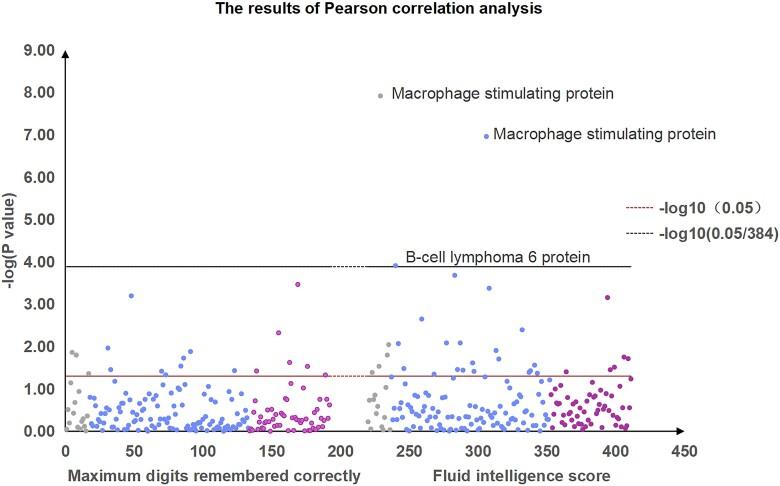
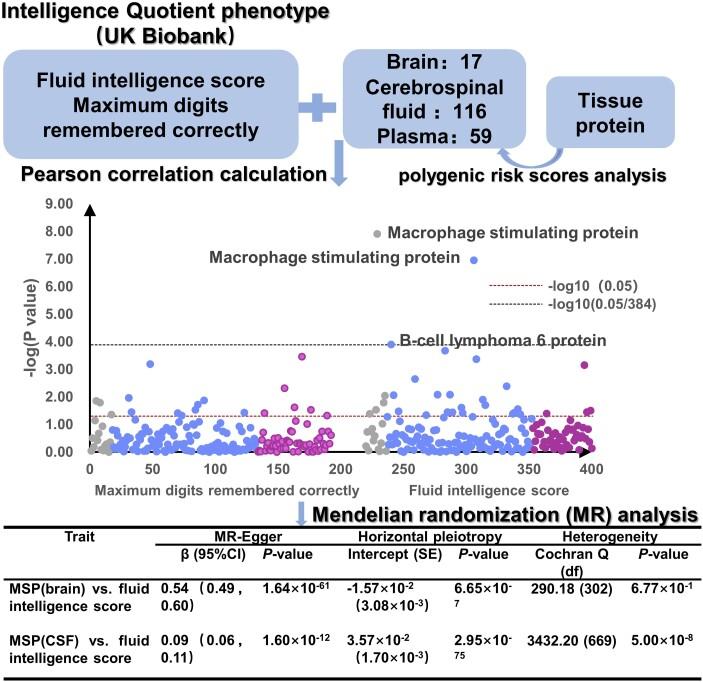
Intelligence quotient is a vital index to evaluate the ability of an individual to think rationally, learn from experience and deal with the environment effectively. However, limited efforts have been paid to explore the potential associations of intelligence quotient traits with the tissue proteins from the brain, CSF and plasma. The information of protein quantitative trait loci was collected from a recently released genome-wide association study conducted on quantification data of proteins from the tissues including the brain, CSF and plasma. Using the individual-level genotypic data from the UK Biobank cohort, we calculated the polygenic risk scores for each protein based on the protein quantitative trait locus data sets above. Then, Pearson correlation analysis was applied to evaluate the relationships between intelligence quotient traits (including 120 330 subjects for 'fluid intelligence score' and 38 949 subjects for 'maximum digits remembered correctly') and polygenic risk scores of each protein in the brain (17 protein polygenic risk scores), CSF (116 protein polygenic risk scores) and plasma (59 protein polygenic risk scores). The Bonferroni corrected -value threshold was < 1.30 × 10 (0.05/384). Finally, Mendelian randomization analysis was conducted to test the causal relationships between 'fluid intelligence score' and pre-specific proteins from correlation analysis results. Pearson correlation analysis identified significant association signals between the protein of macrophage-stimulating protein and fluid intelligence in brain and CSF tissues ( = 1.21 × 10, = 1.10 × 10), as well as between B-cell lymphoma 6 protein and fluid intelligence in CSF ( = 1.23 × 10). Other proteins showed close-to-significant associations with the trait of 'fluid intelligence score', such as plasma protease C1 inhibitor ( = 4.19 × 10, = 6.97 × 10), and with the trait of 'maximum digits remembered correctly', such as tenascin ( = 3.42 × 10). Additionally, Mendelian randomization analysis results suggested that macrophage-stimulating protein (Mendelian randomization-Egger: = 0.54, = 1.64 × 10 in the brain; = 0.09, = 1.60 × 10 in CSF) had causal effects on fluid intelligence score. We observed functional relevance of specific tissue proteins to intelligence quotient and identified several candidate proteins, such as macrophage-stimulating protein. This study provided a novel insight to the relationship between tissue proteins and intelligence quotient traits.
智商是评估个体理性思考、从经验中学习以及有效应对环境能力的重要指标。然而,对于探索智商特征与大脑、脑脊液和血浆中的组织蛋白之间的潜在关联,人们所做的努力有限。蛋白质数量性状位点信息来自最近发布的一项全基因组关联研究,该研究基于包括大脑、脑脊液和血浆在内的组织蛋白定量数据展开。利用英国生物银行队列的个体水平基因型数据,我们根据上述蛋白质数量性状位点数据集为每种蛋白质计算了多基因风险评分。然后,应用Pearson相关分析来评估智商特征(包括“流体智力得分”的120330名受试者和“正确记住的最大数字”的38949名受试者)与大脑(17种蛋白质多基因风险评分)、脑脊液(116种蛋白质多基因风险评分)和血浆(59种蛋白质多基因风险评分)中每种蛋白质的多基因风险评分之间的关系。Bonferroni校正后的P值阈值为<1.30×10⁻⁵(0.05/384)。最后,进行孟德尔随机化分析以检验相关分析结果中“流体智力得分”与特定蛋白质之间的因果关系。Pearson相关分析确定了巨噬细胞刺激蛋白与大脑和脑脊液组织中的流体智力之间存在显著关联信号(P = 1.21×10⁻⁵,P = 1.10×10⁻⁵),以及B细胞淋巴瘤6蛋白与脑脊液中的流体智力之间存在显著关联信号(P = 1.23×10⁻⁵)。其他蛋白质与“流体智力得分”特征呈现出接近显著的关联,例如血浆蛋白酶C1抑制剂(P = 4.19×10⁻⁵,P = 6.97×10⁻⁵),以及与“正确记住的最大数字”特征呈现出接近显著的关联,例如腱生蛋白(P = 3.42×10⁻⁵)。此外,孟德尔随机化分析结果表明,巨噬细胞刺激蛋白(孟德尔随机化-Egger检验:大脑中β = 0.54,P = 1.64×10⁻⁵;脑脊液中β = 0.09,P = 1.60×10⁻⁵)对流体智力得分有因果效应。我们观察到特定组织蛋白与智商之间的功能相关性,并鉴定出几种候选蛋白,如巨噬细胞刺激蛋白。这项研究为组织蛋白与智商特征之间的关系提供了新的见解。
 Zotero 插件