
米氏常数对癌细胞氧化还原平衡和乳酸分泌的重要性——重新审视瓦伯格效应
Importance of Michaelis Constants for Cancer Cell Redox Balance and Lactate Secretion-Revisiting the Warburg Effect.
作者信息
Niepmann Michael
机构信息
Institute of Biochemistry, Medical Faculty, Justus-Liebig-University, 35392 Giessen, Germany.
出版信息
Cancers (Basel). 2024 Jun 21;16(13):2290. doi: 10.3390/cancers16132290.
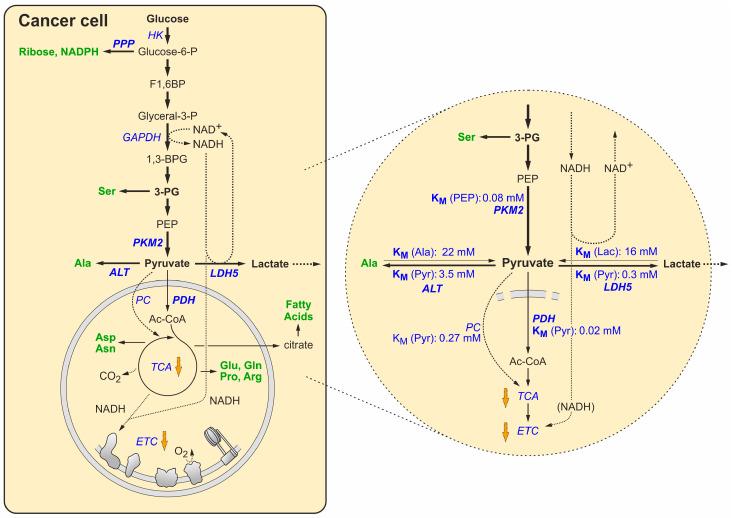
Cancer cells metabolize a large fraction of glucose to lactate, even under a sufficient oxygen supply. This phenomenon-the "Warburg Effect"-is often regarded as not yet understood. Cancer cells change gene expression to increase the uptake and utilization of glucose for biosynthesis pathways and glycolysis, but they do not adequately up-regulate the tricarboxylic acid (TCA) cycle and oxidative phosphorylation (OXPHOS). Thereby, an increased glycolytic flux causes an increased production of cytosolic NADH. However, since the corresponding gene expression changes are not neatly fine-tuned in the cancer cells, cytosolic NAD must often be regenerated by loading excess electrons onto pyruvate and secreting the resulting lactate, even under sufficient oxygen supply. Interestingly, the Michaelis constants (K values) of the enzymes at the pyruvate junction are sufficient to explain the priorities for pyruvate utilization in cancer cells: 1. mitochondrial OXPHOS for efficient ATP production, 2. electrons that exceed OXPHOS capacity need to be disposed of and secreted as lactate, and 3. biosynthesis reactions for cancer cell growth. In other words, a number of cytosolic electrons need to take the "emergency exit" from the cell by lactate secretion to maintain the cytosolic redox balance.
癌细胞会将很大一部分葡萄糖代谢为乳酸,即便在氧气供应充足的情况下也是如此。这种现象——“瓦伯格效应”——通常被认为尚未得到充分理解。癌细胞会改变基因表达,以增加葡萄糖用于生物合成途径和糖酵解的摄取与利用,但它们并未充分上调三羧酸(TCA)循环和氧化磷酸化(OXPHOS)。由此,糖酵解通量增加导致胞质NADH产量增加。然而,由于癌细胞中相应的基因表达变化并未得到精确微调,即使在氧气供应充足的情况下,胞质NAD通常也必须通过将多余的电子加载到丙酮酸上并分泌产生的乳酸来再生。有趣的是,丙酮酸节点处酶的米氏常数(K值)足以解释癌细胞中丙酮酸利用的优先级:1. 线粒体氧化磷酸化用于高效产生ATP;2. 超过氧化磷酸化能力的电子需要通过分泌乳酸来处理和排出;3. 用于癌细胞生长的生物合成反应。换句话说,许多胞质电子需要通过分泌乳酸从细胞中“紧急排出”,以维持胞质氧化还原平衡。

 Zotero 插件