
行走对表观遗传年龄加速的影响:一项孟德尔随机化研究。
Effects of walking on epigenetic age acceleration: a Mendelian randomization study.
机构信息
Department of Orthopedics, The Second Xiangya Hospital of Central South University, Changsha, China.
Hunan Engineering Laboratory for Orthopedic Biomaterials, Changsha, China.
出版信息
Clin Epigenetics. 2024 Jul 18;16(1):94. doi: 10.1186/s13148-024-01707-w.
INTRODUCTION
Walking stands as the most prevalent physical activity in the daily lives of individuals and is closely associated with physical functioning and the aging process. Nonetheless, the precise cause-and-effect connection between walking and aging remains unexplored. The epigenetic clock emerges as the most promising biological indicator of aging, capable of mirroring the biological age of the human body and facilitating an investigation into the association between walking and aging. Our primary objective is to investigate the causal impact of walking with epigenetic age acceleration (EAA).
METHODS
We conducted a two-sample two-way Mendelian randomization (MR) study to investigate the causal relationship between walking and EAA. Walking and Leisure sedentary behavior data were sourced from UK Biobank, while EAA data were gathered from a total of 28 cohorts. The MR analysis was carried out using several methods, including the inverse variance weighted (IVW), weighted median, MR-Egger, and robust adjusted profile score (RAPS). To ensure the robustness of our findings, we conducted sensitivity analyses, which involved the MR-Egger intercept test, Cochran's Q test, and MR-PRESSO, to account for and mitigate potential pleiotropy.
RESULTS
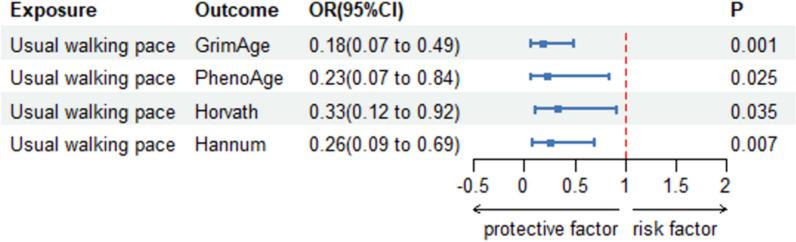
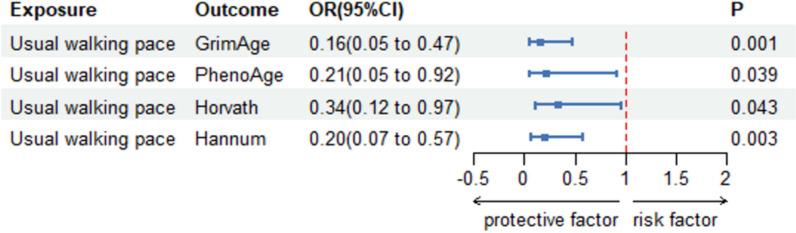
The IVW MR results indicate a significant impact of usual walking pace on GrimAge (BETA = - 1.84, 95% CI (- 2.94, - 0.75)), PhenoAge (BETA = - 1.57, 95% CI (- 3.05, - 0.08)), Horvath (BETA = - 1.09 (- 2.14, - 0.04)), and Hannum (BETA = - 1.63, 95% CI (- 2.70, - 0.56)). Usual walking pace is significantly associated with a delay in epigenetic aging acceleration (EAA) (P < 0.05). Moreover, the direction of effect predicted by the gene remained consistent across RAPS outcomes and sensitivity MR analyses. There is a lack of robust causal relationships between other walking conditions, such as walking duration and walking frequency, on EAA (P > 0.05).
CONCLUSION
Our evidence demonstrates that a higher usual walking pace is associated with a deceleration of the acceleration of all four classical epigenetic clocks acceleration.
简介
行走是人们日常生活中最常见的身体活动,与身体功能和衰老过程密切相关。然而,行走和衰老之间的确切因果关系仍未得到探索。表观遗传时钟是最有前途的衰老生物标志物,能够反映人体的生物年龄,并有助于研究行走与衰老之间的关系。我们的主要目的是研究行走与表观遗传年龄加速(EAA)之间的因果关系。
方法
我们进行了一项两样本双向孟德尔随机化(MR)研究,以调查行走与 EAA 之间的因果关系。行走和休闲久坐行为数据来自英国生物库,而 EAA 数据来自 28 个队列。使用多种方法进行了 MR 分析,包括逆方差加权(IVW)、加权中位数、MR-Egger 和稳健调整轮廓评分(RAPS)。为了确保研究结果的稳健性,我们进行了敏感性分析,包括 MR-Egger 截距检验、Cochran's Q 检验和 MR-PRESSO,以考虑和减轻潜在的混杂因素。
结果
IVW MR 结果表明,通常的步行速度对 GrimAge(BETA=-1.84,95%CI(-2.94,-0.75))、PhenoAge(BETA=-1.57,95%CI(-3.05,-0.08))、Horvath(BETA=-1.09(-2.14,-0.04))和 Hannum(BETA=-1.63,95%CI(-2.70,-0.56))有显著影响。通常的步行速度与表观遗传衰老加速(EAA)的延迟显著相关(P<0.05)。此外,RAPS 结果和敏感性 MR 分析表明,基因预测的效应方向一致。其他行走条件,如行走时间和行走频率与 EAA 之间没有稳健的因果关系(P>0.05)。
结论
我们的证据表明,较高的通常步行速度与四个经典表观遗传时钟加速的加速减速相关。

 Zotero 插件