
白细胞差异计数和表观遗传时钟:一项双向孟德尔随机化研究。
Differential white blood cell count and epigenetic clocks: a bidirectional Mendelian randomization study.
机构信息
Drug Clinical Trail Center, The Second Hospital of Heilongjiang Province, 209 Jiangdu Street, Harbin, China.
School of Computer Science and Technology, Harbin Institute of Technology, Harbin, China.
出版信息
Clin Epigenetics. 2024 Aug 27;16(1):118. doi: 10.1186/s13148-024-01717-8.
BACKGROUND
Human aging and white blood cell (WBC) count are complex traits influenced by multiple genetic factors. Predictors of chronological age have been developed using epigenetic clocks. However, the bidirectional causal effects between epigenetic clocks and WBC count have not been fully examined.
METHODS
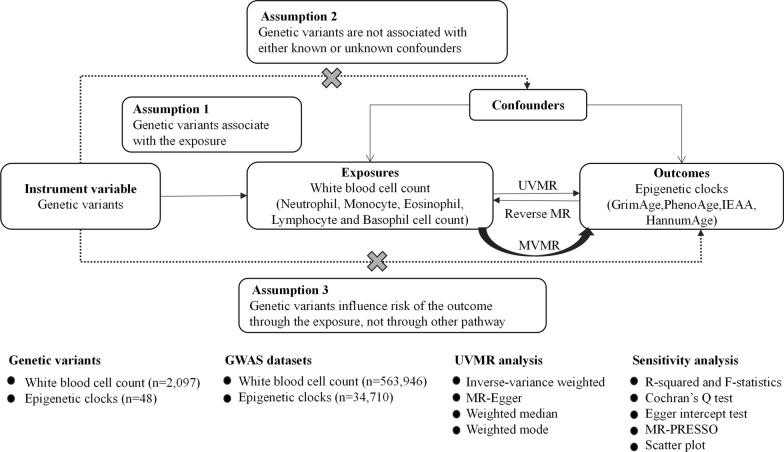
This study employed Mendelian randomization (MR) to analyze summary statistics from four epigenetic clocks involving 34,710 participants, alongside data from the Blood Cell Consortium encompassing 563,946 individuals. We primarily explored bidirectional causal relationships using the random-effects inverse-variance weighted method, supplemented by additional MR methods for comprehensive analysis. Additionally, multivariate MR was applied to investigate independent effects of WBC count on epigenetic age acceleration.
RESULTS
In the two-sample univariate MR (UVMR) analysis, we observed that a decrease in lymphocyte count markedly accelerated aging according to the PhenoAge, GrimAge, and HannumAge metrics (all P < 0.01, β < 0), though it did not affect Intrinsic Epigenetic Age Acceleration (IEAA). Conversely, an increase in neutrophil count significantly elevated PhenoAge levels (β: 0.38; 95% CI 0.14, 0.61; P = 1.65E-03 < 0.01). Reverse MR revealed no significant causal impacts of epigenetic clocks on overall WBC counts. Furthermore, in multivariate MR, the impact of lymphocyte counts on epigenetic aging metrics remained statistically significant. We also identified a marked causal association between neutrophil counts and PhenoAge, GrimAge, and HannumAge, with respective results showing strong associations (PhenoAge β: 0.78; 95% CI 0.47, 1.09; P = 8.26E-07; GrimAge β: 0.55; 95% CI 0.31, 0.79; P = 5.50E-06; HannumAge β: 0.42; 95% CI 0.18, 0.67; P = 6.30E-04). Likewise, eosinophil cell count demonstrated significant association with HannumAge (β: 0.33; 95% CI 0.13, 0.53; P = 1.43E-03 < 0.01).
CONCLUSION
These findings demonstrated that within WBCs, lymphocyte and neutrophil counts exert irreversible and independent causal effects on the acceleration of PhenoAge, GrimAge, and HannumAge. Our findings highlight the critical role of WBCs in influencing epigenetic clocks and underscore the importance of considering immune parameters when interpreting epigenetic age.
背景
人类衰老和白细胞(WBC)计数是受多种遗传因素影响的复杂特征。已使用表观遗传时钟开发了预测实际年龄的指标。然而,表观遗传时钟和 WBC 计数之间的双向因果关系尚未得到充分研究。
方法
本研究采用孟德尔随机化(MR)分析了涉及 34710 名参与者的四个表观遗传时钟的汇总统计数据,以及包含 563946 个人的数据的血液细胞联合会。我们主要使用随机效应逆方差加权法(random-effects inverse-variance weighted method)来探索双向因果关系,并用其他 MR 方法进行综合分析。此外,还应用多元 MR 来研究 WBC 计数对表观遗传年龄加速的独立影响。
结果
在两样本单变量 MR(UVMR)分析中,我们观察到淋巴细胞计数的减少明显加速了 PhenoAge、GrimAge 和 HannumAge 等指标的衰老(均 P<0.01,β<0),但对内在表观遗传年龄加速(IEAA)没有影响。相反,中性粒细胞计数的增加显著提高了 PhenoAge 水平(β:0.38;95%CI 0.14,0.61;P=1.65E-03<0.01)。反向 MR 显示表观遗传时钟对总 WBC 计数没有显著的因果影响。此外,在多元 MR 中,淋巴细胞计数对表观遗传衰老指标的影响仍然具有统计学意义。我们还发现中性粒细胞计数与 PhenoAge、GrimAge 和 HannumAge 之间存在显著的因果关联,结果显示出强烈的关联(PhenoAge β:0.78;95%CI 0.47,1.09;P=8.26E-07;GrimAge β:0.55;95%CI 0.31,0.79;P=5.50E-06;HannumAge β:0.42;95%CI 0.18,0.67;P=6.30E-04)。同样,嗜酸性粒细胞计数与 HannumAge 显著相关(β:0.33;95%CI 0.13,0.53;P=1.43E-03<0.01)。
结论
这些发现表明,在 WBC 中,淋巴细胞和中性粒细胞计数对 PhenoAge、GrimAge 和 HannumAge 的加速具有不可逆转和独立的因果作用。我们的发现强调了 WBC 在影响表观遗传时钟方面的关键作用,并突出了在解释表观遗传年龄时考虑免疫参数的重要性。


 Zotero 插件