
肥胖与表观遗传衰老和端粒长度的因果关系:一项双向孟德尔随机化研究。
Causal association of obesity with epigenetic aging and telomere length: a bidirectional mendelian randomization study.
机构信息
Chinese Academy of Traditional Chinese Medicine, Xiyuan Hospital, Beijing, China.
Heilongjiang University Of Chinese Medicine, Harbin, China.
出版信息
Lipids Health Dis. 2024 Mar 12;23(1):78. doi: 10.1186/s12944-024-02042-y.
BACKGROUND
In observational studies, there exists an association between obesity and epigenetic age as well as telomere length. However, varying and partially conflicting outcomes have notably arisen from distinct studies on this topic. In the present study, two-way Mendelian randomization was used to identify potential causal associations between obesity and epigenetic age and telomeres.
METHODS
A genome-wide association study was conducted using data from individuals of European ancestry to investigate bidirectional Mendelian randomization (MR) regarding the causal relationships between obesity, as indicated by three obesity indicators (body mass index or BMI, waist circumference adjusted for BMI or WCadjBMI, and waist-to-hip ratio adjusted for BMI or WHRadjBMI), and four epigenetic age measures (HannumAge, HorvathAge, GrimAge, PhenoAge), as well as telomere length. To assess these causal associations, various statistical methods were employed, including Inverse Variance Weighted (IVW), Weighted Median, MR Egger, Weighted Mode, and Simple Mode. To address the issue of multiple testing, we applied the Bonferroni correction. These methods were used to determine whether there is a causal link between obesity and epigenetic age, as well as telomere length, and to explore potential bidirectional relationships. Forest plots and scatter plots were generated to show causal associations between exposures and outcomes. For a comprehensive visualization of the results, leave-one-out sensitivity analysis plots, individual SNP-based forest plots for MR analysis, and funnel plots were included in the presentation of the results.
RESULTS
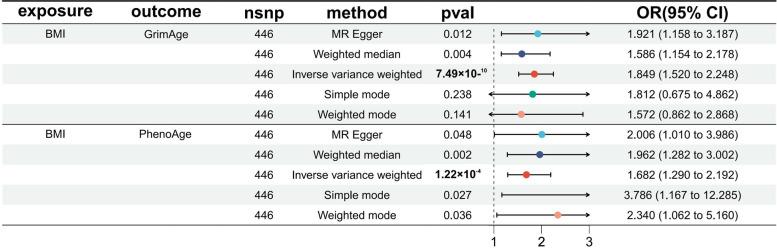
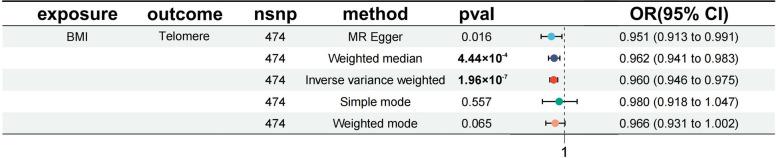
A strong causal association was identified between obesity and accelerated HannumAge, GrimAge, PhenoAge and telomere length shrinkage. The causal relationship between WCadjBMI and PhenoAge acceleration (OR: 2.099, 95%CI: 1.248-3.531, p = 0.005) was the strongest among them. However, only the p-values for the causal associations of obesity with GrimAge, PhenoAge, and telomere length met the criteria after correction using the Bonferroni multiple test. In the reverse MR analysis, there were statistically significant causal associations between HorvathAge, PhenoAge and GrimAge and BMI, but these associations exhibited lower effect sizes, as indicated by their Odds Ratios (ORs). Notably, sensitivity analysis revealed the robustness of the study results.
CONCLUSIONS
The present findings reveal a causal relationship between obesity and the acceleration of epigenetic aging as well as the reduction of telomere length, offering valuable insights for further scientific investigations aimed at developing strategies to mitigate the aging process in humans.
背景
在观察性研究中,肥胖与表观遗传年龄和端粒长度之间存在关联。然而,关于这个主题的不同研究得出了不同的结果,有些甚至相互矛盾。在本研究中,我们使用双向 Mendelian 随机化来识别肥胖与表观遗传年龄和端粒之间潜在的因果关系。
方法
我们使用欧洲血统个体的全基因组关联研究数据,针对肥胖与四种表观遗传年龄测量值(HannumAge、HorvathAge、GrimAge、PhenoAge)以及端粒长度之间的双向 Mendelian 随机化(MR)进行了双向 Mendelian 随机化(MR)分析,肥胖由三个肥胖指标(体重指数或 BMI、BMI 校正的腰围或 WCadjBMI、BMI 校正的腰围与臀围比或 WHRadjBMI)表示。为了评估这些因果关系,我们使用了多种统计方法,包括逆方差加权(Inverse Variance Weighted,IVW)、加权中位数(Weighted Median)、MR Egger、加权模式(Weighted Mode)和简单模式(Simple Mode)。为了解决多重检验的问题,我们应用了 Bonferroni 校正。我们使用这些方法来确定肥胖与表观遗传年龄和端粒长度之间是否存在因果关系,并探讨潜在的双向关系。森林图和散点图用于显示暴露与结局之间的因果关系。为了全面展示结果,我们还包括了单核苷酸多态性(SNP)基于的个体 MR 分析森林图和漏斗图。
结果
我们发现肥胖与 HannumAge、GrimAge、PhenoAge 加速和端粒长度缩短之间存在很强的因果关系。其中,WCadjBMI 与 PhenoAge 加速之间的因果关系最强(OR:2.099,95%CI:1.248-3.531,p=0.005)。然而,只有在使用 Bonferroni 多重检验校正后,肥胖与 GrimAge、PhenoAge 和端粒长度之间的因果关系的 p 值才符合标准。在反向 MR 分析中,HorvathAge、PhenoAge 和 GrimAge 与 BMI 之间存在统计学上显著的因果关系,但这些关系的效应大小较小,表现在它们的比值比(OR)上。值得注意的是,敏感性分析显示研究结果具有稳健性。
结论
本研究结果揭示了肥胖与表观遗传衰老加速和端粒缩短之间的因果关系,为进一步开展旨在减缓人类衰老过程的科学研究提供了有价值的信息。


 Zotero 插件