
在SUSTAIN 6试验中,按KDIGO风险类别划分的每周一次司美格鲁肽对肾脏疾病转归的影响。
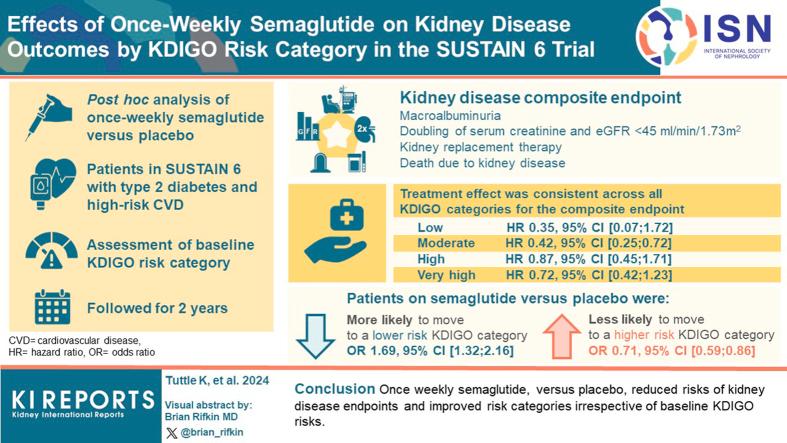
Effects of Once-Weekly Semaglutide on Kidney Disease Outcomes by KDIGO Risk Category in the SUSTAIN 6 Trial.
作者信息
Tuttle Katherine R, Bain Stephen C, Bosch-Traberg Heidrun, Khunti Kamlesh, Rasmussen Søren, Sokareva Ekaterina, Cherney David Z
机构信息
Providence Medical Research Center, Providence Inland Northwest Health, Spolane, Washington, USA.
Nephrology Division and Kidney Research Institute, University of Washington School of Medicine, Seattle, Washington, USA.
出版信息
Kidney Int Rep. 2024 May 22;9(7):2006-2015. doi: 10.1016/j.ekir.2024.04.028. eCollection 2024 Jul.
INTRODUCTION
Glucagon-like peptide-1 receptor agonists (GLP-1RAs) are recommended by Kidney Disease: Improving Global Outcomes (KDIGO) as risk-based treatment for hyperglycemia, weight management, and cardiovascular (CV) risk reduction in people with type 2 diabetes (T2D) and chronic kidney disease (CKD). The aim of this analysis was to assess treatment effects of once weekly semaglutide on kidney disease outcomes by KDIGO risk category and on changes in KDIGO risk category, compared with placebo.
METHODS
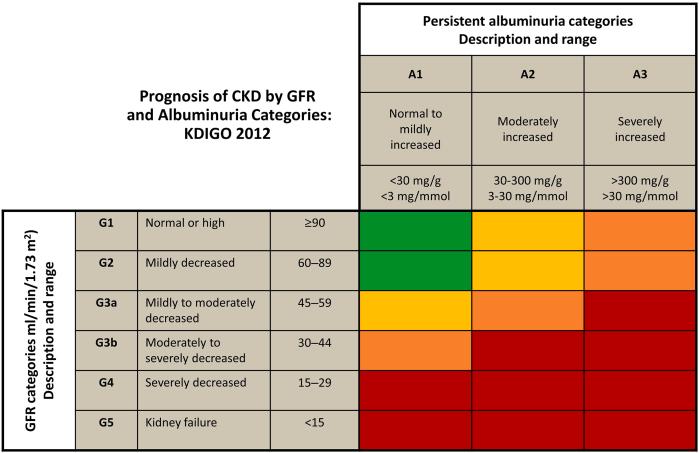
Participants with T2D and established CV disease or at high CV risk treated with once weekly semaglutide or placebo in SUSTAIN 6 (NCT01720446) were stratified by baseline KDIGO risk category (low [ = 1596], moderate [ = 831], high [ = 445], very high [ = 366]). Treatment effect was analyzed for a kidney disease composite end point (macroalbuminuria, serum creatinine doubling and estimated glomerular filtration rate [eGFR] < 45 ml/min per 1.73 m, kidney replacement therapy, or death due to kidney disease) from baseline to 2 years.
RESULTS
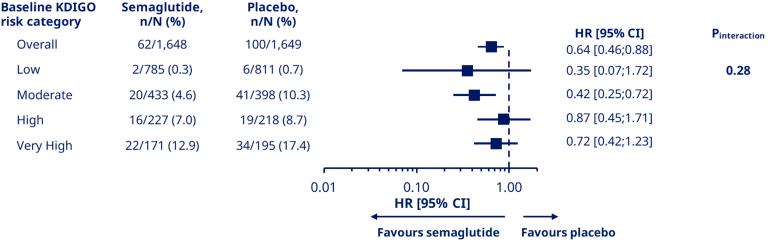
The treatment effect of semaglutide versus placebo was consistent across KDIGO categories for the kidney disease composite end point (hazard ratio [95% confidence interval (CI)]: 0.35 [0.07-1.72], 0.42 [0.25-0.72], 0.87 [0.45-1.71], and 0.72 [0.42-1.23] for low, moderate, high, and very high risk categories, respectively; interaction = 0.28). Participants receiving semaglutide were more likely to move to a lower KDIGO risk category (odds ratio: 1.69; 95% CI: [1.32-2.16]) and less likely to move to a higher KDIGO risk category versus placebo (odds ratio: 0.71; 95% CI: [0.59-0.86]).
CONCLUSION
Once weekly semaglutide versus placebo reduced risks of kidney disease end points and improved risk categories irrespective of baseline KDIGO risk.
简介
胰高血糖素样肽-1受体激动剂(GLP-1RAs)被改善全球肾脏病预后组织(KDIGO)推荐作为基于风险的治疗方法,用于2型糖尿病(T2D)和慢性肾脏病(CKD)患者的高血糖管理、体重控制以及降低心血管(CV)风险。本分析的目的是评估与安慰剂相比,每周一次司美格鲁肽对KDIGO风险类别相关的肾脏疾病结局以及KDIGO风险类别变化的治疗效果。
方法
在SUSTAIN 6(NCT01720446)研究中,将患有T2D且已确诊心血管疾病或心血管风险高的参与者,按照基线KDIGO风险类别(低风险[=1596]、中度风险[=831]、高风险[=445]、极高风险[=366])分为不同层次,分别接受每周一次的司美格鲁肽或安慰剂治疗。分析从基线到2年期间肾脏疾病复合终点(大量白蛋白尿、血清肌酐翻倍且估算肾小球滤过率[eGFR]<45 ml/min/1.73 m²、肾脏替代治疗或因肾脏疾病死亡)的治疗效果。
结果
对于肾脏疾病复合终点,司美格鲁肽与安慰剂相比的治疗效果在KDIGO各风险类别中是一致的(风险比[95%置信区间(CI)]:低风险类别为0.35[0.07 - 1.72],中度风险类别为0.42[0.25 - 0.72],高风险类别为0.87[0.45 - 1.71],极高风险类别为0.72[0.42 - 1.23];交互作用=0.28)。与安慰剂相比,接受司美格鲁肽治疗的参与者更有可能转变为较低的KDIGO风险类别(优势比:1.69;95% CI:[1.32 - 2.16]),而转变为较高KDIGO风险类别的可能性较小(优势比:0.71;95% CI:[0.59 - 0.86])。
结论
与安慰剂相比,每周一次的司美格鲁肽可降低肾脏疾病终点风险并改善风险类别,且不受基线KDIGO风险的影响。



 Zotero 插件