
原人参二醇 A 通过激活液泡型 ATP 酶介导的溶酶体过度酸化诱导间变性甲状腺癌细胞焦亡。
Prosapogenin A induces GSDME-dependent pyroptosis of anaplastic thyroid cancer through vacuolar ATPase activation-mediated lysosomal over-acidification.
机构信息
Otolaryngology & Head and Neck Center, Cancer Center, Department of Head and Neck Surgery, Zhejiang Provincial People's Hospital (Affiliated People's Hospital), Hangzhou Medical College, Hangzhou, Zhejiang, China.
Zhejiang Key Laboratory of Precision Medicine Research on Head & Neck Cancer, Hangzhou, China.
出版信息
Cell Death Dis. 2024 Aug 13;15(8):586. doi: 10.1038/s41419-024-06985-z.
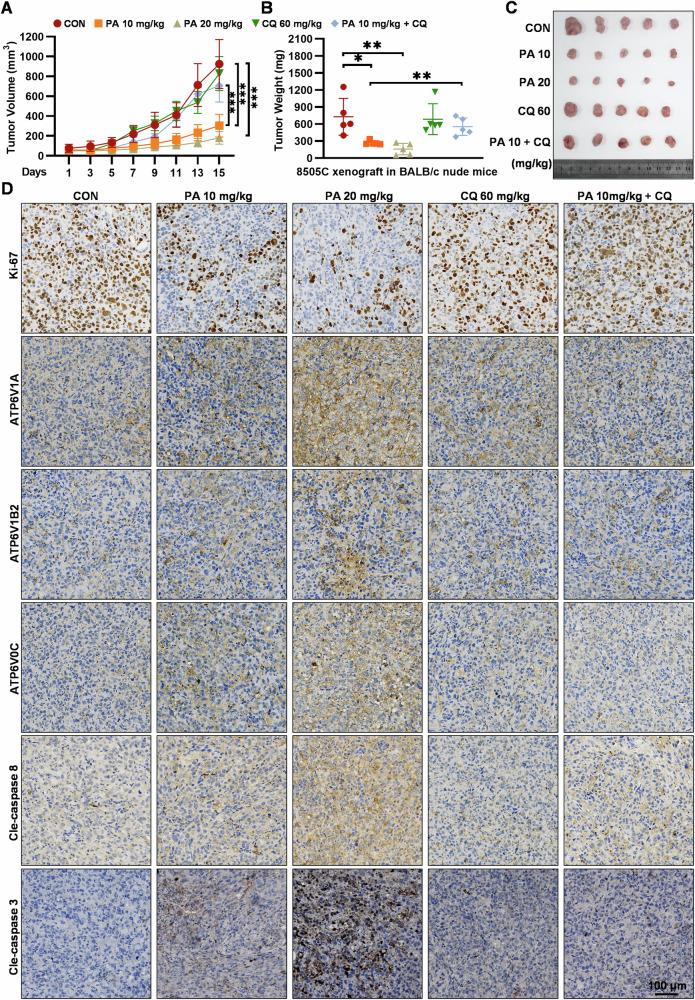
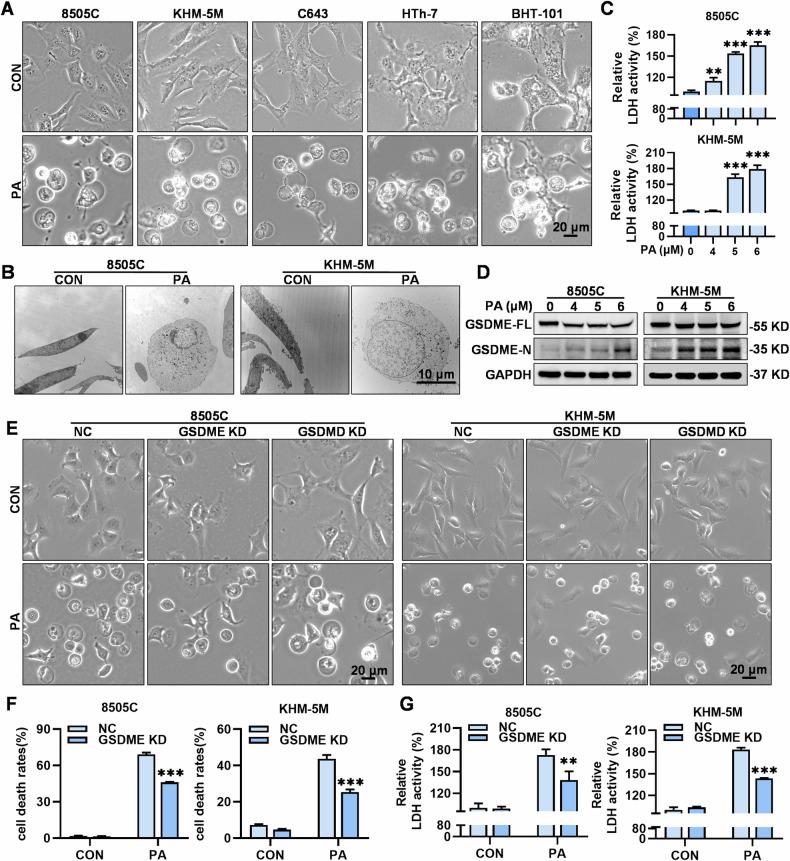
Anaplastic thyroid cancer (ATC) is among the most aggressive and metastatic malignancies, often resulting in fatal outcomes due to the lack of effective treatments. Prosapogenin A (PA), a bioactive compound prevalent in traditional Chinese herbs, has shown potential as an antineoplastic agent against various human tumors. However, its effects on ATC and the underlying mechanism remain unclear. Here, we demonstrate that PA exhibits significant anti-ATC activity both in vitro and in vivo by inducing GSDME-dependent pyroptosis in ATC cells. Mechanistically, PA promotes lysosomal membrane permeabilization (LMP), leading to the release of cathepsins that activate caspase 8/3 to cleave GSDME. Remarkably, PA significantly upregulates three key functional subunits of V-ATPase-ATP6V1A, ATP6V1B2, and ATP6V0C-resulting in lysosomal over-acidification. This over-acidification exacerbates LMP and subsequent lysosomal damage. Neutralization of lysosomal lumen acidification or inhibition/knockdown of these V-ATPase subunits attenuates PA-induced lysosomal damage, pyroptosis and growth inhibition of ATC cells, highlighting the critical role for lysosomal acidification and LMP in PA's anticancer effects. In summary, our findings uncover a novel link between PA and lysosomal damage-dependent pyroptosis in cancer cells. PA may act as a V-ATPase agonist targeting lysosomal acidification, presenting a new potential therapeutic option for ATC treatment.
间变性甲状腺癌(ATC)是最具侵袭性和转移性的恶性肿瘤之一,由于缺乏有效治疗方法,常导致致命后果。原人参二醇(PA)是一种存在于传统中药中的生物活性化合物,已显示出作为多种人类肿瘤的抗肿瘤剂的潜力。然而,其对 ATC 的影响及其潜在机制尚不清楚。在这里,我们证明 PA 通过诱导 ATC 细胞中 GSDME 依赖性细胞焦亡在体外和体内均具有显著的抗 ATC 活性。在机制上,PA 促进溶酶体膜通透性(LMP),导致组织蛋白酶的释放,激活 caspase 8/3 来切割 GSDME。值得注意的是,PA 显著上调 V-ATPase 的三个关键功能亚基-ATP6V1A、ATP6V1B2 和 ATP6V0C-导致溶酶体过度酸化。这种过度酸化加剧了 LMP 和随后的溶酶体损伤。溶酶体腔酸化的中和或这些 V-ATPase 亚基的抑制/敲低可减弱 PA 诱导的 ATC 细胞溶酶体损伤、细胞焦亡和生长抑制,突出了溶酶体酸化和 LMP 在 PA 抗癌作用中的关键作用。总之,我们的研究结果揭示了 PA 与癌细胞中溶酶体损伤依赖性细胞焦亡之间的新联系。PA 可能作为一种溶酶体酸化靶向的 V-ATPase 激动剂,为 ATC 治疗提供了一种新的潜在治疗选择。



 Zotero 插件