
双食欲素受体拮抗剂(DORAs)的数据挖掘与安全性分析:一项基于FAERS数据库的真实世界药物警戒研究。
Data mining and safety analysis of dual orexin receptor antagonists (DORAs): a real-world pharmacovigilance study based on the FAERS database.
作者信息
Jiang Manxue, Li Hao, Kong Lingti
机构信息
Department of Pharmacy, The First Affiliated Hospital of Bengbu Medical University, Bengbu, China.
School of Pharmacy, Bengbu Medical University, Bengbu, China.
出版信息
Front Pharmacol. 2024 Aug 6;15:1436405. doi: 10.3389/fphar.2024.1436405. eCollection 2024.
OBJECTIVE
Using the Food and Drug Administration Adverse Event Reporting System (FAERS) database, four signal detection methods were applied to mine adverse drug events (ADEs) related to use of dual orexin receptor antagonists (DORAs) to provide reference for safe clinical use.
RESEARCH DESIGN AND METHODS
Data collected from Q3rd 2014 to Q4th 2023 were obtained from the FAERS database. According to the preferred terminology (PT) and systematic organ classification (SOC) of MedDRA v.26.0, the reporting odds ratio (ROR), proportional reporting ratio (PRR), multi-item gamma Poisson shrinker (MGPS), and Bayesian confidence propagation neural network (BCPNN) were used to detect ADE signals.
RESULTS
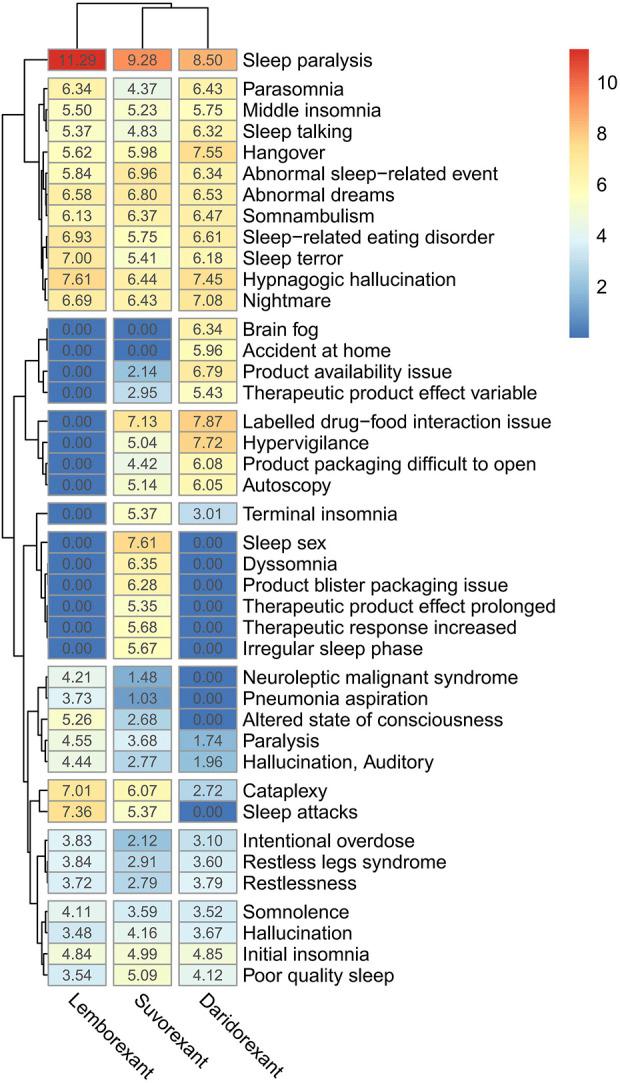
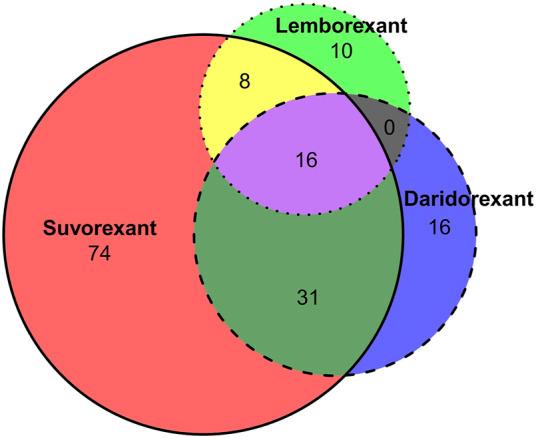
A total of 11,857 DORAs-related adverse reactions were detected, reported with suvorexant, lemborexant, and daridorexant as the main suspected drugs was 8717584, and 2556, respectively. A higher proportion of females than males were reported (57.27% vs. 33.04%). The top 20 positive PT signals from three DORAs showed that "sleep paralysis" ranked first. "Brain fog" was stronger following daridorexant but was not detected for the other two drugs, and "sleep sex" and "dyssomnia" were stronger in suvorexant but not in the other two drugs. Additionally, some PTs occurred that were not included in drug instructions, such as "hangover" and "hypnagogic hallucination."
CONCLUSION
In this study, four algorithms (ROR, PRR, BCPNN, and MGPS) were used to mine the safety signals of DORAs. We identified some potential ADE signals that can promote the rational use of DORAs and improve their safety.
目的
利用美国食品药品监督管理局不良事件报告系统(FAERS)数据库,应用四种信号检测方法挖掘与使用双重食欲素受体拮抗剂(DORAs)相关的药物不良事件(ADEs),为临床安全用药提供参考。
研究设计与方法
从FAERS数据库获取2014年第三季度至2023年第四季度收集的数据。根据MedDRA v.26.0的首选术语(PT)和系统器官分类(SOC),采用报告比值比(ROR)、比例报告比(PRR)、多项目伽马泊松收缩器(MGPS)和贝叶斯置信传播神经网络(BCPNN)检测ADE信号。
结果
共检测到11857例与DORAs相关的不良反应,以苏沃雷生、伦扎雷生和达立雷生为主要可疑药物报告的分别为8717、584和2556例。报告的女性比例高于男性(57.27%对33.04%)。三种DORAs的前20个阳性PT信号显示,“睡眠麻痹”排名第一。“脑雾”在达立雷生之后更强,但在其他两种药物中未检测到,“睡眠相关性行为”和“失眠”在苏沃雷生中更强,但在其他两种药物中未出现。此外,还出现了一些药品说明书中未包含的PT,如“宿醉”和“入睡幻觉”。
结论
本研究采用四种算法(ROR、PRR、BCPNN和MGPS)挖掘DORAs的安全信号。我们识别出一些潜在的ADE信号,可促进DORAs的合理使用并提高其安全性。

 Zotero 插件