
血浆外泌体miR-203a-3p是评估乳腺癌患者肿瘤进展的潜在液体活检标志物。
Plasma Exosome miR-203a-3p is a Potential Liquid Biopsy Marker for Assessing Tumor Progression in Breast Cancer Patients.
作者信息
Yang Xin, Fan Lei, Huang Jicheng, Li Yongjun
机构信息
Peking University Fifth School of Clinical Medicine, Beijing, People's Republic of China.
Breast Center, Department of Thyroid-Breast-Hernia Surgery, Department of General Surgery, Beijing Hospital, National Center of Gerontology, Institute of Geriatric Medicine, Chinese Academy of Medical Sciences, Beijing, People's Republic of China.
出版信息
Breast Cancer (Dove Med Press). 2024 Sep 18;16:631-643. doi: 10.2147/BCTT.S478328. eCollection 2024.
BACKGROUND
Timely detection of tumor progression in breast cancer (BC) patients is critical for therapeutic management and prognosis. Plasma exosomal miRNAs are potential liquid biopsy markers for monitoring tumor progression, but their roles in BC remain unclear.
METHODS
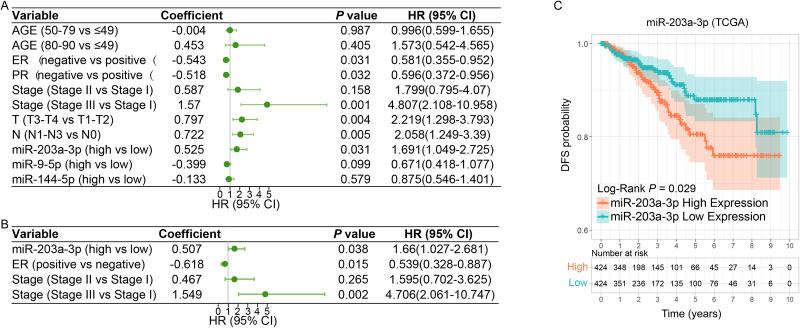
In the TCGA database, we first screened for miRNAs significantly associated with BC progression by comparing miRNA expression in para-carcinoma tissues, stage I BC tissues, and stage II-III BC tissues (n = 1026). Cox regression analyses and survival analyses were performed on candidate miRNAs to explore their prognostic value (n = 848). KEGG, GO, and PPI analyses were used to identify enriched pathways associated with cancer. Finally, the potential of candidate miRNAs as liquid biopsy markers was evaluated by sequencing and analyzing plasma exosomal miRNAs from our collection of 45 BC patients (14 in stage I, 31 in stage II-III) and 5 healthy controls, combined with qRT-PCR analysis to assess the correlation of candidate gene expression in plasma exosomes and BC tissues.
RESULTS
We found that only miR-203a-3p was progressively elevated with BC progression and was associated with poor prognosis in the TCGA dataset. Its potential target genes were enriched in pathways related to tumor progression, and the downregulation of 48 of these genes was associated with poor prognosis. More importantly, plasma exosomal miR-203a-3p was also found to gradually increase with BC progression, and its expression was positively correlated with miR-203a-3p in BC tissues. This result suggests that plasma exosomal miR-203a-3p may reflect the expression of miR-203a-3p in tumor tissues and serve as a potential liquid biopsy marker for monitoring BC progressions.
CONCLUSION
We found for the first time that elevated miR-203a-3p was associated with BC progression and poor prognosis. Our findings suggested that plasma exosomal miR-203a-3p could hold potential as a liquid biopsy marker for evaluating BC progression in patients.
背景
及时检测乳腺癌(BC)患者的肿瘤进展对于治疗管理和预后至关重要。血浆外泌体微小RNA(miRNA)是监测肿瘤进展的潜在液体活检标志物,但其在乳腺癌中的作用仍不明确。
方法
在TCGA数据库中,我们首先通过比较癌旁组织、I期乳腺癌组织和II-III期乳腺癌组织中的miRNA表达,筛选出与乳腺癌进展显著相关的miRNA(n = 1026)。对候选miRNA进行Cox回归分析和生存分析,以探索其预后价值(n = 848)。使用KEGG、GO和PPI分析来确定与癌症相关的富集通路。最后,通过对我们收集的45例乳腺癌患者(I期14例,II-III期31例)和5例健康对照的血浆外泌体miRNA进行测序和分析,并结合qRT-PCR分析来评估候选基因在血浆外泌体和乳腺癌组织中的表达相关性,从而评估候选miRNA作为液体活检标志物的潜力。
结果
我们发现只有miR-203a-3p随着乳腺癌进展而逐渐升高,并且在TCGA数据集中与不良预后相关。其潜在靶基因富集在与肿瘤进展相关的通路中,其中48个基因的下调与不良预后相关。更重要的是,还发现血浆外泌体miR-203a-3p也随着乳腺癌进展而逐渐增加,并且其表达与乳腺癌组织中的miR-203a-3p呈正相关。这一结果表明,血浆外泌体miR-203a-3p可能反映肿瘤组织中miR-203a-3p的表达,并作为监测乳腺癌进展的潜在液体活检标志物。
结论
我们首次发现miR-203a-3p升高与乳腺癌进展和不良预后相关。我们的研究结果表明,血浆外泌体miR-203a-3p有潜力作为评估患者乳腺癌进展的液体活检标志物。




 Zotero 插件