
感兴趣区域定位、组织储存时间和抗体结合密度——关于GeoMx®数字空间剖析仪的技术说明
Region of interest localization, tissue storage time, and antibody binding density-a technical note on the GeoMx® Digital Spatial Profiler.
作者信息
Böning S, Schneider F, Huber A-K, Langhoff D, Lin H, Kaczorowski A, Stenzinger A, Hohenfellner M, Duensing S, Duensing A
机构信息
Molecular Urooncology, Department of Urology, University Hospital Heidelberg, Heidelberg.
Institute of Pathology, University Hospital Heidelberg, Heidelberg.
出版信息
Immunooncol Technol. 2024 Aug 20;23:100727. doi: 10.1016/j.iotech.2024.100727. eCollection 2024 Sep.
BACKGROUND
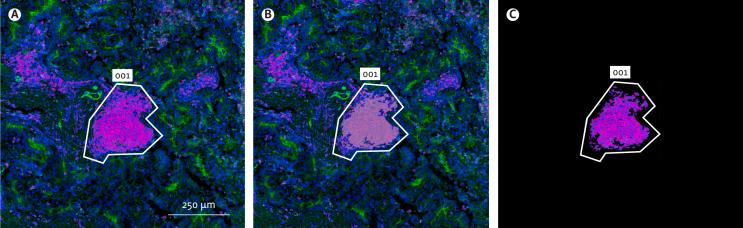
Spatial biology is an emerging concept to interrogate tumor heterogeneity. The NanoString GeoMx® Digital Spatial Profiling (DSP) platform has become increasingly available. It combines high-plex analysis of protein or messenger RNA expression using barcoded antibodies or oligonucleotide probes with investigator-driven selection of regions of interest. Cell populations, e.g. immune cells, can be selectively analyzed via segmentation. A key advantage is the use of archived formalin-fixed, paraffin-embedded tissue, however, begging the question whether and to what extent tissue fixation and storage time affect the results.
MATERIALS AND METHODS
Antibody binding density (ABD), i.e. the number of barcodes/μm, is a key quality control measure for DSP spatial proteomics. To assess whether regional differences in tissue fixation have an influence on ABD, we compared 652 regions of interest selected from tumor center and periphery of 49 prostate cancer and 25 renal cell carcinoma (RCC) specimens. Moreover, the effect of tissue storage time on ABD was examined. Finally, we tested whether regional differences have an influence on ABD of segmented CD45+ or CD8+ cells.
RESULTS
No significant differences in ABD between tumor center and periphery were found in prostate cancer or RCC. However, ABD was significantly higher in recent specimens (≤5 years) when compared with those that were older (>5 years; = 0.027). There was a trend towards higher ABD in the tumor periphery of RCC specimens after segmentation for immune cells, albeit without reaching statistical significance.
CONCLUSIONS
The NanoString GeoMx® DSP platform delivers robust data to interrogate tumor heterogeneity, but tissue storage time should be considered when interpreting the results.
背景
空间生物学是一个用于研究肿瘤异质性的新兴概念。NanoString GeoMx®数字空间分析(DSP)平台的应用越来越广泛。它将使用条形码抗体或寡核苷酸探针进行的蛋白质或信使RNA表达的高多重分析与研究者驱动的感兴趣区域选择相结合。细胞群体,如免疫细胞,可以通过分割进行选择性分析。一个关键优势是使用存档的福尔马林固定石蜡包埋组织,然而,这就引出了一个问题,即组织固定和储存时间是否以及在多大程度上会影响结果。
材料与方法
抗体结合密度(ABD),即条形码数量/μm,是DSP空间蛋白质组学的关键质量控制指标。为了评估组织固定的区域差异是否对ABD有影响,我们比较了从49例前列腺癌和25例肾细胞癌(RCC)标本的肿瘤中心和周边选取的652个感兴趣区域。此外,还研究了组织储存时间对ABD的影响。最后,我们测试了区域差异是否对分割后的CD45+或CD8+细胞的ABD有影响。
结果
在前列腺癌或RCC中,肿瘤中心和周边的ABD没有显著差异。然而,与保存时间较长(>5年)的标本相比,近期标本(≤5年)的ABD显著更高(P = 0.027)。对于免疫细胞分割后的RCC标本,肿瘤周边的ABD有升高趋势,尽管未达到统计学意义。
结论
NanoString GeoMx® DSP平台能够提供可靠的数据来研究肿瘤异质性,但在解释结果时应考虑组织储存时间。


 Zotero 插件