
2019 年全球 60 岁及以上人群因膳食纤维摄入不足导致的心血管疾病负担:全球疾病负担研究的年龄-时期-队列分析。
The global burden of cardiovascular disease attributable to diet low in fiber among people aged 60 years and older, 1990-2019: an age-period-cohort analysis of the global burden of disease study.
机构信息
Department of Vascular Surgery, School of Medicine, Shanghai Putuo People's Hospital, Tongji University, No.1291 Jiangning Road, Huangpu District, Shanghai, 200060, China.
Department of Vascular Surgery, Shanghai Ninth People's Hospital, Shanghai Jiao Tong University, No.639 Zhizaoju Road, Huangpu District, Shanghai, 200011, PR China.
出版信息
BMC Public Health. 2024 Sep 27;24(1):2639. doi: 10.1186/s12889-024-19897-6.
OBJECTIVES
This study aimed to quantify the global cardiovascular disease (CVD) burden attributable to diet low in fiber among adults aged 60 years and older using data from the Global Burden of Disease (GBD) Study 2019.
METHODS
We extracted data on CVD mortality, disability-adjusted life-years (DALYs), and risk-factor exposures from the GBD 2019 study for people aged 60 and older. Age-period-cohort models were used to estimate the overall annual percentage change in mortality and DALY rate (net drift, % per year), mortality and DALY rate for each age group from 1990 to 2019 (local drift, % per year), longitudinal age-specific rate corrected for period bias (age effect), and mortality and Daly rate for each age group from 1990 to 2019 (local drift, % per year). And period/cohort relative risk (period/cohort effect).
RESULTS
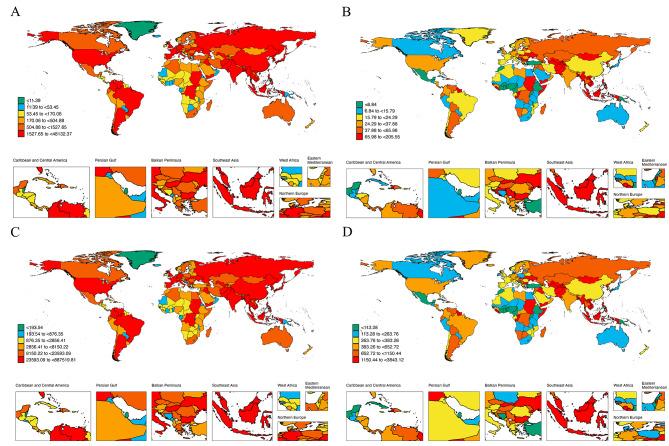
From 1990 to 2019, global age-standardized cardiovascular disease (CVD) mortality rates attributable to low dietary fiber intake decreased by 2.37% per year, while disability-adjusted life years (DALYs) fell by 2.48% annually. Decreases were observed across all sociodemographic index regions, with fastest declines in high and high-middle SDI areas. CVD mortality and DALY rates attributable to low fiber increased exponentially with age, peaking at 85-89 years, and were higher in men than women. Regarding period effects, mortality and DALY rates declined since 2000, reaching nadirs in 2015-2019. For birth cohort patterns, risks attributable to low fiber intake peaked among early 1900s births and subsequently fell, with more pronounced reductions over time in women.
CONCLUSIONS
Low dietary fiber intake is a leading contributor to the global cardiovascular disease burden, accounting for substantial mortality and disability specifically among older adults over recent decades.
目的
本研究旨在利用 2019 年全球疾病负担(GBD)研究的数据,量化 60 岁及以上成年人膳食纤维摄入不足导致的全球心血管疾病(CVD)负担。
方法
我们从 GBD 2019 研究中提取了 60 岁及以上人群的 CVD 死亡率、残疾调整生命年(DALY)和危险因素暴露数据。使用年龄-时期-队列模型来估计死亡率和 DALY 率的总体年度百分比变化(净漂移,每年%)、1990 年至 2019 年每个年龄组的死亡率和 DALY 率(局部漂移,每年%)、针对时期偏差进行纵向年龄特异性率校正(年龄效应)以及 1990 年至 2019 年每个年龄组的死亡率和 DALY 率(局部漂移,每年%)。以及时期/队列相对风险(时期/队列效应)。
结果
1990 年至 2019 年,全球年龄标准化心血管疾病(CVD)死亡率归因于低膳食纤维摄入量每年下降 2.37%,而残疾调整生命年(DALY)每年下降 2.48%。所有社会人口指数区域均观察到下降,高和高-中社会发展指数地区下降最快。CVD 死亡率和 DALY 率归因于低纤维的发病率随年龄呈指数增长,在 85-89 岁时达到峰值,并且男性高于女性。关于时期效应,自 2000 年以来死亡率和 DALY 率下降,在 2015-2019 年达到最低点。对于出生队列模式,低纤维摄入量引起的风险在 20 世纪初出生的人群中达到峰值,随后下降,女性的风险随着时间的推移呈下降趋势。
结论
低膳食纤维摄入是全球心血管疾病负担的主要原因,特别是在过去几十年中,对老年人的死亡率和残疾率有很大影响。




 Zotero 插件