
正常细胞和恶性细胞中外源信号对发育调控增强子活性的调节:AP-1处于核心地位。
Regulation of developmentally controlled enhancer activity by extrinsic signals in normal and malignant cells: AP-1 at the centre.
作者信息
Maytum Alexander, Obier Nadine, Cauchy Pierre, Bonifer Constanze
机构信息
Blood Cell Development Group, Novo Nordisk Foundation Center for Stem Cell Medicine, Murdoch Children's Research Institute, The Royal Children's Hospital, Parkville, Victoria 3052 Australia, Country.
Institute of Cancer and Genomic Sciences, College of Medical and Dental Sciences, University of Birmingham, Birmingham, UK.
出版信息
Front Epigenet Epigenom. 2024 Sep 16;2. doi: 10.3389/freae.2024.1465958.
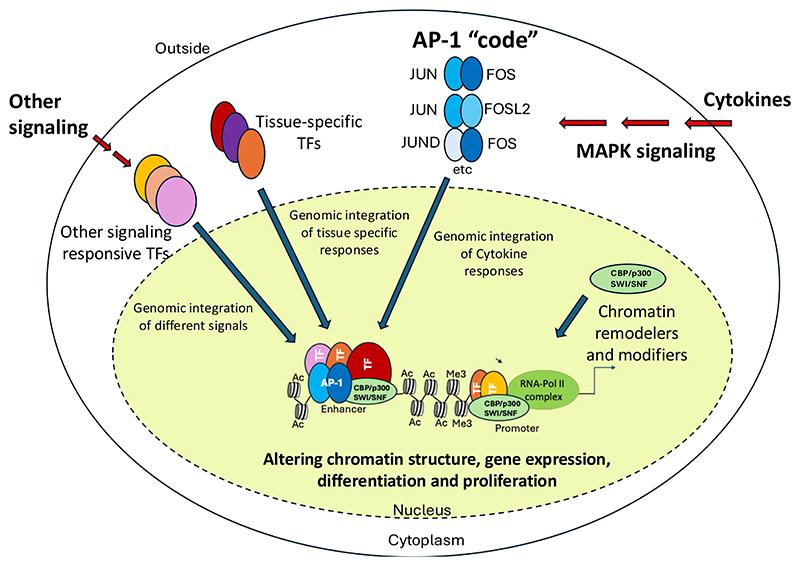
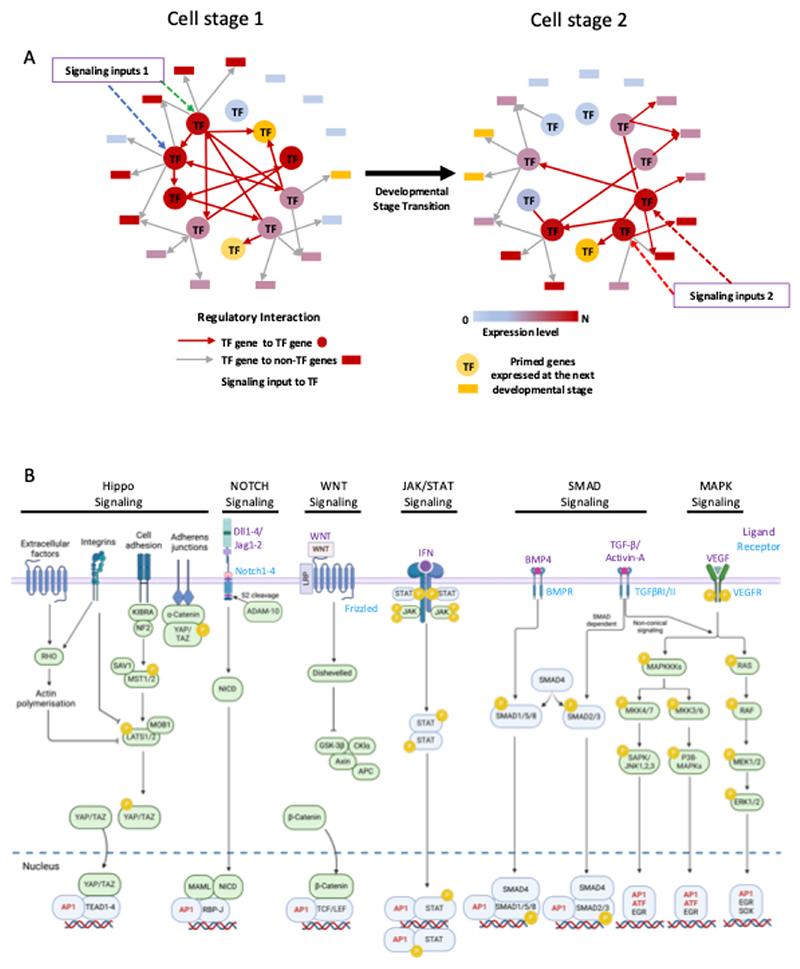
The ability of cells to respond to external stimuli is one of the characteristics of life as we know it. Multicellular organisms have developed a huge machinery that interprets the cellular environment and instigates an appropriate cellular response by changing gene expression, metabolism, proliferation state and motility. Decades of research have studied the pathways transmitting the various signals within the cell. However, whilst we know most of the players, we know surprisingly little about the mechanistic details of how extrinsic signals are interpreted and integrated within the genome. In this article we revisit the long-standing debate of whether factors regulating cellular growth (cytokines) act in an instructive or permissive fashion on cell fate decisions. We touch upon this topic by highlighting the paradigm of AP-1 as one of the most important signaling-responsive transcription factor family and summarize our work and that of others to explain what is known about cytokine responsive cis-regulatory elements driving differential gene expression. We propose that cytokines and, by extension, multiple types of external signals are the main drivers of cell differentiation and act via inducible transcription factors that transmit signaling processes to the genome and are essential for changing gene expression to drive transitions between gene regulatory networks. Importantly, inducible transcription factors cooperate with cell type specific factors within a pre-existing chromatin landscape and integrate multiple signaling pathways at specific enhancer elements, to both maintain and alter cellular identities. We also propose that signaling processes and signaling responsive transcription factors are at the heart of tumor development.
细胞对外部刺激作出反应的能力是我们所知的生命特征之一。多细胞生物已经进化出一套庞大的机制,用于解读细胞环境,并通过改变基因表达、新陈代谢、增殖状态和运动性来引发适当的细胞反应。数十年来,研究人员一直在研究细胞内传递各种信号的途径。然而,尽管我们了解了大多数参与其中的分子,但对于外部信号如何在基因组中被解读和整合的机制细节,我们却知之甚少。在本文中,我们重新审视了一个长期存在的争论:调节细胞生长的因子(细胞因子)在细胞命运决定中是以指导性方式还是许可性方式发挥作用。我们通过强调AP-1这一最重要的信号响应转录因子家族之一的范例来探讨这个话题,并总结我们自己以及他人的工作,以解释关于驱动差异基因表达的细胞因子响应顺式调控元件的已知情况。我们提出,细胞因子以及由此延伸的多种外部信号是细胞分化的主要驱动因素,它们通过诱导性转录因子发挥作用,这些转录因子将信号传导过程传递到基因组,对于改变基因表达以驱动基因调控网络之间的转变至关重要。重要的是,诱导性转录因子在预先存在的染色质环境中与细胞类型特异性因子协同作用,并在特定增强子元件处整合多种信号通路,以维持和改变细胞身份。我们还提出,信号传导过程和信号响应转录因子是肿瘤发展的核心。

 Zotero 插件