
抗菌肽设计中的创新策略与方法
Innovative Strategies and Methodologies in Antimicrobial Peptide Design.
作者信息
Verma Devesh Pratap, Tripathi Amit Kumar, Thakur Ashwani Kumar
机构信息
Department of Biological Sciences & Bioengineering, Indian Institute of Technology, Kanpur 208016, Uttar Pradesh, India.
Department of Microbiology, Immunology and Genetics, University of North Texas Health Science Center, Fort Worth, TX 76107, USA.
出版信息
J Funct Biomater. 2024 Oct 29;15(11):320. doi: 10.3390/jfb15110320.
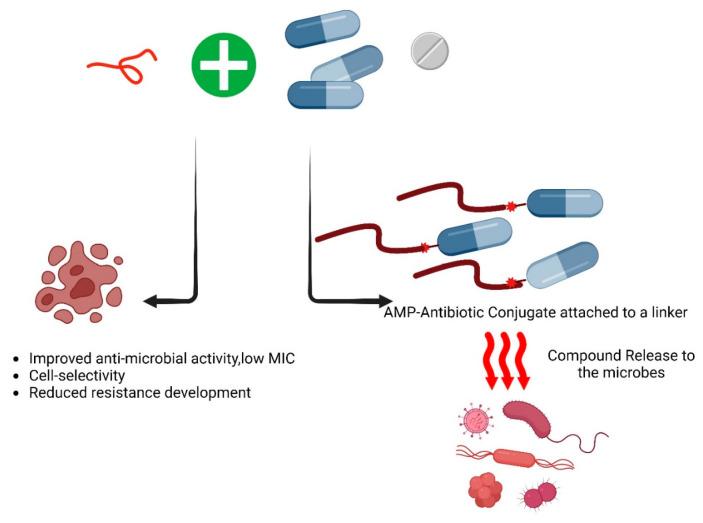
Multiple lines of research have led to the hypothesis that antimicrobial peptides (AMPs) are an important component of the innate immune response, playing a vital role in the defense against a wide range of infectious diseases. In this review, we explore the occurrence and availability of antimicrobial proteins and peptides across various species, highlighting their natural abundance and evolutionary significance. The design of AMPs has been driven by the identification of key structural and functional features, which are essential for optimizing their antimicrobial activity and reducing toxicity to host cells. We discuss various approaches, including rational design, high-throughput screening, and computational modeling, that have been employed to develop novel AMPs with enhanced efficacy. A particular focus is given to the identification and characterization of peptide fragments derived from naturally occurring host defense proteins, which offer a promising avenue for the discovery of new AMPs. The incorporation of artificial intelligence (AI) and machine learning (ML) tools into AMP research has further accelerated the identification, optimization, and application of these peptides. This review also discusses the current status and therapeutic potential of AMPs, emphasizing their role in addressing the growing issue of antibiotic resistance. The conclusion highlights the importance of continued research and innovation in AMP development to fully harness their potential as next-generation antimicrobial agents.
多条研究线索引出了这样一个假说
抗菌肽(AMPs)是先天免疫反应的重要组成部分,在抵御多种传染病中发挥着至关重要的作用。在这篇综述中,我们探讨了抗菌蛋白和肽在不同物种中的存在情况和可得性,强调了它们的天然丰度和进化意义。抗菌肽的设计是由关键结构和功能特征的识别驱动的,这些特征对于优化其抗菌活性和降低对宿主细胞的毒性至关重要。我们讨论了各种方法,包括合理设计、高通量筛选和计算建模,这些方法已被用于开发具有更高疗效的新型抗菌肽。特别关注从天然宿主防御蛋白衍生的肽片段的识别和表征,这为发现新的抗菌肽提供了一条有前景的途径。将人工智能(AI)和机器学习(ML)工具纳入抗菌肽研究进一步加速了这些肽的识别、优化和应用。这篇综述还讨论了抗菌肽的现状和治疗潜力,强调了它们在解决日益严重的抗生素耐药性问题中的作用。结论强调了在抗菌肽开发中持续研究和创新的重要性,以充分发挥它们作为下一代抗菌剂的潜力。


 Zotero 插件