
早期进食(大早餐饮食)、时钟基因 mRNA 表达与肠道微生物群相互作用,调节肥胖和 2 型糖尿病患者的体重减轻和葡萄糖代谢。
Interaction Between Early Meals (Big-Breakfast Diet), Clock Gene mRNA Expression, and Gut Microbiome to Regulate Weight Loss and Glucose Metabolism in Obesity and Type 2 Diabetes.
机构信息
Endocrinology and Diabetes Unit, Wolfson Medical Center, Sackler Faculty of Medicine, Tel Aviv University, Holon 58100, Israel.
Institute of Biochemistry, Food Science and Nutrition, The Robert H. Smith Faculty of Agriculture, Food and Environment, The Hebrew University of Jerusalem, Rehovot 76100, Israel.
出版信息
Int J Mol Sci. 2024 Nov 18;25(22):12355. doi: 10.3390/ijms252212355.
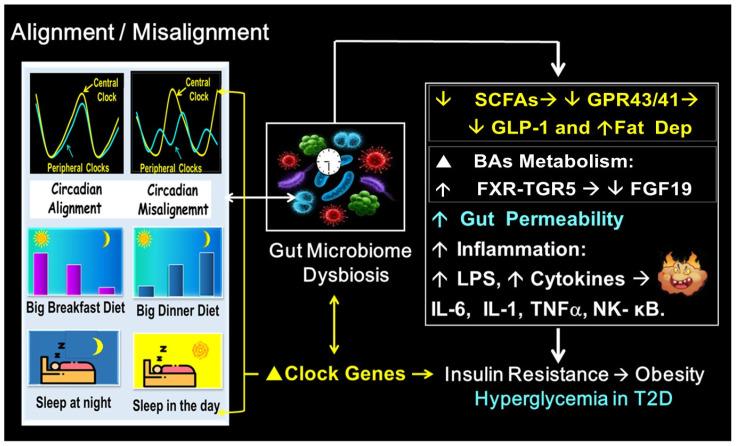
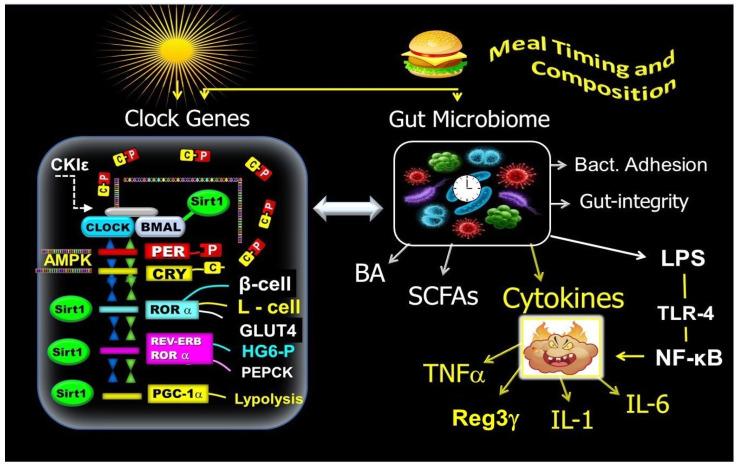
The circadian clock gene system plays a pivotal role in coordinating the daily rhythms of most metabolic processes. It is synchronized with the light-dark cycle and the eating-fasting schedule. Notably, the interaction between meal timing and circadian clock genes (CGs) allows for optimizing metabolic processes at specific times of the day. Breakfast has a powerful resetting effect on the CG network. A misaligned meal pattern, such as skipping breakfast, can lead to a discordance between meal timing and the endogenous CGs, and is associated with obesity and T2D. Conversely, concentrating most calories and carbohydrates (CH) in the early hours of the day upregulates metabolic CG expression, thus promoting improved weight loss and glycemic control. Recently, it was revealed that microorganisms in the gastrointestinal tract, known as the gut microbiome (GM), and its derived metabolites display daily oscillation, and play a critical role in energy and glucose metabolism. The timing of meal intake coordinates the oscillation of GM and GM-derived metabolites, which in turn influences CG expression, playing a crucial role in the metabolic response to food intake. An imbalance in the gut microbiota (dysbiosis) can also reciprocally disrupt CG rhythms. Evidence suggests that misaligned meal timing may cause such disruptions and can lead to obesity and hyperglycemia. This manuscript focuses on the reciprocal interaction between meal timing, GM oscillation, and circadian CG rhythms. It will also review studies demonstrating how aligning meal timing with the circadian clock can reset and synchronize CG rhythms and GM oscillations. This synchronization can facilitate weight loss and improve glycemic control in obesity and those with T2D.
生物钟基因系统在协调大多数代谢过程的日常节律方面起着关键作用。它与光-暗周期和进食-禁食时间表同步。值得注意的是,进餐时间和生物钟基因(CG)之间的相互作用允许在一天中的特定时间优化代谢过程。早餐对 CG 网络具有强大的重置作用。不规律的进餐模式,如不吃早餐,可能导致进餐时间与内源性 CG 之间的不协调,并与肥胖和 T2D 相关。相反,将大部分卡路里和碳水化合物(CH)集中在一天的早期,可上调代谢 CG 表达,从而促进体重减轻和血糖控制的改善。最近,人们发现,胃肠道中的微生物,即肠道微生物组(GM)及其衍生代谢物,呈现出日常波动,并在能量和葡萄糖代谢中发挥关键作用。进餐时间的安排协调 GM 和 GM 衍生代谢物的波动,进而影响 CG 表达,在对食物摄入的代谢反应中起着至关重要的作用。肠道微生物群(失调)的失衡也会反过来破坏 CG 节律。有证据表明,不规律的进餐时间可能会导致这种破坏,并可能导致肥胖和高血糖。本文重点介绍进餐时间、GM 波动和生物钟 CG 节律之间的相互作用。它还将回顾表明如何使进餐时间与生物钟同步来重置和同步 CG 节律和 GM 波动的研究。这种同步可以促进肥胖和 T2D 患者的体重减轻和改善血糖控制。


 Zotero 插件