
在微生物学实验室自动化系统上孵育4小时后采集的数字图像在指导阳性血培养物传代培养检查工作中的效用。
Utility of digital images captured after 4 h of incubation on a microbiology laboratory automation system in guiding the work-up of subcultures from positive blood cultures.
作者信息
Cintrón Melvilí, Clark Brenden, Miranda Edwin, Babady N Esther
机构信息
Clinical Microbiology Service, Department of Pathology and Laboratory Medicine, Memorial Sloan Kettering Cancer Center, New York, New York, USA.
Infectious Disease Service, Department of Medicine, Memorial Sloan Kettering Cancer Center, New York, New York, USA.
出版信息
J Clin Microbiol. 2025 Feb 19;63(2):e0132024. doi: 10.1128/jcm.01320-24. Epub 2024 Dec 20.
UNLABELLED
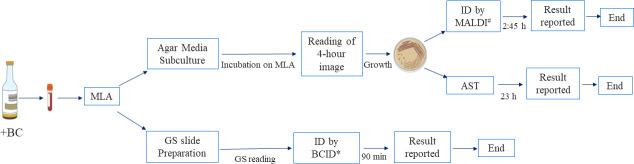
Initial workup [e.g., identification (ID) and/or antimicrobial susceptibility testing (AST)] of bacterial growth on solid media traditionally occurs 16-24 h after sub-culturing of positive blood cultures (BC). Early ID and AST can be facilitated by reviewing digital images captured using a Microbiology Laboratory Automation (MLA) system. The goal of this study was to evaluate the utility of images captured at 4 h on the WASPLab MLA system for rapid bacterial ID and AST. Retrospective review of all positive BCs results between 1 January 2021 and 31 July 2022 was performed. WASPLab App data were extracted to determine the decision (e.g., perform ID and/or AST or re-incubate plates) made from the 4 h image. Culture results were extracted from the laboratory information system (LIS). A total of 6,845 BCs flagged positive during the study period. The 4 h images for 1,476 cultures (21.6%) were reviewed: 1,200 cultures were re-incubated due to insufficient growth and 276 cultures (4.0%) were sent for ID and/or AST. ID by mass spectrometry was in 100% agreement with that of the molecular BC identification panels. Overall categorical agreement between AST results from the 4 h and overnight growth was 98%. The 4 h images for the remaining 5,369 cultures (78.4%) were not available for review during the day shift. Implementing early reading times for BCs on MLA allows for rapid and accurate ID and AST results. However, optimization of the reading schedule to align with the laboratory's operation schedule is key to realizing the full potential of early reading times.
IMPORTANCE
In recent years, an increasing number of clinical microbiology laboratories have adopted laboratory automation for processing and incubation of specimens submitted for bacterial culture. At our institution, we implemented the Copan WASPLab in 2018 for all cultures, including positive blood cultures. Given that positive blood cultures start with a higher biomass of organisms, the first image capture was set up to occur after 4 h of incubation. In this study, we investigated the utility of this early 4 h image by capturing and calculating the percentage of useful actions taken based on growth identified on the image and the yield of both new identification by MALDI-TOF MS and valid and accurate antimicrobial susceptibility testing (AST) results. We found that while the 4-hour time point provided accurate, early identification and AST results, the overall yield was minimal. From a practical standpoint, this review prompted us to discontinue capture and review of this time point. While our staffing model is likely responsible for this low yield, we hope that our experience would help other laboratories decide how to implement WASPLab workflow for positive blood cultures. Thus, we believe that this information will be of interest to the readers of JCM.
未标注
传统上,在固体培养基上细菌生长的初始检查[例如,鉴定(ID)和/或抗菌药敏试验(AST)]在阳性血培养(BC)传代培养16 - 24小时后进行。通过查看使用微生物实验室自动化(MLA)系统捕获的数字图像,可以促进早期ID和AST。本研究的目的是评估在WASPLab MLA系统上4小时时捕获的图像用于快速细菌ID和AST的效用。对2021年1月1日至2022年7月31日期间所有阳性BC结果进行回顾性分析。提取WASPLab应用程序数据以确定根据4小时图像做出的决定(例如,进行ID和/或AST或重新孵育平板)。从实验室信息系统(LIS)中提取培养结果。在研究期间,共有6845份BC被标记为阳性。对1476份培养物(21.6%)的4小时图像进行了查看:1200份培养物因生长不足而重新孵育,276份培养物(4.0%)送去进行ID和/或AST。质谱鉴定与分子BC鉴定面板的鉴定结果100%一致。4小时和过夜生长的AST结果之间的总体分类一致性为98%。其余5369份培养物(78.4%)的4小时图像在白班期间无法查看。在MLA上对BC实施早期读取时间可实现快速准确的ID和AST结果。然而,优化读取时间表以与实验室的操作时间表相匹配是充分发挥早期读取时间潜力的关键。
重要性
近年来,越来越多的临床微生物实验室采用实验室自动化来处理和孵育提交进行细菌培养的标本。在我们机构,我们于2018年对所有培养物,包括阳性血培养,实施了Copan WASPLab。鉴于阳性血培养开始时生物体的生物量较高,首次图像捕获设置在孵育4小时后进行。在本研究中,我们通过捕获并计算基于图像上识别的生长所采取的有用行动的百分比以及基质辅助激光解吸电离飞行时间质谱(MALDI - TOF MS)新鉴定的产量和有效准确的抗菌药敏试验(AST)结果,研究了这个早期4小时图像的效用。我们发现,虽然4小时这个时间点能提供准确的早期鉴定和AST结果,但总体产量很低。从实际角度来看,这次分析促使我们停止捕获和查看这个时间点。虽然我们的人员配置模式可能是导致产量低的原因,但我们希望我们的经验能帮助其他实验室决定如何为阳性血培养实施WASPLab工作流程。因此,我们相信这些信息会让《临床微生物学杂志》的读者感兴趣。

 Zotero 插件