
KLF5缺失使细胞对ATR抑制敏感,并且与ARID1A缺陷具有合成致死性。
KLF5 loss sensitizes cells to ATR inhibition and is synthetic lethal with ARID1A deficiency.
作者信息
Awwad Samah W, Doyle Colm, Coulthard Josie, Bader Aldo S, Gueorguieva Nadia, Lam Simon, Gupta Vipul, Belotserkovskaya Rimma, Tran Tuan-Anh, Balasubramanian Shankar, Jackson Stephen P
机构信息
Cancer Research UK Cambridge Institute, University of Cambridge, Cambridge, UK.
The Gurdon Institute, University of Cambridge, Cambridge, UK.
出版信息
Nat Commun. 2025 Jan 8;16(1):480. doi: 10.1038/s41467-024-55637-5.
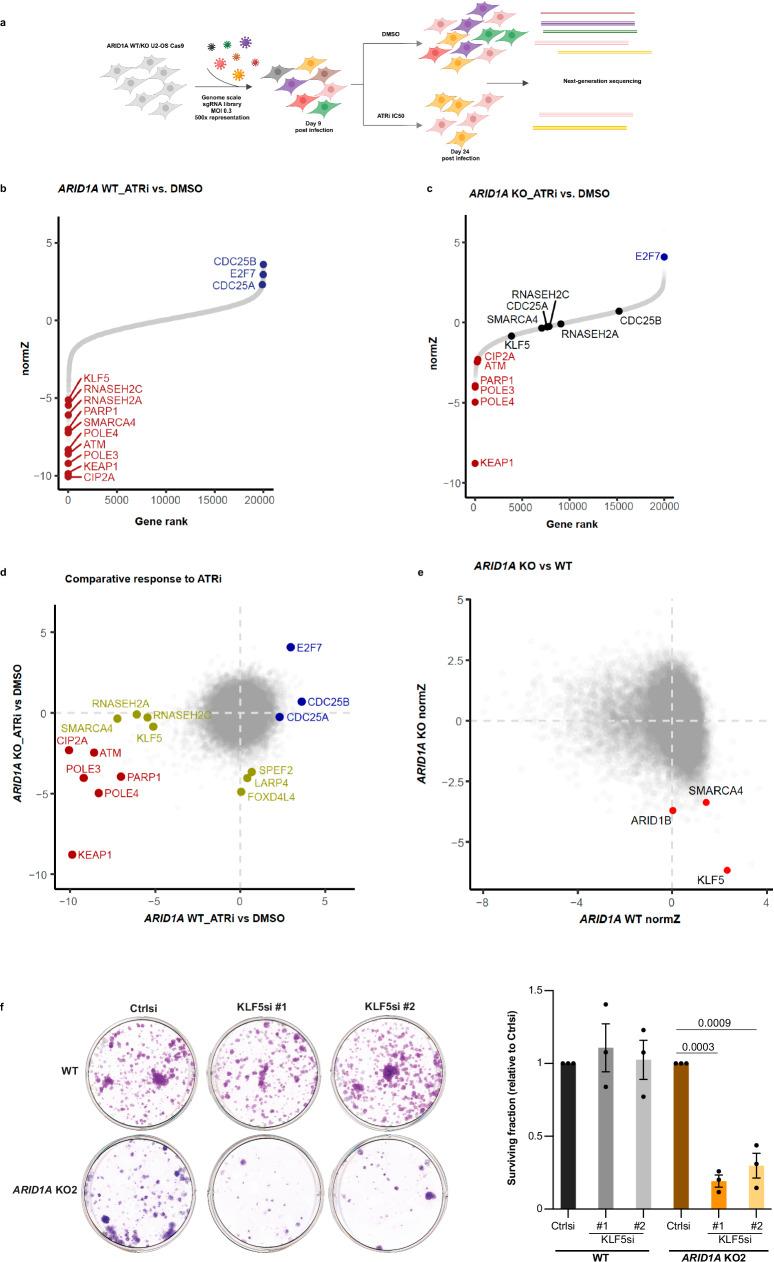
ATR plays key roles in cellular responses to DNA damage and replication stress, a pervasive feature of cancer cells. ATR inhibitors (ATRi) are in clinical development for treating various cancers, including those with high replication stress, such as is elicited by ARID1A deficiency, but the cellular mechanisms that determine ATRi efficacy in such backgrounds are unclear. Here, we have conducted unbiased genome-scale CRISPR screens in ARID1A-deficient and proficient cells treated with ATRi. We found that loss of transcription factor KLF5 has severe negative impact on fitness of ARID1A-deficient cells while hypersensitising ARID1A-proficient cells to ATRi. KLF5 loss induced replication stress, DNA damage, increased DNA-RNA hybrid formation, and genomic instability upon ATR inhibition. Mechanistically, we show that KLF5 protects cells from replication stress, at least in part through regulating BRD4 recruitment to chromatin. Overall, our work identifies KLF5 as a potential target for eradicating ARID1A-deficient cancers.
ATR在细胞对DNA损伤和复制应激的反应中发挥关键作用,而这是癌细胞的一个普遍特征。ATR抑制剂(ATRi)正在进行治疗各种癌症的临床试验,包括那些具有高复制应激的癌症,如由ARID1A缺陷引发的癌症,但在此类背景下决定ATRi疗效的细胞机制尚不清楚。在此,我们对用ATRi处理的ARID1A缺陷型和野生型细胞进行了无偏差的全基因组CRISPR筛选。我们发现转录因子KLF5的缺失对ARID1A缺陷型细胞的适应性有严重负面影响,同时使ARID1A野生型细胞对ATRi超敏。KLF5缺失在ATR抑制后诱导复制应激、DNA损伤、DNA-RNA杂交形成增加和基因组不稳定。从机制上讲,我们表明KLF5至少部分通过调节BRD4募集到染色质来保护细胞免受复制应激。总体而言,我们的工作将KLF5确定为根除ARID1A缺陷型癌症的潜在靶点。

 Zotero 插件