
数字健康干预对血糖控制和体重管理的影响。
Impact of digital health interventions on glycemic control and weight management.
作者信息
Veluvali Arvind, Dehghani Zahedani Ashkan, Hosseinian Amir, Aghaeepour Nima, McLaughlin Tracey, Woodward Mark, DiTullio Alex, Hashemi Noosheen, Snyder Michael P
机构信息
January AI, Menlo Park, CA, USA.
出版信息
NPJ Digit Med. 2025 Jan 9;8(1):20. doi: 10.1038/s41746-025-01430-7.
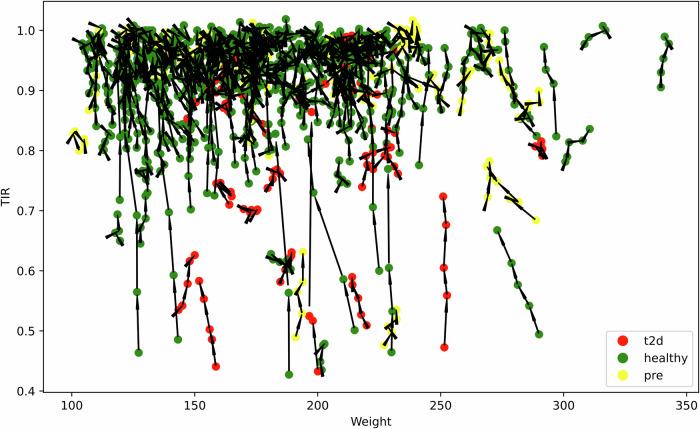
This retrospective cohort study evaluates the impact of an AI-supported continuous glucose monitoring (CGM) mobile app ("January V2") on glycemic control and weight management in 944 users, including healthy individuals and those with prediabetes or type 2 diabetes (T2D). The app, leveraging AI to personalize feedback, tracked users' food intake, activity, and glucose responses over 14 days. Significant improvements in time in range (TIR) were observed, particularly in users with lower baseline TIR. Healthy users' TIR increased from 74.7% to 85.5% (p < 0.0001), while T2D users' TIR improved from 49.7% to 57.4% (p < 0.0004). Higher app engagement correlated with greater TIR improvements. Users also experienced an average weight reduction of 3.3 lbs over 33 days. These findings suggest that AI-enhanced digital health interventions can improve glycemic control and promote weight loss, particularly when users are actively engaged.
这项回顾性队列研究评估了一款人工智能支持的持续葡萄糖监测(CGM)移动应用程序(“January V2”)对944名用户(包括健康个体以及患有前驱糖尿病或2型糖尿病(T2D)的人群)血糖控制和体重管理的影响。该应用程序利用人工智能提供个性化反馈,在14天内跟踪用户的食物摄入量、活动情况和血糖反应。研究观察到血糖达标时间(TIR)有显著改善,尤其是基线TIR较低的用户。健康用户的TIR从74.7%提高到85.5%(p<0.0001),而T2D用户的TIR从49.7%提高到57.4%(p<0.0004)。更高的应用程序参与度与更大的TIR改善相关。用户在33天内平均体重减轻了3.3磅。这些发现表明,人工智能增强的数字健康干预措施可以改善血糖控制并促进体重减轻,尤其是当用户积极参与时。



 Zotero 插件