
AIP56是由亚种分泌的一种AB毒素,对髓样细胞具有嗜性。
AIP56, an AB toxin secreted by subsp. , has tropism for myeloid cells.
作者信息
Freitas Inês Lua, Macedo Maria Fátima, Oliveira Liliana, Oliveira Pedro, do Vale Ana, Dos Santos Nuno M S
机构信息
Fish Immunology and Vaccinology Group, Instituto de Biologia Molecular e Celular (IBMC), Universidade do Porto, Porto, Portugal.
Fish Immunology and Vaccinology Group, Instituto de Investigação e Inovação em Saúde (i3S), Universidade do Porto, Porto, Portugal.
出版信息
Front Immunol. 2025 Jan 13;15:1527088. doi: 10.3389/fimmu.2024.1527088. eCollection 2024.
INTRODUCTION
The AB-type toxin AIP56 is a key virulence factor of Photobacterium damselae subsp. piscicida (Phdp), inducing apoptosis in fish immune cells. The discovery of AIP56-like and AIP56-related toxins in diverse organisms, including human-associated Vibrio strains, highlights the evolutionary conservation of this toxin family, suggesting that AIP56 and its homologs may share conserved receptors across species. These toxins have potential for biotechnological applications, such as therapeutic protein delivery and immune modulation.
METHODS
Herein, the cell specificity of AIP56 for immune cells was characterized. The tropism of AIP56 for cells of the sea bass, mouse and human immune system was analyzed by following toxin internalization by flow cytometry and arrival of the toxin in the cytosol by evaluating the cleavage of NF-kB p65 by western blotting.
RESULTS
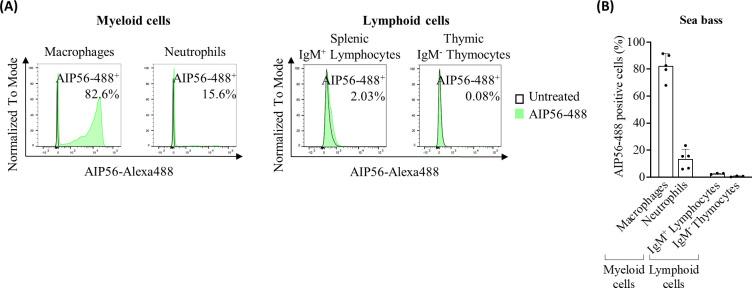
Only a small population of sea bass neutrophils internalized AIP56, indicating that most of the neutrophilic destruction during Phdp infection and/or AIP56 intoxication does not result from the direct action of the toxin. Moreover, the cellular tropism of AIP56 for myeloid cells was observed in the three species, including its preference for macrophages. Further, mouse and human M0 and M2-like macrophages internalized more toxin than M1-like macrophages. Despite the limited interaction of lymphoid cells with AIP56, mouse B1-cells were able to internalize the toxin, possibly due to its myeloid features.
CONCLUSION
AIP56 has tropism for sea bass, mouse and human myeloid cells, with greater affinity for macrophages. This points to an evolutionary conservation of its receptor(s) and mechanism of action across species, raising the possibility that AIP56-like and -related toxins may also play a role in pathogenesis. These findings are relevant for both pathogenicity and biomedical contexts.
引言
AB 型毒素 AIP56 是杀鲑气单胞菌杀鲑亚种(Phdp)的关键毒力因子,可诱导鱼类免疫细胞凋亡。在包括与人类相关的弧菌菌株在内的多种生物中发现了 AIP56 样和 AIP56 相关毒素,这突出了该毒素家族的进化保守性,表明 AIP56 及其同源物可能在物种间共享保守受体。这些毒素具有生物技术应用潜力,如治疗性蛋白质递送和免疫调节。
方法
在此,对 AIP56 对免疫细胞的细胞特异性进行了表征。通过流式细胞术追踪毒素内化情况,并通过蛋白质免疫印迹法评估 NF-κB p65 的裂解来分析 AIP56 对鲈鱼、小鼠和人类免疫系统细胞的嗜性,以确定毒素是否到达细胞质。
结果
只有一小部分鲈鱼中性粒细胞内化 AIP56,这表明在 Phdp 感染和/或 AIP56 中毒期间,大多数嗜中性粒细胞的破坏并非由毒素的直接作用引起。此外,在这三个物种中均观察到 AIP56 对髓样细胞的细胞嗜性,包括其对巨噬细胞的偏好。此外,小鼠和人类的 M0 和 M2 样巨噬细胞比 M1 样巨噬细胞内化更多毒素。尽管淋巴细胞与 AIP56 的相互作用有限,但小鼠 B1 细胞能够内化该毒素,这可能是由于其髓样特征。
结论
AIP56 对鲈鱼、小鼠和人类的髓样细胞具有嗜性,对巨噬细胞具有更高的亲和力。这表明其受体和作用机制在物种间具有进化保守性,增加了 AIP56 样和相关毒素也可能在发病机制中起作用的可能性。这些发现对致病性和生物医学背景都具有重要意义。


 Zotero 插件