
靶向糖酵解:探索胶质母细胞瘤治疗的新前沿
Targeting glycolysis: exploring a new frontier in glioblastoma therapy.
作者信息
Yang Lu, Li Sijia, Yu Lei, Leng Jiao, Li Na
机构信息
Department of Oncology, Suining Central Hospital, Suining, Sichuan, China.
出版信息
Front Immunol. 2025 Jan 14;15:1522392. doi: 10.3389/fimmu.2024.1522392. eCollection 2024.
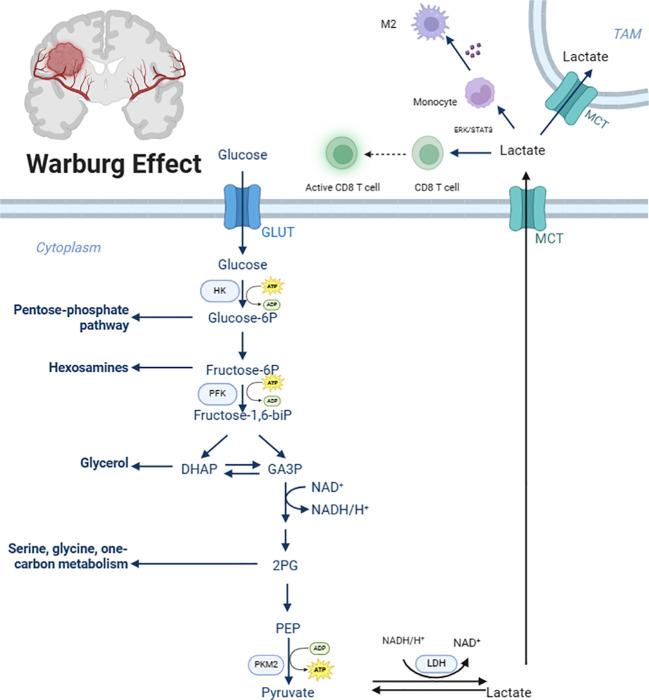
Glioblastoma(GBM) is a highly malignant primary central nervous system tumor that poses a significant threat to patient survival due to its treatment resistance and rapid recurrence.Current treatment options, including maximal safe surgical resection, radiotherapy, and temozolomide (TMZ) chemotherapy, have limited efficacy.In recent years, the role of glycolytic metabolic reprogramming in GBM has garnered increasing attention. This review delves into the pivotal role of glycolytic metabolic reprogramming in GBM, with a particular focus on the multifaceted roles of lactate, a key metabolic product, within the tumor microenvironment (TME). Lactate has been implicated in promoting tumor cell proliferation, invasion, and immune evasion. Additionally, this review systematically analyzes potential therapeutic strategies targeting key molecules within the glycolytic pathway, such as Glucose Transporters (GLUTs), Monocarboxylate Transporters(MCTs), Hexokinase 2 (HK2), 6-Phosphofructo-2-Kinase/Fructose-2,6-Biphosphatase 3 (PFKFB3), Pyruvate Kinase Isozyme Type M2 (PKM2), and the Lactate Dehydrogenase A (LDHA). These studies provide a novel perspective for GBM treatment. Despite progress made in existing research, challenges remain, including drug penetration across the blood-brain barrier, side effects, and resistance. Future research will aim to address these challenges by improving drug delivery, minimizing side effects, and exploring combination therapies with radiotherapy, chemotherapy, and immunotherapy to develop more precise and effective personalized treatment strategies for GBM.
胶质母细胞瘤(GBM)是一种高度恶性的原发性中枢神经系统肿瘤,因其具有治疗抗性和快速复发的特点,对患者的生存构成了重大威胁。目前的治疗选择,包括最大程度的安全手术切除、放射治疗和替莫唑胺(TMZ)化疗,疗效有限。近年来,糖酵解代谢重编程在GBM中的作用受到了越来越多的关注。这篇综述深入探讨了糖酵解代谢重编程在GBM中的关键作用,特别关注肿瘤微环境(TME)中关键代谢产物乳酸的多方面作用。乳酸已被证明与促进肿瘤细胞增殖、侵袭和免疫逃逸有关。此外,本综述系统地分析了针对糖酵解途径中关键分子的潜在治疗策略,如葡萄糖转运蛋白(GLUTs)、单羧酸转运蛋白(MCTs)、己糖激酶2(HK2)、6-磷酸果糖-2-激酶/果糖-2,6-二磷酸酶3(PFKFB3)、丙酮酸激酶M2型同工酶(PKM2)和乳酸脱氢酶A(LDHA)。这些研究为GBM的治疗提供了新的视角。尽管现有研究取得了进展,但挑战依然存在,包括药物透过血脑屏障、副作用和耐药性。未来的研究将致力于通过改善药物递送、最小化副作用以及探索与放疗、化疗和免疫疗法的联合治疗来应对这些挑战,从而为GBM开发更精确有效的个性化治疗策略。
 Zotero 插件