
分子成像在靶向肿瘤免疫微环境中的现状与未来前景
Current status and future prospects of molecular imaging in targeting the tumor immune microenvironment.
作者信息
Wang Xiang, Shen Weifen, Yao Lingjun, Li Chao, You Huiming, Guo Duancheng
机构信息
Department of Radiology, First People's Hospital of Linping District, Hangzhou, China.
The Second Affiliated Hospital of Zhejiang University School of Medicine, Hangzhou, China.
出版信息
Front Immunol. 2025 Jan 22;16:1518555. doi: 10.3389/fimmu.2025.1518555. eCollection 2025.
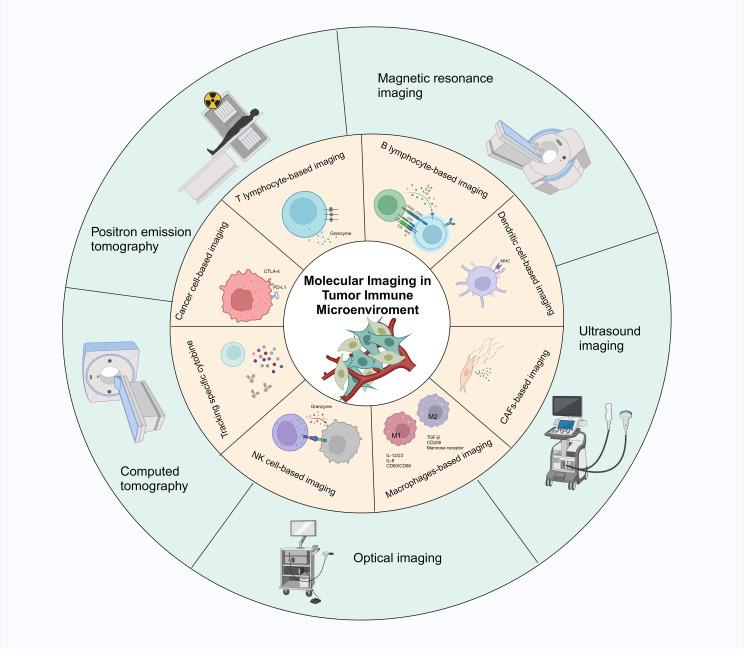
Molecular imaging technologies have significantly transformed cancer research and clinical practice, offering valuable tools for visualizing and understanding the complex tumor immune microenvironment. These technologies allow for the non-invasive examination of key components within the tumor immune microenvironment, including immune cells, cytokines, and stromal cells, providing crucial insights into tumor biology and treatment responses. This paper reviews the latest advancements in molecular imaging, with a focus on its applications in assessing interactions within the tumor immune microenvironment. Additionally, the challenges faced by molecular imaging technologies are discussed, such as the need for highly sensitive and specific imaging agents, issues with data integration, and difficulties in clinical translation. The future outlook emphasizes the potential of molecular imaging to enhance personalized cancer treatment through the integration of artificial intelligence and the development of novel imaging probes. Addressing these challenges is essential to fully realizing the potential of molecular imaging in improving cancer diagnosis, treatment, and patient outcomes.
分子成像技术显著改变了癌症研究和临床实践,为可视化和理解复杂的肿瘤免疫微环境提供了有价值的工具。这些技术能够对肿瘤免疫微环境中的关键成分进行非侵入性检查,包括免疫细胞、细胞因子和基质细胞,从而为肿瘤生物学和治疗反应提供关键见解。本文综述了分子成像的最新进展,重点关注其在评估肿瘤免疫微环境内相互作用方面的应用。此外,还讨论了分子成像技术面临的挑战,如对高灵敏度和特异性成像剂的需求、数据整合问题以及临床转化困难。未来展望强调了分子成像通过整合人工智能和开发新型成像探针来增强个性化癌症治疗的潜力。应对这些挑战对于充分实现分子成像在改善癌症诊断、治疗和患者预后方面的潜力至关重要。


 Zotero 插件