
一种针对人PINK1的灵敏夹心酶联免疫吸附测定法的开发与验证
Development and validation of a sensitive sandwich ELISA against human PINK1.
作者信息
Baninameh Zahra, Watzlawik Jens O, Bustillos Bernardo A, Fiorino Gabriella, Yan Tingxiang, Lewicki Szymon L, Zhang Haonan, Dickson Dennis W, Siuda Joanna, Wszolek Zbigniew K, Springer Wolfdieter, Fiesel Fabienne C
机构信息
Department of Neuroscience, Mayo Clinic, Jacksonville, FL, USA.
Mayo Graduate School of Biomedical Sciences, Mayo Clinic, Jacksonville, FL, USA.
出版信息
Autophagy. 2025 May;21(5):1144-1159. doi: 10.1080/15548627.2025.2457915. Epub 2025 Feb 6.
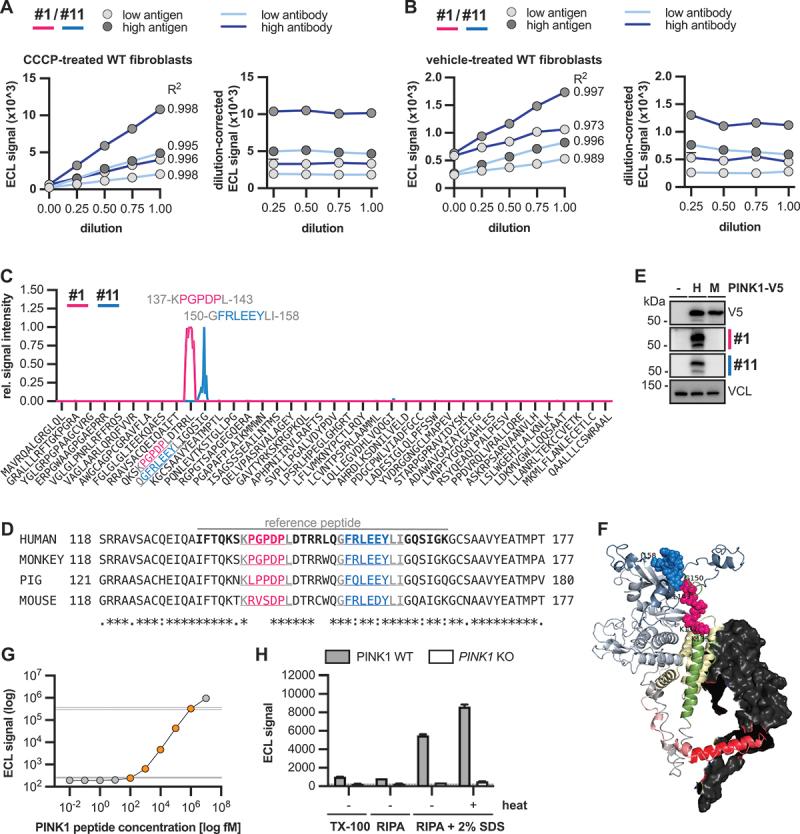
The ubiquitin kinase and ligase PINK1 and PRKN together label damaged mitochondria for their elimination in lysosomes by selective autophagy (mitophagy). This cytoprotective quality control pathway is genetically linked to familial Parkinson disease but is also altered during aging and in other neurodegenerative disorders. However, the molecular mechanisms of these mitophagy changes remain uncertain. In healthy mitochondria, PINK1 protein is continuously imported, cleaved, and degraded, but swiftly accumulates on damaged mitochondria, where it triggers the activation of the mitophagy pathway by phosphorylating its substrates ubiquitin and PRKN. Levels of PINK1 protein can therefore be used as a proxy for mitochondrial damage and mitophagy initiation. However, validated methodologies to sensitively detect and quantify PINK1 protein are currently not available. Here, we describe the development and thorough validation of a novel immunoassay to measure human PINK1 on the Meso Scale Discovery platform. The final assay showed excellent linearity, parallelism, and sensitivity. Even in the absence of mitochondrial stress (i.e. at basal conditions), when PINK1 protein is usually not detectable by immunoblotting, significant differences were obtained when comparing samples from patient fibroblasts or differentiated neurons with and without PINK1 expression. Of note, PINK1 protein levels were found increased in human postmortem brain with normal aging, but not in brains with Alzheimer disease, suggesting that indeed different molecular mechanisms are at play. In summary, we have developed a novel sensitive PINK1 immunoassay that will complement other efforts to decipher the roles and biomarker potential of the PINK1-PRKN mitophagy pathway in the physiological and pathological context. : AD: Alzheimer disease; CCCP: carbonyl cyanide 3-chlorophenylhydrazone; ECL: electrochemiluminescence; ELISA: enzyme-linked immunosorbent assay; iPSC: induced pluripotent stem cell; KO: knockout; LLOQ: lower limit of quantification; MSD: Meso Scale Discovery; PD: Parkinson disease; p-S65-Ub: serine-65 phosphorylated ubiquitin; Ub: ubiquitin; ULOQ: upper limit of quantification; WT: wild-type.
泛素激酶和连接酶PINK1与PRKN共同标记受损线粒体,以便通过选择性自噬(线粒体自噬)将其在溶酶体中清除。这种细胞保护性质控途径在基因上与家族性帕金森病相关,但在衰老过程及其他神经退行性疾病中也会发生改变。然而,这些线粒体自噬变化的分子机制仍不明确。在健康的线粒体中,PINK1蛋白持续被导入、切割和降解,但在受损线粒体上会迅速积累,在那里它通过磷酸化其底物泛素和PRKN来触发线粒体自噬途径的激活。因此,PINK1蛋白水平可用作线粒体损伤和线粒体自噬起始的指标。然而,目前尚无经过验证的灵敏检测和定量PINK1蛋白的方法。在此,我们描述了一种在Meso Scale Discovery平台上测量人PINK1的新型免疫测定方法的开发及全面验证。最终的测定方法显示出出色的线性、平行性和灵敏度。即使在没有线粒体应激的情况下(即基础条件下),当通过免疫印迹通常检测不到PINK1蛋白时,比较有或没有PINK1表达的患者成纤维细胞或分化神经元的样本时仍获得了显著差异。值得注意的是,发现正常衰老的人类尸检大脑中PINK1蛋白水平升高,但在患有阿尔茨海默病的大脑中未升高,这表明确实有不同的分子机制在起作用。总之,我们开发了一种新型灵敏的PINK1免疫测定方法,它将补充其他旨在破译PINK1 - PRKN线粒体自噬途径在生理和病理背景下的作用及生物标志物潜力的研究工作。:AD:阿尔茨海默病;CCCP:羰基氰3 - 氯苯腙;ECL:电化学发光;ELISA:酶联免疫吸附测定;iPSC:诱导多能干细胞;KO:敲除;LLOQ:定量下限;MSD:Meso Scale Discovery;PD:帕金森病;p - S65 - Ub:丝氨酸 - 65磷酸化泛素;Ub:泛素;ULOQ:定量上限;WT:野生型



 Zotero 插件