
2019年至2023年中国某特大城市5岁以下儿童百日咳流行病学监测及免疫史
Pertussis epidemiological surveillance and immunization history in children under five years in a megacity in China from 2019 to 2023.
作者信息
Liu Yang, Chen Jing, Yao Ning, Hu Xiaoxiao, Yu Nian, Wang Qing, Xu Jiawei
机构信息
EPI Department, Chongqing Center for Disease Control and Prevention, Chongqing, China.
EPI Department, Liangping District Center for Disease Control and Prevention, Chongqing, China.
出版信息
Hum Vaccin Immunother. 2025 Dec;21(1):2460273. doi: 10.1080/21645515.2025.2460273. Epub 2025 Feb 9.
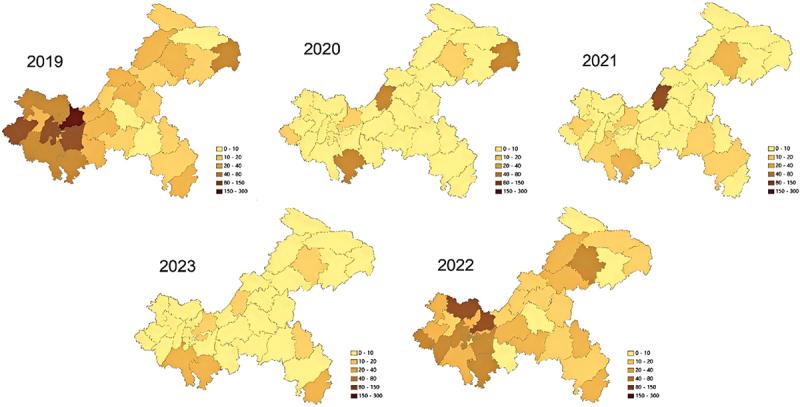
To analyze the epidemiological characteristics and influencing factors of pertussis in children under five years in Chongqing from 2019 to 2023, providing scientific evidence for further prevention and control. The epidemiological characteristics of pertussis cases in children under five years and vaccination history with pertussis-containing vaccines were described, and the influencing factors and cumulative risk of disease onset after vaccination were analyzed using the Cox proportional hazards regression model. From 2019 to 2023, a total of 4,135 pertussis cases were reported in children under five years in Chongqing, with cases occurring predominantly between April and August. Infants under 1 year accounted for the highest proportion of cases at 66.82% (2,763/4,135); the annual reported incidence was higher in boys (141.26/100,000) than in girls (122.09/100,000). Over half of the cases, 59.78% (2,472/4,135) had received at least one dose of a pertussis-containing vaccine, and there were significant differences in vaccination history among different age groups (χ = 483.248, < .01). Cox's regression analysis indicated that the total number of doses received ( < .01) was an influencing factor for the interval between vaccination and disease onset. The hazard ratios (HRs) for three doses, two doses, and one dose were 0.182 (95% CI: 0.138-0.241), 0.485 (95% CI: 0.359-0.654), and 0.315 (95% CI: 0.233-0.425). Young children, including infants and preschool-aged children, were still a high-risk group for pertussis infection in Chongqing. It is recommended to administer an additional dose of Diphtheria-Tetanus-Pertussis vaccine (DTaP) vaccine to preschool children aged four to six in China.
分析2019年至2023年重庆市5岁以下儿童百日咳的流行病学特征及影响因素,为进一步防控提供科学依据。描述了5岁以下儿童百日咳病例的流行病学特征及含百日咳疫苗的接种史,并采用Cox比例风险回归模型分析了影响因素及接种后发病的累积风险。2019年至2023年,重庆市共报告5岁以下儿童百日咳病例4135例,病例主要发生在4月至8月。1岁以下婴儿病例占比最高,为66.82%(2763/4135);男孩的年报告发病率(141.26/10万)高于女孩(122.09/10万)。超过半数的病例,即59.78%(2472/4135)至少接种过一剂含百日咳疫苗,不同年龄组的接种史存在显著差异(χ = 483.248,P <.01)。Cox回归分析表明,接种总剂次数(P <.01)是影响接种与发病间隔的因素。三剂、两剂和一剂的风险比(HR)分别为0.182(95%CI:0.138 - 0.241)、0.485(95%CI:0.359 - 0.654)和0.315(95%CI:0.233 - 0.425)。包括婴儿和学龄前儿童在内的幼儿仍是重庆百日咳感染的高危人群。建议在中国对4至6岁的学龄前儿童额外接种一剂白喉 - 破伤风 - 百日咳疫苗(DTaP)。


 Zotero 插件