
随机免疫治疗研究中缓解率与生存获益之间的关系
The Relationship Between Response Rate and Survival Benefits in Randomized Immunotherapy Studies.
作者信息
Jain Aditi, Stebbing Justin
机构信息
Edinburgh Medical School, Biomedical Sciences, The University of Edinburgh, Edinburgh EH8 9YL, UK.
School of Life Sciences, Anglia Ruskin University, Cambridge CB1 1PT, UK.
出版信息
Cancers (Basel). 2025 Feb 2;17(3):495. doi: 10.3390/cancers17030495.
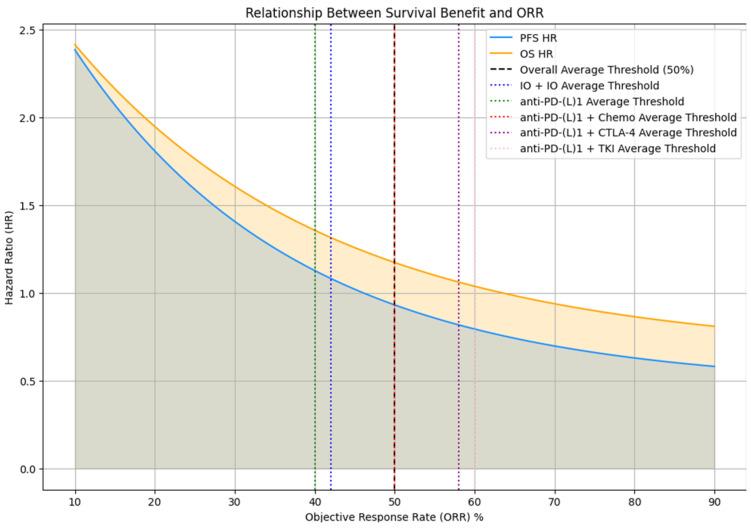
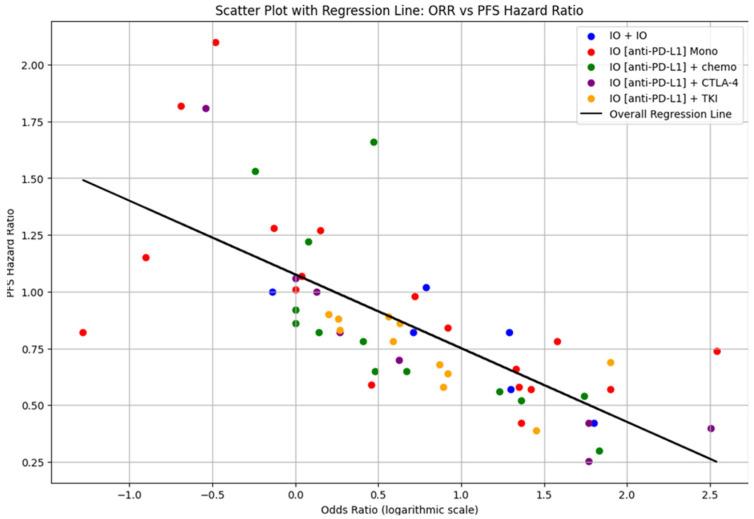
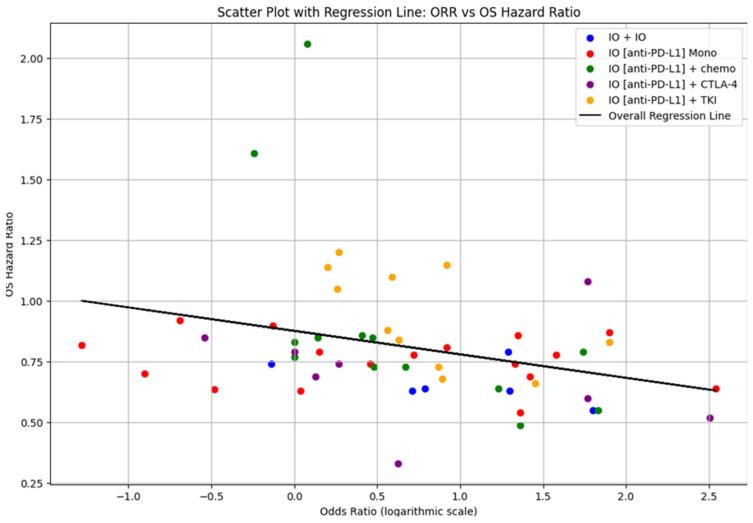
Understanding the relationship between the Objective Response Rate (ORR) and survival outcomes, notably Progression-Free Survival (PFS) and Overall Survival (OS), is relevant for assessing the efficacy of regimens in oncology. We evaluate the relationship between ORR, PFS and OS in immuno-oncology (IO) trials. Data from 68 clinical trials submitted to the FDA were evaluated, examining immunotherapy regimens, notably immune checkpoint inhibitors such as anti-programmed death (ligand)-1 [anti-PD-(L)1], cytotoxic T-lymphocyte-associated protein-4 (CTLA-4) inhibitors and combination therapies [e.g., IO + IO, anti-PD-L1 + chemotherapy, anti-PD-L1 + CTLA-4, anti-PD-L1 + TKI (tyrosine kinase inhibitors)]. Studies were included based on their reporting of ORR, PFS, and OS. Of the 68 clinical trials reviewed, 55 were included in the analysis. The correlation between ORR and PFS was moderate across most immunotherapy regimens, indicating that ORR can serve as a useful predictor of short-term disease control. However, the correlation between ORR and OS was weaker, especially in trials including combination therapies, indicating that ORR alone may not reliably predict long-term survival outcomes. ORR predicts PFS better in first-line treatment but declines in later lines and remains a weak OS predictor overall. Differing degrees of correlation between ORR and survival metrics, particularly across treatment lines and combinations, are observed. While ORR can serve as a surrogate marker for PFS in IO trials, its utility in predicting OS is restricted and the interpretation of the relationship between ORR and PFS or OS is a key limitation. Rather, a decline in PFS with increasing ORR may reflect trial differences rather than a direct relationship. Future analyses should adopt better methodologies to capture these dynamics and focus on improving surrogate endpoints for immunotherapy to improve clinical trial design and patient outcomes.
了解客观缓解率(ORR)与生存结果之间的关系,尤其是无进展生存期(PFS)和总生存期(OS),对于评估肿瘤学治疗方案的疗效具有重要意义。我们评估了免疫肿瘤学(IO)试验中ORR、PFS和OS之间的关系。对提交给美国食品药品监督管理局(FDA)的68项临床试验数据进行了评估,研究了免疫治疗方案,尤其是免疫检查点抑制剂,如抗程序性死亡(配体)-1[抗PD-(L)1]、细胞毒性T淋巴细胞相关蛋白4(CTLA-4)抑制剂以及联合治疗方案[例如,IO+IO、抗PD-L1+化疗、抗PD-L1+CTLA-4、抗PD-L1+酪氨酸激酶抑制剂(TKI)]。纳入的研究需报告ORR、PFS和OS。在审查的68项临床试验中,有55项纳入了分析。在大多数免疫治疗方案中,ORR与PFS之间的相关性为中等,这表明ORR可作为短期疾病控制的有用预测指标。然而,ORR与OS之间的相关性较弱,尤其是在包括联合治疗方案的试验中,这表明仅ORR可能无法可靠地预测长期生存结果。ORR在一线治疗中对PFS的预测较好,但在后续治疗线中预测能力下降,总体上对OS的预测能力仍然较弱。观察到ORR与生存指标之间存在不同程度的相关性,尤其是在不同治疗线和联合治疗方案之间。虽然在IO试验中ORR可作为PFS的替代标志物,但其在预测OS方面的效用有限,且ORR与PFS或OS之间关系的解释是一个关键限制因素。相反,随着ORR升高PFS下降可能反映的是试验差异而非直接关系。未来的分析应采用更好的方法来捕捉这些动态变化,并专注于改善免疫治疗的替代终点,以改进临床试验设计和患者预后。

 Zotero 插件