
墨西哥五岁以下儿童发育迟缓的社会经济预测因素:通过XGB模型的综合方法
Social and economic predictors of under-five stunting in Mexico: a comprehensive approach through the XGB model.
作者信息
Fogarty Brian, García-Martínez Angélica, Chawla Nitesh V, Serván-Mori Edson
机构信息
Lucy Family Institute for Data & Society, University of Notre Dame, South Bend, Indiana, USA.
Centre for Health Systems Research, the National Institute of Public Health, Cuernavaca, Morelos, Mexico.
出版信息
J Glob Health. 2025 Mar 14;15:04065. doi: 10.7189/jogh.15.04065.
BACKGROUND
The multifaceted issue of childhood stunting in low- and middle-income countries has a profound and enduring impact on children's well-being, cognitive development, and future earning potential. Childhood stunting arises from a complex interplay of genetic, environmental, and socio-cultural factors. It requires a comprehensive approach across nutrition, education, healthcare, and poverty reduction sectors to mitigate its prevalence and short- and long-term effects. The Mexican case presents a distinct challenge, as the country has experienced the recent dissolution of social health security programmes, rising poverty rates, and reduced government expenditures for childhood well-being.
METHODS
We propose a machine learning approach to understand the contribution of social and economic determinants to childhood stunting risk in Mexico. Using data from the 2006-2018 population-based Mexican National Health and Nutrition Surveys, six different machine learning classification algorithms were used to model and identify the most important predictors of childhood stunting.
FINDINGS
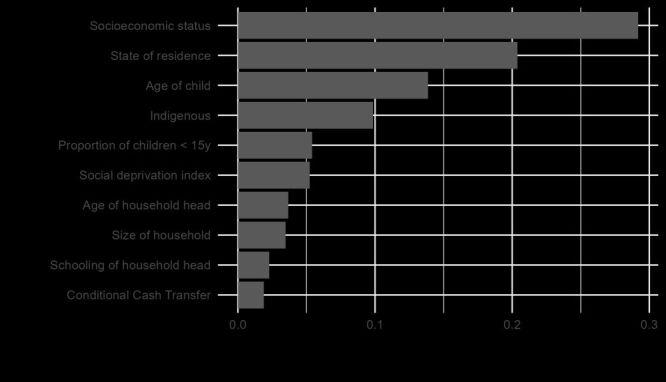
Among the six classification algorithms tested, Extreme Gradient Boosting (XGB) obtained the highest Youden Index value, effectively balancing the correct classification of children with and without stunting. In the XGB model, the most important predictor for classifying childhood stunting is the household's socioeconomic status, followed by the state of residence, the child's age, indigenous population status, the household's portion of children under five years old, and the local area's deprivation level.
CONCLUSIONS
This paper contributes to understanding the structural determinants of stunting in children, emphasising the importance of implementing tailored interventions and policies, especially given our findings that highlight indigenous status and local deprivation as key predictors. In the context of diminishing health initiatives, this underscores the urgent need for specific, targeted, and sustainable actions to prevent and address a potential rise in stunting in similar settings.
KEYWORDS
social and economic deprivation, stunting, children, machine learning, XGB model, Mexico.
背景
低收入和中等收入国家儿童发育迟缓这一复杂问题对儿童的福祉、认知发展以及未来的收入潜力有着深远且持久的影响。儿童发育迟缓源于遗传、环境和社会文化因素的复杂相互作用。减轻其流行程度以及短期和长期影响需要在营养、教育、医疗保健和减贫等部门采取综合方法。墨西哥的情况带来了独特的挑战,因为该国近期经历了社会健康保障计划的解体、贫困率上升以及政府用于儿童福祉的支出减少。
方法
我们提出一种机器学习方法,以了解社会和经济决定因素对墨西哥儿童发育迟缓风险的影响。利用2006 - 2018年基于人群的墨西哥国家健康与营养调查数据,使用六种不同的机器学习分类算法对儿童发育迟缓的最重要预测因素进行建模和识别。
结果
在测试的六种分类算法中,极端梯度提升(XGB)获得了最高的约登指数值,有效地平衡了发育迟缓和未发育迟缓儿童的正确分类。在XGB模型中,分类儿童发育迟缓的最重要预测因素是家庭的社会经济地位,其次是居住州、儿童年龄、原住民身份、家庭中五岁以下儿童的比例以及当地的贫困水平。
结论
本文有助于理解儿童发育迟缓的结构决定因素,强调实施量身定制的干预措施和政策的重要性,特别是鉴于我们的研究结果突出了原住民身份和当地贫困是关键预测因素。在健康举措减少的背景下,这凸显了采取具体、有针对性和可持续行动以预防和应对类似环境中发育迟缓潜在增加的迫切需求。
关键词
社会和经济剥夺;发育迟缓;儿童;机器学习;XGB模型;墨西哥
 Zotero 插件