
超越适应性免疫:训练有素的先天免疫反应作为肝细胞癌治疗的新前沿
Beyond Adaptive Immunity: Trained Innate Immune Responses as a Novel Frontier in Hepatocellular Carcinoma Therapy.
作者信息
Hsieh Ching-Hua, Chuang Pei-Chin, Liu Yueh-Wei
机构信息
Department of Plastic Surgery, Kaohsiung Chang Gung Memorial Hospital and Chang Gung University College of Medicine, Kaohsiung 83301, Taiwan.
Department of Medical Research, Kaohsiung Chang Gung Memorial Hospital, Kaohsiung 83301, Taiwan.
出版信息
Cancers (Basel). 2025 Apr 7;17(7):1250. doi: 10.3390/cancers17071250.
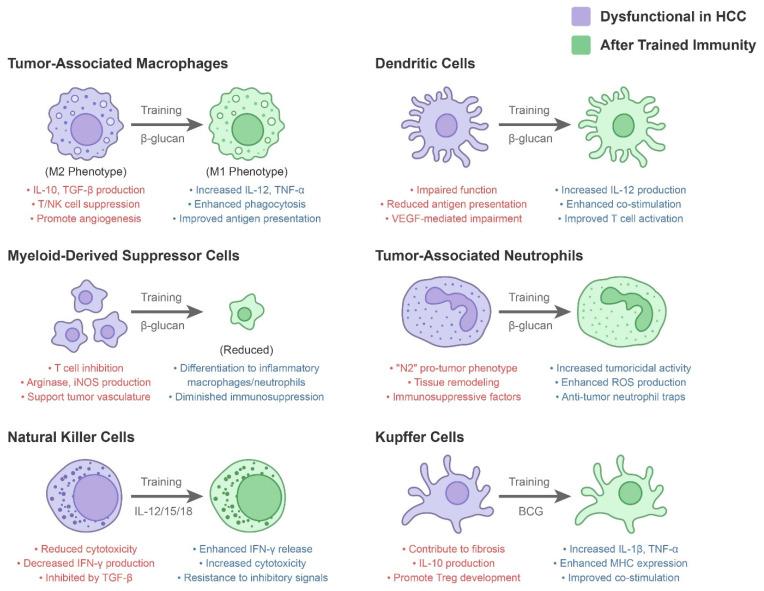
Hepatocellular carcinoma (HCC) is a leading cause of cancer death globally, with the majority of cases detected at advanced stages when curative options are limited. Current systemic therapies, including immune checkpoint inhibitors, demonstrate limited efficacy with durable responses in only 15-20% of patients. This poor response is largely attributed to HCC's immunosuppressive microenvironment, which blunts effective T-cell responses. By illustrating that innate immune cells can acquire memory-like characteristics through a process known as trained immunity, recent evidence has challenged the conventional belief that innate immunity is devoid of memory. This review investigates the potential of trained immunity, which is defined by the long-term functional reprogramming of innate immune cells through epigenetic, transcriptomic, and metabolic changes, to provide new therapeutic opportunities for HCC. We discuss mechanisms by which trained immunity can transform the HCC microenvironment, including enhanced inflammatory cytokine production, repolarization of tumor-associated macrophages toward anti-tumor phenotypes, increased immune cell infiltration, and improved bridging to adaptive immunity. We further evaluate emerging therapeutic strategies leveraging trained immunity principles, including BCG vaccination, β-glucan administration, cytokine-trained NK cell therapy, and innovative combination approaches. Finally, we address potential resistance mechanisms and future directions for clinical application. By integrating trained immunity into conventional immunotherapeutic regimens, we may significantly improve outcomes for HCC patients, potentially transforming advanced disease into a more manageable condition.
肝细胞癌(HCC)是全球癌症死亡的主要原因之一,大多数病例在晚期被检测到,此时治愈选择有限。目前的全身治疗方法,包括免疫检查点抑制剂,疗效有限,只有15%至20%的患者能产生持久反应。这种不良反应很大程度上归因于HCC的免疫抑制微环境,它削弱了有效的T细胞反应。最近的证据表明,先天免疫细胞可以通过一种称为训练免疫的过程获得记忆样特征,这一发现挑战了传统观念,即先天免疫没有记忆。本综述探讨了训练免疫的潜力,即通过表观遗传、转录组和代谢变化对先天免疫细胞进行长期功能重编程,为HCC提供新的治疗机会。我们讨论了训练免疫改变HCC微环境的机制,包括增强炎性细胞因子的产生、将肿瘤相关巨噬细胞重新极化至抗肿瘤表型、增加免疫细胞浸润以及改善与适应性免疫的衔接。我们进一步评估了利用训练免疫原理的新兴治疗策略,包括卡介苗接种、β-葡聚糖给药、细胞因子训练的自然杀伤细胞疗法以及创新的联合方法。最后,我们探讨了潜在的耐药机制和临床应用的未来方向。通过将训练免疫整合到传统免疫治疗方案中,我们可能显著改善HCC患者的治疗效果,有可能将晚期疾病转变为更易管理的状态。
 Zotero 插件