
靶向高度保守的严重急性呼吸综合征冠状病毒2(SARS-CoV-2)开放阅读框3a(ORF3a)胞外域的新型疫苗在小鼠模型中引发免疫原性。
Novel Vaccines Targeting the Highly Conserved SARS-CoV-2 ORF3a Ectodomain Elicit Immunogenicity in Mouse Models.
作者信息
Meza Jacob, Glass Elizabeth, Sandhu Avinaash K, Li Yangchen, Karanika Styliani, Fessler Kaitlyn, Hui Yinan, Schill Courtney, Wang Tianyin, Zhang Jiaqi, Bates Rowan E, Taylor Alannah D, Kapoor Aakanksha R, Ayeh Samuel K, Karakousis Petros C, Markham Richard B, Gordy James T
机构信息
Department of Molecular Microbiology and Immunology, Johns Hopkins Bloomberg School of Public Health, Baltimore, MD 21205, USA.
Center for Tuberculosis Research, Division of Infectious Diseases, Department of Medicine, Johns Hopkins University School of Medicine, Baltimore, MD 21287, USA.
出版信息
Vaccines (Basel). 2025 Feb 22;13(3):220. doi: 10.3390/vaccines13030220.
BACKGROUND
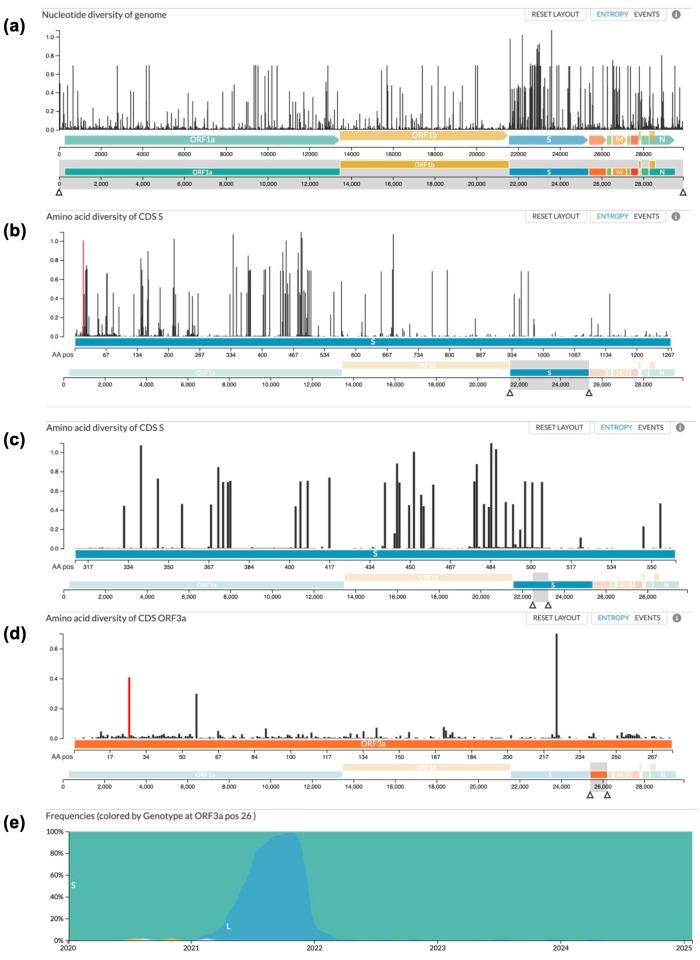
The majority of antigen-based SARS-CoV-2 (SCV2) vaccines utilized in the clinic have had the Spike protein or domains thereof as the immunogen. While the Spike protein is highly immunogenic, it is also subject to genetic drift over time, which has led to a series of variants of concern that continue to evolve, requiring yearly updates to the vaccine formulations. In this study, we investigate the potential of the N-terminal ectodomain of the ORF3a protein encoded by the gene of SCV2 to be an evolution-resistant vaccine antigen. This domain is highly conserved over time, and, unlike many other SCV2 conserved proteins, it is present on the exterior of the virion, making it accessible to antibodies. ORF3a is also important for eliciting robust anti-SARS-CoV-2 T-cell responses.
METHODS
We designed a DNA vaccine by fusing the N-terminal ectodomain of to (MIP3α), which is a chemokine utilized in our laboratory that enhances vaccine immunogenicity by targeting an antigen to its receptor CCR6 present on immature dendritic cells. The DNA vaccine was tested in mouse immunogenicity studies, vaccinating by intramuscular (IM) electroporation and by intranasal (IN) with CpG adjuvant administrations. We also tested a peptide vaccine fusing amino acids 15-28 of the ectodomain to immunogenic carrier protein KLH, adjuvanted with Addavax.
RESULTS
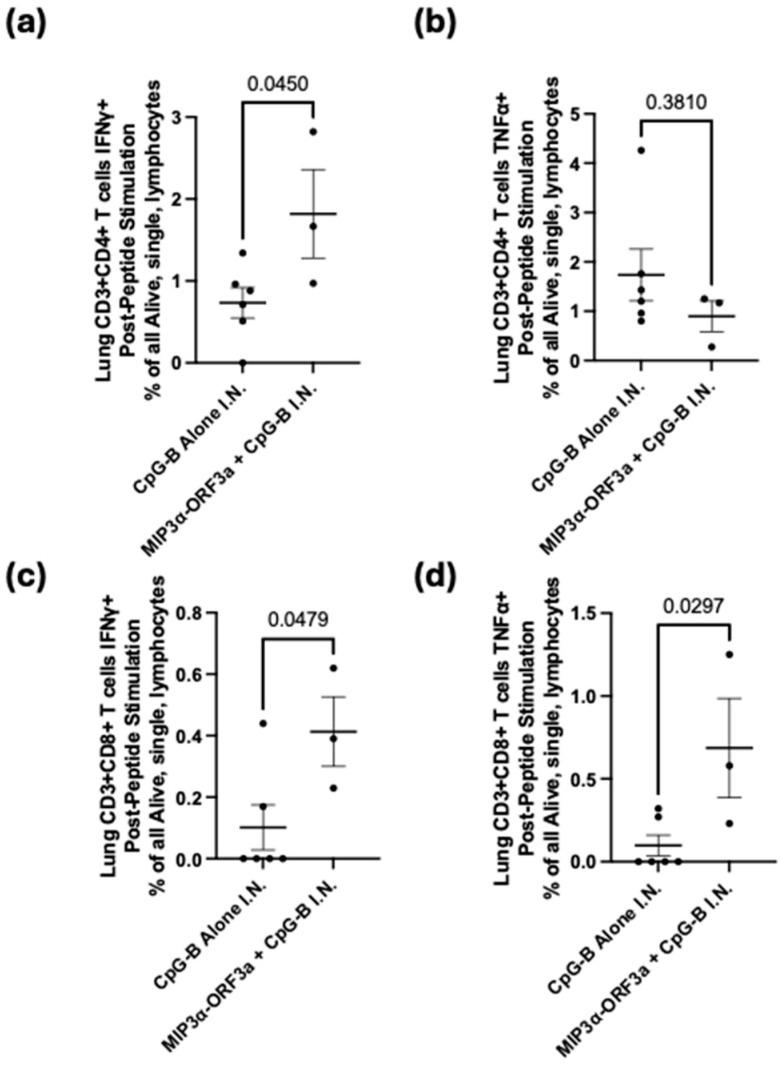
The DNA IM route was able to induce 3a-specific splenic T-cell responses, showing proof of principle that the region can be immunogenic. The DNA IN route further showed that we could induce ORF3a-specific T-cell responses in the lung, which are critical for potential disease mitigation. The peptide vaccine elicited a robust anti-ORF3a antibody response systemically, as well as in the mucosa of the lungs and sinus cavity.
CONCLUSIONS
These studies collectively show that this evolutionarily stable region can be targeted by vaccination strategies, and future work will test if these vaccines, alone or in combination, can result in reduced disease burden in animal challenge models.
背景
临床上使用的大多数基于抗原的严重急性呼吸综合征冠状病毒2(SCV2)疫苗都以刺突蛋白或其结构域作为免疫原。虽然刺突蛋白具有高度免疫原性,但随着时间的推移它也会发生基因漂移,这导致了一系列令人担忧的变异株不断演变,需要每年更新疫苗配方。在本研究中,我们调查了SCV2基因编码的ORF3a蛋白的N端胞外结构域作为抗进化疫苗抗原的潜力。该结构域随着时间的推移高度保守,并且与许多其他SCV2保守蛋白不同,它存在于病毒粒子的外部,可被抗体识别。ORF3a对于引发强大的抗SARS-CoV-2 T细胞反应也很重要。
方法
我们通过将的N端胞外结构域与(MIP3α)融合设计了一种DNA疫苗,(MIP3α)是我们实验室使用的一种趋化因子,通过将抗原靶向未成熟树突细胞上的受体CCR6来增强疫苗免疫原性。该DNA疫苗在小鼠免疫原性研究中进行了测试,通过肌肉内(IM)电穿孔和鼻内(IN)给予CpG佐剂进行接种。我们还测试了一种将胞外结构域的15 - 28位氨基酸与免疫原性载体蛋白KLH融合的肽疫苗,并使用Addavax作为佐剂。
结果
DNA肌肉内接种途径能够诱导3a特异性脾T细胞反应,证明该区域具有免疫原性。DNA鼻内接种途径进一步表明,我们可以在肺部诱导ORF3a特异性T细胞反应,这对于潜在的疾病缓解至关重要。该肽疫苗在全身以及肺和鼻窦腔黏膜中引发了强大的抗ORF3a抗体反应。
结论
这些研究共同表明,这种进化稳定区域可以成为疫苗接种策略的靶点,未来的工作将测试这些疫苗单独或联合使用是否能减轻动物攻毒模型中的疾病负担。



 Zotero 插件