
肠道微生物群将肥胖与2型糖尿病联系起来:孟德尔随机化研究的见解
Gut microbiome links obesity to type 2 diabetes: insights from Mendelian randomization.
作者信息
Fu Li, Baranova Ancha, Cao Hongbao, Zhang Fuquan
机构信息
Department of Psychiatry, The Affiliated Brain Hospital of Nanjing Medical University, Nanjing, 210029, Jiangsu, China.
School of Systems Biology, George Mason University, Manassas, VA, 20110, USA.
出版信息
BMC Microbiol. 2025 Apr 27;25(1):253. doi: 10.1186/s12866-025-03968-8.
BACKGROUND
Research has established links between the gut microbiome (GM) and both obesity and type 2 diabetes (T2D), which is much discussed, but underexplored. This study employed body mass index (BMI) as the measurement of obesity to delve deeper into the correlations from a genetic perspective.
METHODS
We performed the Mendelian randomization (MR) analysis to examine the causal effects of GM on T2D and BMI, and vice versa. Genome-wide association study (GWAS) summary datasets were utilized for the analysis, including T2D (N = 933,970), BMI (N = 806,834), and two GM datasets from the international consortium MiBioGen (211 taxa, N = 18,340) and the Dutch Microbiome Project (DMP) (207 taxa, N = 7,738). These datasets mainly cover European populations, with additional cohorts from Asia and other regions. To further explore the potential mediating role of GM in the connections between BMI and T2D, their interaction patterns were summarized into a network.
RESULTS
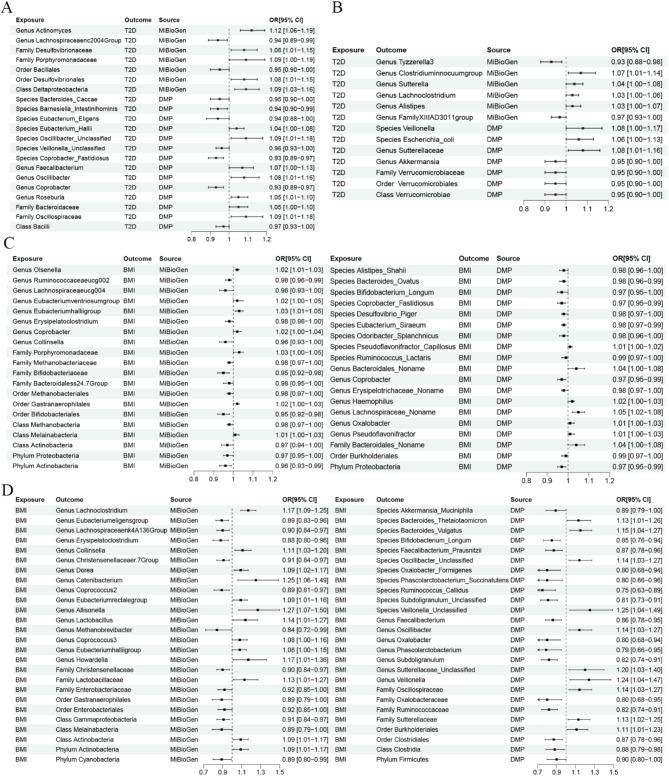
MR analysis identified 9 taxa that showed protective properties against T2D. Seven species were within the Firmicutes and Bacteroidales phyla in the DMP, and two were from the MiBioGen (Odds Ratio (OR): 0.94-0.95). Conversely, genetic components contributing to the abundance of 12 taxa were associated with increased risks of T2D (OR: 1.04-1.12). Furthermore, T2D may elevate the abundance of seven taxa (OR: 1.03-1.08) and reduce the abundance of six taxa (OR: 0.93-0.97). In the analysis of the influence of the genetic component of BMI on GM composition, BMI affected 52 bacterial taxa, with 28 decreasing (OR: 0.75-0.92) and 24 increasing (OR: 1.08-1.27). Besides, abundances of 25 taxa were negatively correlated with BMI (OR: 0.95-0.99), while positive correlations were detected for 14 taxa (OR: 1.01-1.05). Notably, we uncovered 11 taxa genetically associated with both BMI and T2D, which formed an interactive network.
CONCLUSIONS
Our findings provide evidence for the GM-mediated links between obesity and T2D. The identification of relevant GM taxa offers valuable insights into the potential role of the microbiome in these diseases.
背景
研究已证实肠道微生物群(GM)与肥胖症和2型糖尿病(T2D)之间存在联系,这一话题虽备受讨论,但仍未得到充分探索。本研究采用体重指数(BMI)作为肥胖症的衡量指标,从基因角度更深入地探究两者之间的相关性。
方法
我们进行了孟德尔随机化(MR)分析,以检验GM对T2D和BMI的因果效应,反之亦然。利用全基因组关联研究(GWAS)汇总数据集进行分析,包括T2D(N = 933,970)、BMI(N = 806,834),以及来自国际财团MiBioGen(211个分类单元,N = 18,340)和荷兰微生物组计划(DMP)(207个分类单元,N = 7,738)的两个GM数据集。这些数据集主要涵盖欧洲人群,还有来自亚洲和其他地区的额外队列。为了进一步探究GM在BMI与T2D之间联系中的潜在中介作用,将它们的相互作用模式总结成一个网络。
结果
MR分析确定了9个对T2D具有保护作用的分类单元。7个物种属于DMP中的厚壁菌门和拟杆菌目,2个来自MiBioGen(优势比(OR):0.94 - 0.95)。相反,导致12个分类单元丰度增加的遗传成分与T2D风险增加相关(OR:1.04 - 1.12)。此外,T2D可能会提高7个分类单元的丰度(OR:1.03 - 1.08),并降低6个分类单元的丰度(OR:0.93 - 0.97)。在分析BMI的遗传成分对GM组成的影响时,BMI影响了52个细菌分类单元,其中28个减少(OR:0.75 - 0.92),24个增加(OR:1.08 - 1.27)。此外,25个分类单元的丰度与BMI呈负相关(OR:0.95 - 0.99),而14个分类单元呈正相关(OR:1.01 - 1.05)。值得注意的是,我们发现了11个与BMI和T2D均存在基因关联的分类单元,它们形成了一个相互作用网络。
结论
我们的研究结果为GM介导的肥胖症与T2D之间的联系提供了证据。对相关GM分类单元的识别为微生物群在这些疾病中的潜在作用提供了有价值的见解。


 Zotero 插件