
噬菌体诱导的针对致死性细菌再次感染的保护作用。
Phage-induced protection against lethal bacterial reinfection.
作者信息
Xing Yikun, Hernandez Santos Haroldo J, Qiu Ling, Ritter Samantha R, Zulk Jacob J, Lahowetz Rachel, Patras Kathryn A, Terwilliger Austen L, Maresso Anthony W
机构信息
TAILOR Labs, Baylor College of Medicine, Houston, TX 77030.
Department of Molecular Virology and Microbiology, Baylor College of Medicine, Houston, TX 77030.
出版信息
Proc Natl Acad Sci U S A. 2025 Jun 3;122(22):e2423286122. doi: 10.1073/pnas.2423286122. Epub 2025 May 30.
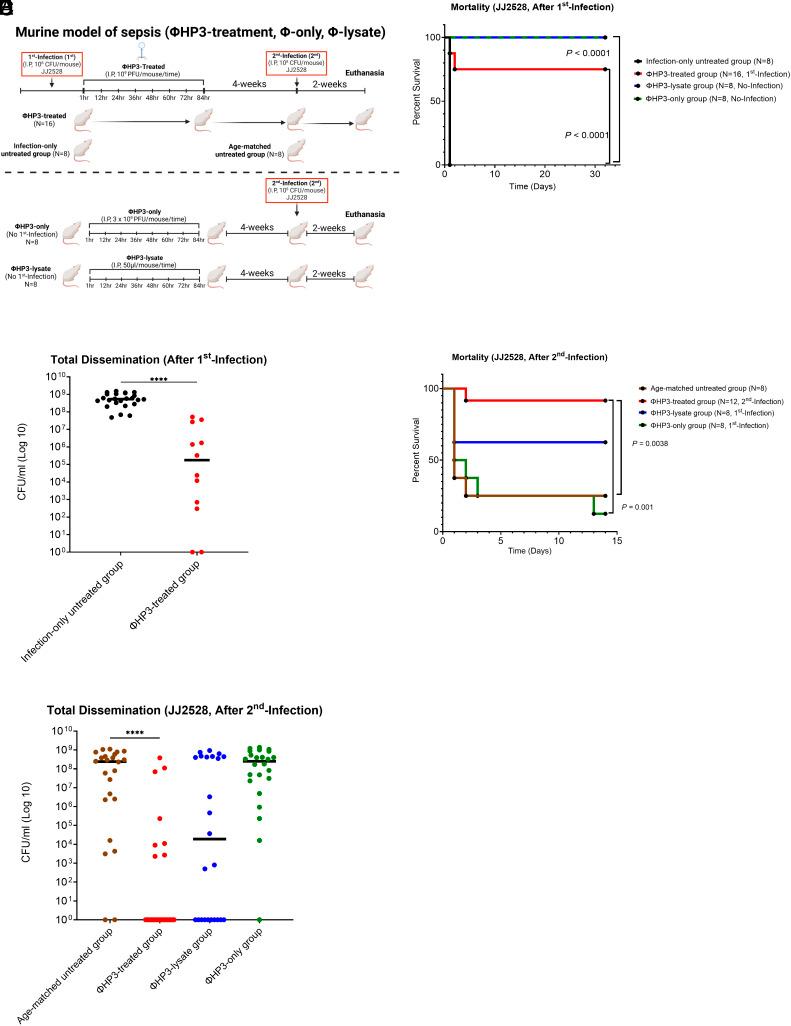
Bacteriophages, or phages, are viruses that target and infect bacteria. Due to a worldwide rise in antimicrobial resistance (AMR), phages have been proposed as a promising alternative to antibiotics for the treatment of resistant bacterial infections. Up to this point in history, phage use in preclinical animal studies, clinical trials, and emergency-use compassionate care cases has centered around the original observation from 1915 showing phage as lytic agent, and thus a treatment that kills bacteria. Here, we describe an activity associated with phage therapy that extends beyond lytic activity that results in long-term protection against reinfection. This activity is potent, providing almost complete protection against a second lethal infection for animals treated with phage therapy. The activity also reduced infection burden an astounding billion-fold over the control. Reinfection protection requires phage lytic killing of its target bacterium but is independent of additional phage therapy. The effect is not driven by phage alone, lingering phage resistors, or a sublethal inoculum. In vitro phage-lysed bacteria provide partial protection, suggesting a combination of phage-induced lytic activity and immune stimulation by phage treatment is responsible for the effect. These observations imply certain phages may induce host adaptive responses following the lysis of the infecting bacteria. This work suggests phage therapy may contain a dual-action effect, an initial treatment efficacy followed by a long-term protection against reoccurring infection, a therapeutic-vaccination mechanism of action.
噬菌体,或称为 phages,是靶向并感染细菌的病毒。由于全球范围内抗菌药物耐药性(AMR)的上升,噬菌体已被提议作为治疗耐药细菌感染的一种有前景的抗生素替代品。在历史的这一阶段,噬菌体在临床前动物研究、临床试验以及紧急使用的同情用药案例中的应用一直围绕着1915年的最初观察结果,即噬菌体作为裂解剂,因此是一种杀死细菌的治疗方法。在此,我们描述了一种与噬菌体疗法相关的活性,这种活性超出了导致对再次感染产生长期保护的裂解活性。这种活性很强,为接受噬菌体疗法治疗的动物提供了几乎完全的保护,使其免受第二次致命感染。这种活性还使感染负担比对照组降低了惊人的十亿倍。再次感染保护需要噬菌体对其靶细菌进行裂解杀伤,但与额外的噬菌体疗法无关。这种效果不是由单独的噬菌体、残留的噬菌体抗性菌或亚致死接种物驱动的。体外被噬菌体裂解的细菌提供了部分保护,这表明噬菌体诱导的裂解活性和噬菌体治疗引起的免疫刺激的结合是造成这种效果的原因。这些观察结果意味着某些噬菌体在感染细菌裂解后可能会诱导宿主的适应性反应。这项工作表明噬菌体疗法可能具有双重作用效果,即最初的治疗效果,随后是对再次感染的长期保护,这是一种治疗性疫苗接种的作用机制。


 Zotero 插件