
行为模式对英国生物银行中加速衰老的影响。
The impact of behavioral patterns on accelerated aging in the UK biobank.
作者信息
Zhou Jinhua, Meng Xin, Wang Fan, Zhong Yun, Zhang Tongtong, Mao Rui, Zhang Hu
机构信息
Department of Critical Care Medicine, The Third People's Hospital of Chengdu, Chengdu, 610031, China.
Department of Dermatology, Xiangya Hospital, Central South University, Changsha, China.
出版信息
Aging Clin Exp Res. 2025 Jun 4;37(1):177. doi: 10.1007/s40520-025-03074-9.
BACKGROUND
Biological Age Acceleration (BAA), as quantified by epigenetic clocks, is a well-established biomarker for mortality and age-related morbidity. This study aimed to investigate the independent and combined associations of sleep duration, sedentary behavior, and physical activity with BAA risk.
METHODS
Leveraging the UK Biobank cohort, we conducted multiple linear regression analyses to assess the relationships between modifiable lifestyle factors and BAA. Nonlinear associations were evaluated using restricted cubic spline models, while causal inference was reinforced through two-sample Mendelian randomization analyses.
RESULTS
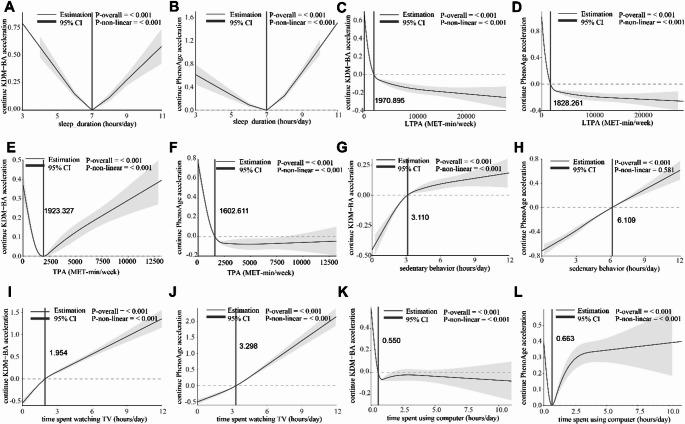
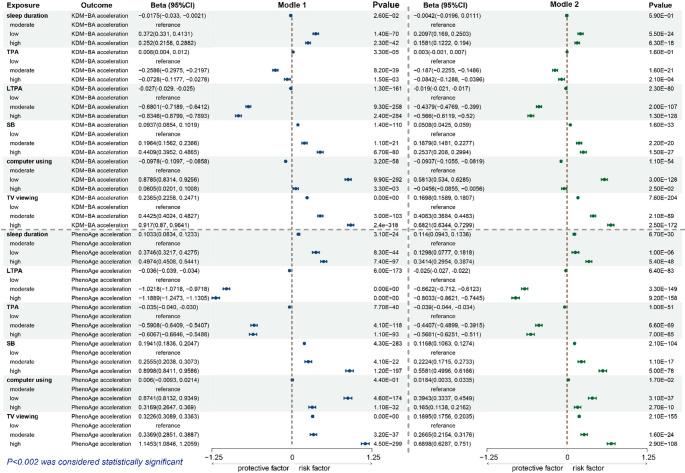
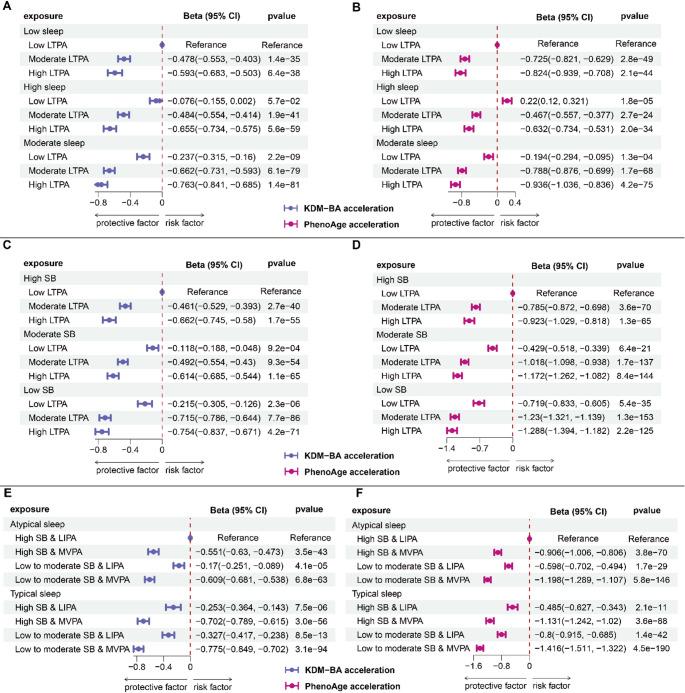
A total of 241,125 participants (mean [SD] age, 55.99 [8.11] years; 124,029 female) were included in this analysis. Distinct non-linear patterns were discernible in the relationship of sedentary behavior, sleep duration, and physical activity with BAA risk. Sleep duration was correlated with BAA in a U-shaped pattern, with an apex of benefit at 7 h nightly. Leisure-time physical activity related to BAA in an L-shaped curve, suggesting limited benefits beyond a threshold of activity. Conversely, sedentary behavior exhibited a linear relationship with BAA, characterized by a progressively escalating risk. Interaction analyses revealed that a combination of 7 h of sleep, moderate-to-high leisure-time physical activity, and minimal sedentary behavior offered substantial protection against BAA (β = -0.775; 95% Confidence Interval, -0.849 to -0.702). These findings were substantiated by subsequent Mendelian randomization analysis.
CONCLUSIONS
Our findings demonstrate that modifiable lifestyle patterns-specifically increased leisure-time physical activity, optimized sleep duration, and reduced sedentary behavior-are significantly associated with attenuated biological aging. These results suggest behavioral modifications may represent viable strategies for decelerating aging.
背景
通过表观遗传时钟量化的生物年龄加速(BAA)是一种公认的死亡率和年龄相关发病率的生物标志物。本研究旨在调查睡眠时间、久坐行为和身体活动与BAA风险的独立关联和联合关联。
方法
利用英国生物银行队列,我们进行了多元线性回归分析,以评估可改变的生活方式因素与BAA之间的关系。使用受限立方样条模型评估非线性关联,同时通过两样本孟德尔随机化分析加强因果推断。
结果
本分析共纳入241,125名参与者(平均[标准差]年龄,55.99[8.11]岁;124,029名女性)。久坐行为、睡眠时间和身体活动与BAA风险的关系呈现出明显的非线性模式。睡眠时间与BAA呈U形相关,每晚7小时时益处最大。休闲时间身体活动与BAA呈L形曲线相关,表明超过一定活动阈值后益处有限。相反,久坐行为与BAA呈线性关系,其特征是风险逐渐增加。交互分析显示,7小时睡眠、中度至高度休闲时间身体活动和最少久坐行为的组合可提供对BAA的显著保护(β = -0.775;95%置信区间,-0.849至-0.702)。随后的孟德尔随机化分析证实了这些发现。
结论
我们的研究结果表明,可改变的生活方式模式——特别是增加休闲时间身体活动、优化睡眠时间和减少久坐行为——与生物衰老的减缓显著相关。这些结果表明,行为改变可能是延缓衰老的可行策略。

 Zotero 插件