
归因于高体重指数的慢性肾脏病的全球负担及流行趋势:来自《2021年全球疾病负担研究》的见解
Global burden and epidemic trends of chronic kidney disease attributable to high body mass index: insights from the Global Burden of Disease Study 2021.
作者信息
Rao Zehui, Wang Kaihong, Zhou Kun, Duan Yuanyuan, Zhang Yida
机构信息
Department of Urology, The First Affiliated Hospital of Nanchang University, Nanchang, Jiangxi, China.
The First Clinical Medical College of Nanchang University, Nanchang, Jiangxi, China.
出版信息
Ren Fail. 2025 Dec;47(1):2512400. doi: 10.1080/0886022X.2025.2512400. Epub 2025 Jun 8.
BACKGROUND
High body mass index (BMI) is associated with an increased risk of chronic kidney disease (CKD). However, studies on the CKD burden due to high BMI are limited.
METHODS
This research uses data from the Global Burden of Disease (GBD) study to analyze the epidemiological characteristics of CKD due to high BMI from 1990 to 2021, including mortality rate and disability-adjusted life years (DALYs). Age-standardized mortality rate (ASMR) and age-standardized DALY rate (ASDR) were calculated, with stratified analyses by sex, age, and socio-demographic index (SDI) regions. The estimated annual percentage change (EAPC) assessed the trends over 32 years, and a Bayesian age-period-cohort (BAPC) model predicted the disease burden for the next 15 years.
RESULTS
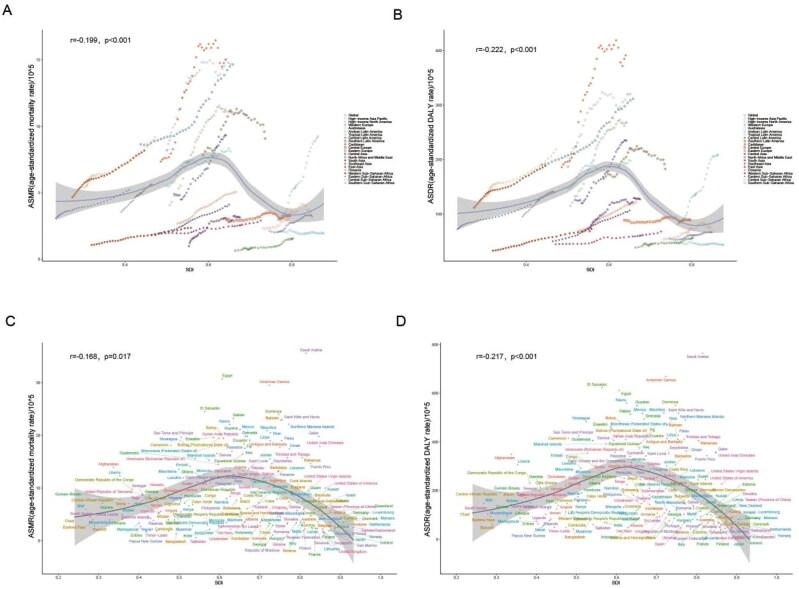
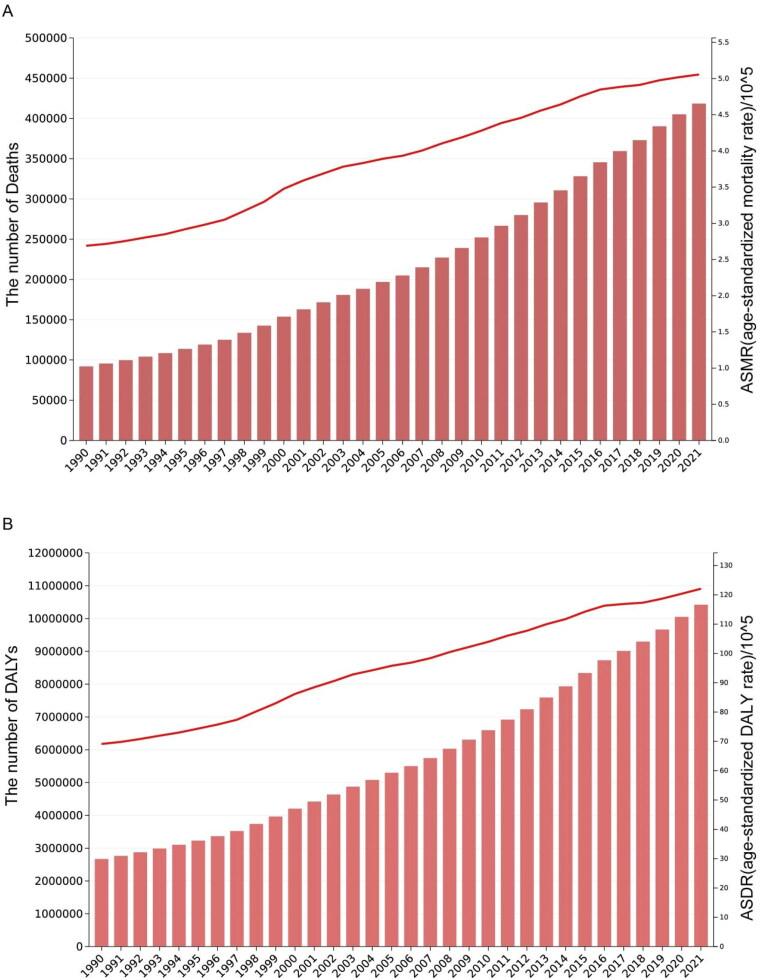
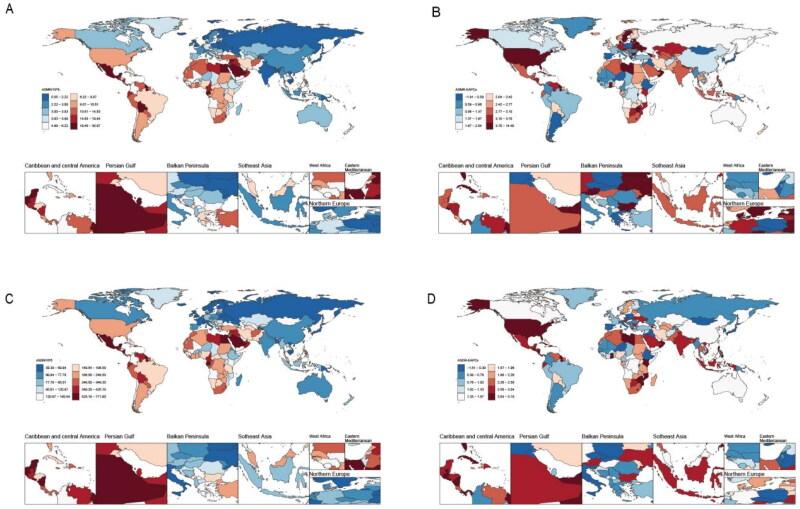
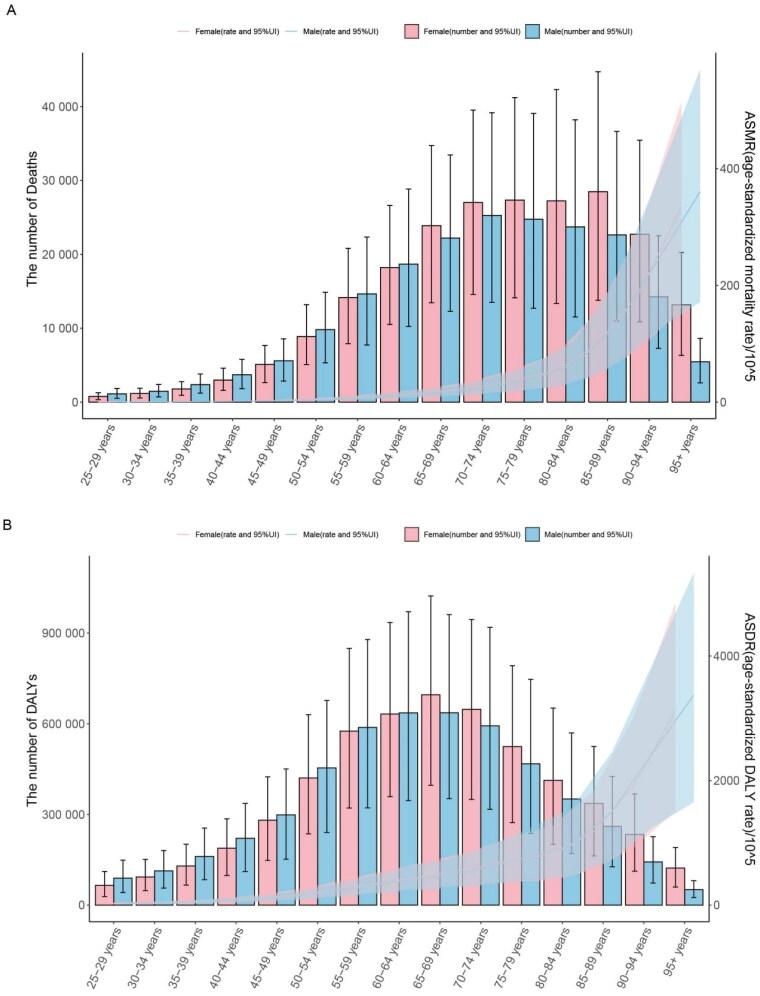
In 2021, the ASMR and ASDR for CKD attributable to high BMI globally were estimated at 5.06 [95% uncertainty interval (UI): 2.70-7.51] and 122.08 (95% UI: 66.25-180.18) per 100,000 population, respectively. Significant variations in these metrics were observed across sex, age groups, and regions. Between 1990 and 2021, both ASMR and ASDR exhibited an upward trajectory, with projections indicating a continued rise through to 2040.
CONCLUSIONS
Our findings indicate that the CKD burden due to high BMI is increasing, with notable disparities across sex, age, and geographic regions. Targeted public health interventions, particularly those focusing on males and older adults, are essential to address this growing health challenge.
背景
高体重指数(BMI)与慢性肾脏病(CKD)风险增加相关。然而,关于高BMI所致CKD负担的研究有限。
方法
本研究使用全球疾病负担(GBD)研究的数据,分析1990年至2021年高BMI所致CKD的流行病学特征,包括死亡率和伤残调整生命年(DALYs)。计算年龄标准化死亡率(ASMR)和年龄标准化DALY率(ASDR),并按性别、年龄和社会人口学指数(SDI)区域进行分层分析。估计年度百分比变化(EAPC)评估32年间的趋势,贝叶斯年龄-时期-队列(BAPC)模型预测未来15年的疾病负担。
结果
2021年,全球高BMI所致CKD的ASMR和ASDR估计分别为每10万人5.06[95%不确定区间(UI):2.70 - 7.51]和每10万人年122.08(95% UI:66.25 - 180.18)。这些指标在性别、年龄组和区域间存在显著差异。1990年至2021年期间,ASMR和ASDR均呈上升趋势,预测显示到2040年仍将持续上升。
结论
我们的研究结果表明,高BMI所致的CKD负担正在增加,在性别、年龄和地理区域方面存在显著差异。针对性的公共卫生干预措施,特别是针对男性和老年人的措施,对于应对这一日益严峻的健康挑战至关重要。
 Zotero 插件