
1990 - 2021年头痛疾病负担的全球趋势与区域差异:全球疾病负担研究的综合分析
Global trends and regional disparities in the burden of headache disorders, 1990-2021: a comprehensive analysis of the global burden of disease study.
作者信息
Rui Yuanyuan, Wu Bing, Li Qian, Zhang Kai
机构信息
Department of Emergency, The First Affiliated Hospital of Wannan Medical College, Wuhu, Anhui, China.
Department of Emergency, The Second People's Hospital of Lu'an City, Luan, Anhui, China.
出版信息
Front Neurol. 2025 Jun 5;16:1575705. doi: 10.3389/fneur.2025.1575705. eCollection 2025.
BACKGROUND
Headache disorders significantly impact health and functioning, yet studies on their global burden across all age groups are limited. This study utilizes data from the Global Burden of Disease (GBD) 2021 to investigate the global burden of headache disorders.
METHODS
This analysis draws on GBD 2021 data, covering 204 countries and territories. We investigated the prevalence, incidence, and DALYs for headache disorders from 1990 to 2021, calculating Estimated Annual Percentage Change (EAPC) to analyze temporal trends. Additionally, decomposition analysis was used to evaluate the contributions of aging, population growth, and epidemiological changes. The slope index of inequality and concentration index were employed to assess inequalities in disease burden.
RESULTS
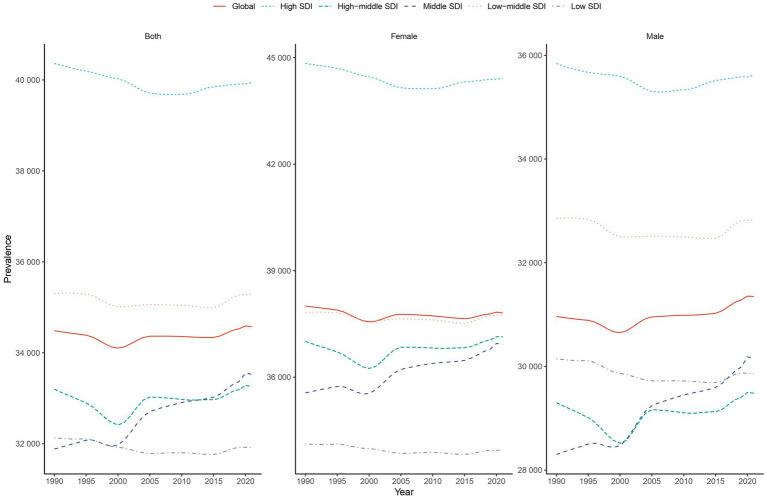
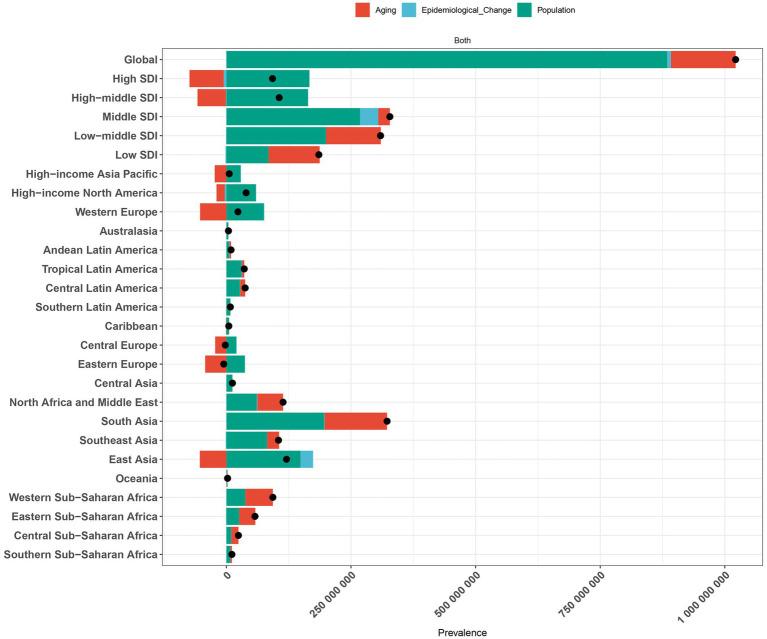
From 1990 to 2021, the global prevalence of headache disorders increased significantly, reaching approximately 2.81 billion cases in 2021, a 57.16% increase from approximately 1.79 billion cases in 1990. During this period, the global Age-Standardized Prevalence Rate (ASPR) and Age-Standardized DALY Rate (ASDR) both showed gradual increases, while the Age-Standardized Incidence Rate (ASIR) remained stable, with EAPC values of 0.01, 0.04 and-0.0002, respectively. High Socio-demographic Index (SDI) regions exhibited the highest rates of ASPR, ASIR, and ASDR, whereas Middle SDI regions experienced the fastest growth, with EAPC values of 0.17, 0.17, and 0.18, respectively. The SDI exhibited significant positive correlations with the EAPC of ASPR ( = 0.18, = 0.0093) and ASIR ( = 0.16, = 0.027). Decomposition analysis identified population growth as the primary driver in regions with increasing disease burden. The slope index of inequality (SII) shows that disparities in ASPR, ASIR, and ASDR slightly increased from 7,648.13, 2,506.76, and 88.45 in 1990 to 7,851.55, 2,557.94, and 100.38 in 2021. In contrast, the concentration index (CI) in 2021 were 0.05, 0.05, and 0.04, showing no significant change from 1990.
CONCLUSION
Headache disorders continue to impose a growing burden globally, with marked regional and socio-economic disparities. Addressing these trends requires targeted public health interventions, particularly in high-burden and low-resource settings.
背景
头痛疾病对健康和功能有重大影响,但针对所有年龄组的全球负担研究有限。本研究利用《2021年全球疾病负担》(GBD 2021)的数据来调查头痛疾病的全球负担。
方法
本分析采用了GBD 2021的数据,涵盖204个国家和地区。我们调查了1990年至2021年头痛疾病的患病率、发病率和伤残调整生命年(DALYs),计算估计年百分比变化(EAPC)以分析时间趋势。此外,采用分解分析来评估老龄化、人口增长和流行病学变化的贡献。利用不平等斜率指数和集中指数来评估疾病负担的不平等情况。
结果
1990年至2021年,全球头痛疾病患病率显著上升,2021年达到约28.1亿例,比1990年的约17.9亿例增加了57.16%。在此期间,全球年龄标准化患病率(ASPR)和年龄标准化伤残调整生命年率(ASDR)均呈逐渐上升趋势,而年龄标准化发病率(ASIR)保持稳定,EAPC值分别为0.01、0.04和 -0.0002。社会人口指数(SDI)高的地区ASPR、ASIR和ASDR率最高,而SDI中等的地区增长最快,EAPC值分别为0.17、0.17和0.18。SDI与ASPR的EAPC( = 0.18, = 0.0093)和ASIR的EAPC( = 0.16, = 0.027)呈显著正相关。分解分析确定人口增长是疾病负担增加地区的主要驱动因素。不平等斜率指数(SII)表明,ASPR、ASIR和ASDR的差距从1990年的7648.13、2506.76和88.45略有增加到2021年的7851.55、2557.94和100.38。相比之下,2021年的集中指数(CI)分别为0.05、0.05和0.04,与1990年相比无显著变化。
结论
头痛疾病在全球范围内造成的负担持续增加,存在明显的地区和社会经济差异。应对这些趋势需要有针对性的公共卫生干预措施,特别是在高负担和资源匮乏地区。



 Zotero 插件