
长新冠中的重度抑郁症与感染严重急性呼吸综合征冠状病毒2期间暴露于促炎细胞因子
Major Depressive Disorder in Long COVID and Exposure to Pro-Inflammatory Cytokines During Infection by SARS-CoV-2.
作者信息
Guillen-Burgos Hernan F, Gálvez-Flórez Juan F, Moreno-López Sergio, Wong Sabrina, Kwan Angela T H, Ramirez-Posada Mariana, Anaya Juan-Manuel, McIntyre Roger S
机构信息
Centro de Investigaciones en Ciencias de la Vida Universidad Simón Bolívar Center for Clinical and Translational Research Barranquilla Colombia.
Faculty of Medicine Universidad El Bosque Center for Clinical and Translational Research Bogotá Colombia.
出版信息
Psychiatr Res Clin Pract. 2025 Mar 27;7(2):139-149. doi: 10.1176/appi.prcp.20240112. eCollection 2025 Summer.
OBJECTIVE
Major Depressive Disorder (MDD) is common in long COVID syndrome; however, the neurobiological mechanisms are unclear. An immune activation response has been associated with COVID-19 severity as well as in MDD. We hypothesize that high levels of pro-inflammatory cytokines during SARS-CoV-2 infection may be associated with new-onset MDD and severe outcomes such as treatment-resistant depression (TRD) and risk of suicide ideation and behavior (SI/SB).
METHODS
A case-control nested to a cohort study was carried out on a total of 678 COVID-19 survivors (MDD = 184 vs. non-MDD = 494). A pro-inflammatory panel of serum levels of cytokines (IL-1β, IL-4, IL-6, IL-8, IL-13, IL-17α, TNF-α) was evaluated during COVID-19 hospitalization and severe outcomes such as TRD and SI/SB were assessed in individuals with new onset of MDD after hospital discharge compared to non-MDD COVID-19 survivors.
RESULTS
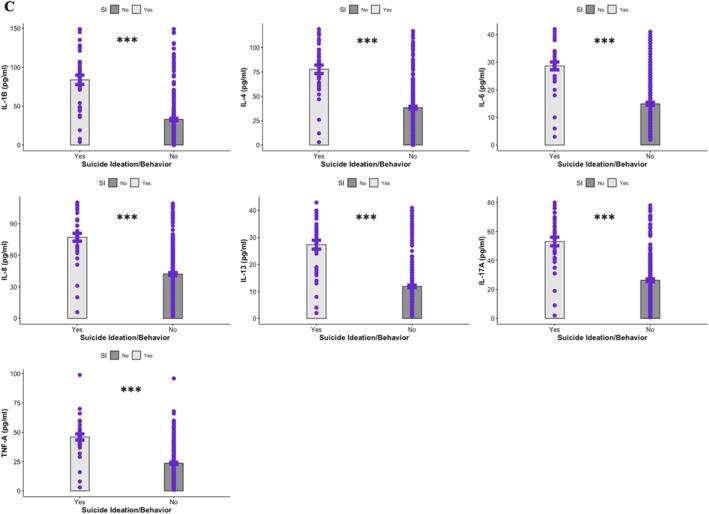
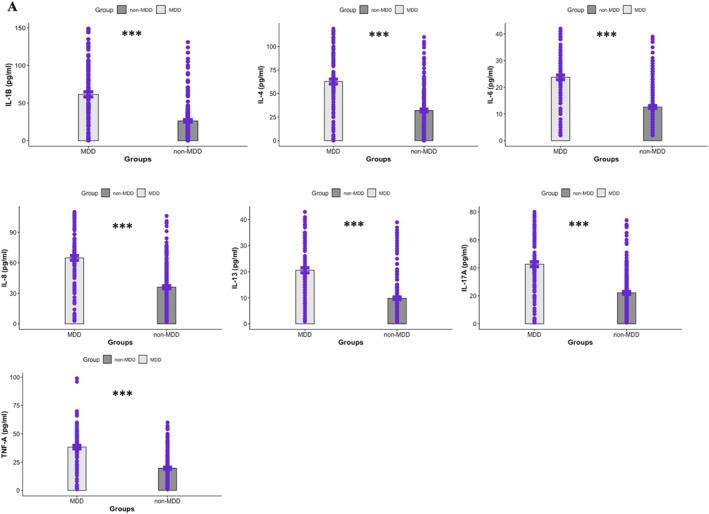
High levels of pro-inflammatory cytokines during SARS-CoV-2 infection were identified in MDD participants compared to non-MDD subgroups during long COVID. These differences were sustained also for TRD and SI/SB severity outcomes. There is a mild association of high levels of pro-inflammatory cytokines and MDD, TRD, and SI/SB.
CONCLUSION
High levels of pro-inflammatory cytokines during severe or critical COVID-19 exposure may explain long COVID associated MDD and thus severe outcomes such as TRD and SI/SB.
RELEVANCE TO CLINICAL PRACTICE
Identifying elevated pro-inflammatory cytokines during COVID-19 as a risk factor for MDD and severe outcomes underscores the need for early screening and targeted treatments in long COVID. Monitoring cytokine levels may help clinicians predict and manage TRD and SI/SB in this population, improving long-term psychiatric outcomes.
目的
重度抑郁症(MDD)在新冠后综合征中很常见;然而,其神经生物学机制尚不清楚。免疫激活反应与新冠病毒疾病(COVID-19)的严重程度以及MDD有关。我们假设,在严重急性呼吸综合征冠状病毒2(SARS-CoV-2)感染期间促炎细胞因子水平升高可能与新发MDD以及难治性抑郁症(TRD)和自杀意念及行为(SI/SB)风险等严重后果相关。
方法
对总共678名COVID-19幸存者进行了一项嵌套于队列研究的病例对照研究(MDD患者 = 184例,非MDD患者 = 494例)。在COVID-19住院期间评估了一组促炎细胞因子(白细胞介素-1β、白细胞介素-4、白细胞介素-6、白细胞介素-8、白细胞介素-13、白细胞介素-17α、肿瘤坏死因子-α)的血清水平,并在出院后新发MDD的个体中评估了TRD和SI/SB等严重后果,与非MDD的COVID-19幸存者进行比较。
结果
与新冠后非MDD亚组相比,MDD参与者在SARS-CoV-2感染期间促炎细胞因子水平较高。这些差异在TRD和SI/SB严重程度结果中也持续存在。促炎细胞因子水平升高与MDD、TRD和SI/SB之间存在轻度关联。
结论
在严重或危重型COVID-19感染期间促炎细胞因子水平升高可能解释了新冠后相关的MDD,以及TRD和SI/SB等严重后果。
与临床实践的相关性
将COVID-19期间促炎细胞因子升高确定为MDD和严重后果的危险因素,凸显了对新冠后患者进行早期筛查和靶向治疗的必要性。监测细胞因子水平可能有助于临床医生预测和管理该人群中的TRD和SI/SB,改善长期精神科预后。


 Zotero 插件