
胰腺腺鳞癌鳞状细胞转化过程中免疫监视功能减弱为癌症拦截提供了新的治疗机会。
Attenuated immune surveillance during squamous cell transformation of pancreatic adenosquamous cancer defines new therapeutic opportunity for cancer interception.
作者信息
Chen Xinyuan, Sun Shanyue, Li Shuofeng, Yu Shuangni, Chen Jie, Chen Xianlong
机构信息
Department of Pathology, Peking Union Medical College Hospital, Beijing, Beijing, China.
Key Laboratory of Research in Pancreatic Tumor, Chinese Academy of Medical Sciences and Peking Union Medical College, Beijing, Beijing, China.
出版信息
J Immunother Cancer. 2025 Jun 23;13(6):e012066. doi: 10.1136/jitc-2025-012066.
BACKGROUND
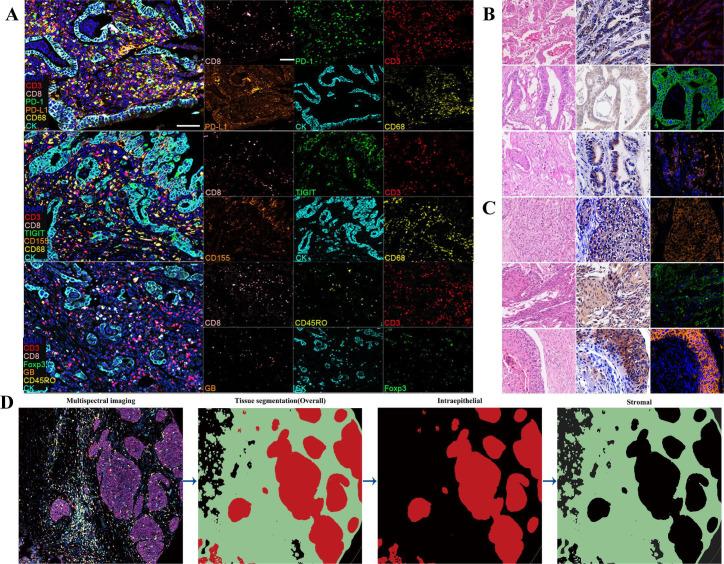
Pancreatic adenosquamous cancer (PASC) is an extremely rare subtype of pancreatic cancer characterized by a poorer prognosis and higher likelihood of metastasis compared with the more prevalent pancreatic ductal adenocarcinoma (PDAC). Although genomic changes during PASC tumorigenesis have been documented, the corresponding alterations in the tumor immune microenvironment (TIME) remain inadequately elucidated. Therefore, this study aims to analyze the immune landscape of PASC by employing multiplex immunohistochemistry (mIHC) and digital image analysis.
METHODS
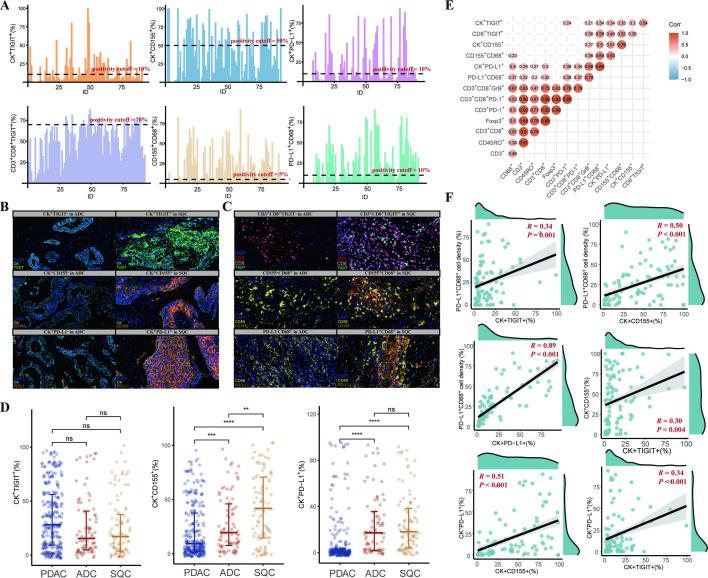
In this study, we analyzed four independent cohorts comprising 120 patients with PASC and 386 patients with PDAC. We employed mIHC to quantify three in situ panels of immuno-oncology-related biomarkers at subcellular resolution. We then used five samples to perform laser capture microdissection, RNA sequencing, and whole-exome sequencing to explore the underlying mechanisms of the compartment-specific immune phenotypes in PASC.
RESULTS
Our findings revealed a more immunosuppressive TIME in PASC compared with PDAC, characterized by a decreased abundance of T cells. Immune cell types indicative of enhanced immune surveillance, including cytotoxic and memory T cells and antigen-experienced T cells, were present at significantly lower densities in PASC compared with PDAC. Conversely, some immunosuppressive macrophage phenotypes exhibited increased distribution in PASC. Immunosuppressive immune cells (ICs) were abundant, enriched within stromal regions, highly heterogeneous across tumors, and exhibited distinct distributions between squamous cell (SQC) and adenocarcinoma (ADC) compartments in PASC. Notably, the TIME of SQC compartments harbored more exhausted T cells compared with synchronous ADC compartments, indicating attenuated immune surveillance during squamous transformation. Transcriptomic profiling of microdissected SQC and ADC regions revealed immune exhaustion signatures and downregulated T-cell differentiation pathways in SQC compartments, alongside altered antigen presentation machinery and elevated tumor mutational burden, suggesting squamous-specific tumor-associated antigens with potential immunotherapeutic relevance. Beyond differences in IC density, we observed closer spatial proximity of CD45RO and PD-1CD3CD8 T cells to tumor cells within 10, 20 and 30 µm ranges in PASC compared with PDAC, with variations by histological subregion. Furthermore, we found distinct expression patterns of the programmed cell death protein-1 (PD-1)/programmed death ligand 1 (PD-L1) and T-cell immunoreceptor with immunoglobulin and the ITIM domain (TIGIT)/CD155 axes in the PASC TIME associated with survival outcomes. Notably, TIGITCD8 T cells and CD155 CD68macrophages, along with their proximity to tumor cells, served as independent prognostic indicators. These findings were validated in an independent cohort study.
CONCLUSION
Our study advances the understanding of PASC by providing updated insights into its immunoenvironmental features. These findings underscore the potential of targeting immune checkpoint pathways, particularly the TIGIT/CD155 and PD-1/PD-L1 axes, as a therapeutic strategy for PASC.
背景
胰腺腺鳞癌(PASC)是一种极其罕见的胰腺癌亚型,与更常见的胰腺导管腺癌(PDAC)相比,其预后较差,转移可能性更高。尽管已记录了PASC肿瘤发生过程中的基因组变化,但肿瘤免疫微环境(TIME)中的相应改变仍未得到充分阐明。因此,本研究旨在通过多重免疫组化(mIHC)和数字图像分析来分析PASC的免疫格局。
方法
在本研究中,我们分析了四个独立队列,包括120例PASC患者和386例PDAC患者。我们采用mIHC在亚细胞分辨率下对三个免疫肿瘤学相关生物标志物的原位面板进行定量。然后,我们使用五个样本进行激光捕获显微切割、RNA测序和全外显子测序,以探索PASC中特定区域免疫表型的潜在机制。
结果
我们的研究结果显示,与PDAC相比,PASC中的TIME具有更强的免疫抑制作用,其特征是T细胞丰度降低。与免疫监视增强相关的免疫细胞类型,包括细胞毒性和记忆T细胞以及抗原经验丰富的T细胞,在PASC中的密度明显低于PDAC。相反,一些免疫抑制性巨噬细胞表型在PASC中的分布增加。免疫抑制性免疫细胞(ICs)丰富,在基质区域富集,肿瘤间高度异质性,并且在PASC的鳞状细胞(SQC)和腺癌(ADC)区域之间表现出不同的分布。值得注意的是,与同步ADC区域相比,SQC区域的TIME中含有更多耗竭的T细胞,表明鳞状化生过程中免疫监视减弱。对显微切割的SQC和ADC区域进行转录组分析,发现SQC区域存在免疫耗竭特征和T细胞分化途径下调,同时抗原呈递机制改变和肿瘤突变负担增加,提示具有潜在免疫治疗相关性的鳞状特异性肿瘤相关抗原。除了IC密度的差异外,我们观察到与PDAC相比,在PASC中,CD45RO和PD-1+CD3+CD8+T细胞在10、20和30μm范围内与肿瘤细胞的空间距离更近,且在组织学亚区域存在差异。此外,我们发现程序性细胞死亡蛋白1(PD-1)/程序性死亡配体1(PD-L1)和具有免疫球蛋白和ITIM结构域的T细胞免疫受体(TIGIT)/CD155轴在PASC的TIME中的不同表达模式与生存结果相关。值得注意的是,TIGIT+CD8+T细胞和CD155+CD68+巨噬细胞及其与肿瘤细胞的接近程度是独立的预后指标。这些发现在一项独立队列研究中得到了验证。
结论
我们的研究通过提供对其免疫环境特征的最新见解,推进了对PASC的理解。这些发现强调了靶向免疫检查点途径,特别是TIGIT/CD155和PD-1/PD-L1轴,作为PASC治疗策略的潜力。



 Zotero 插件