
邻里劣势与神经炎症和神经退行性变的生物标志物之间的横断面和纵向关联
Cross-Sectional and Longitudinal Associations of Neighborhood Disadvantage With Fluid Biomarkers of Neuroinflammation and Neurodegeneration.
作者信息
Gogniat Marissa A, Khan Omair A, Ratangee Brina, Bolton Corey J, Zhang Panpan, Liu Dandan, Pechman Kimberly R, Yates Alexis, Gaynor Leslie S, Eaton James, Peterson Amalia, Gifford Katherine A, Hohman Timothy J, Blennow Kaj, Zetterberg Henrik, Jefferson Angela L
机构信息
Vanderbilt Memory and Alzheimer's Center, Vanderbilt University Medical Center, Nashville, TN.
Department of Neurology, Vanderbilt University Medical Center, Nashville, TN.
出版信息
Neurology. 2025 Jul 22;105(2):e213770. doi: 10.1212/WNL.0000000000213770. Epub 2025 Jun 25.
BACKGROUND AND OBJECTIVES
Living in a socioeconomically disadvantaged neighborhood has an adverse impact on health outcomes, including increased risk of Alzheimer disease (AD). The biological mechanisms underlying this risk are poorly understood. We sought to examine how neighborhood disadvantage relates to core AD pathology, neurodegeneration, and inflammatory biomarkers in community-dwelling older adults cross-sectionally and over time.
METHODS
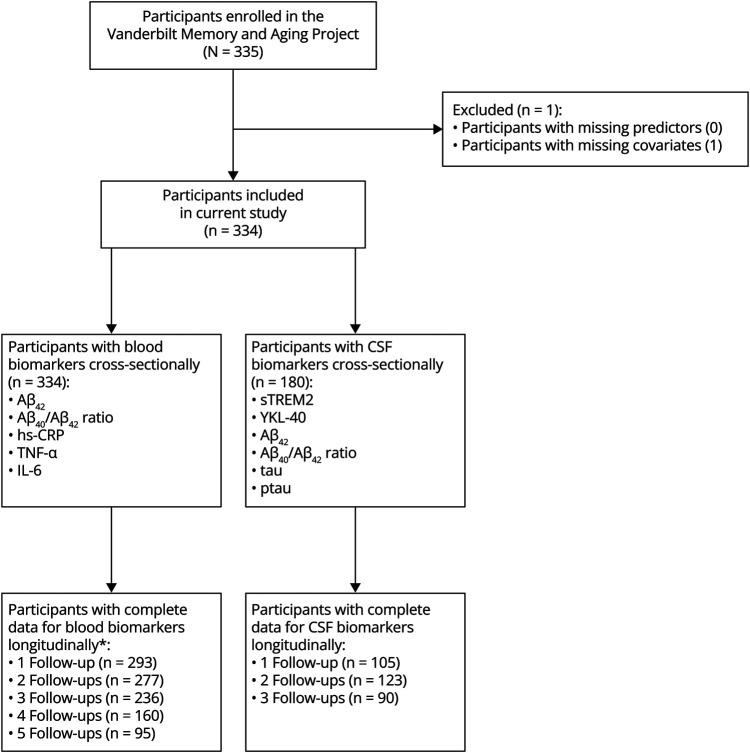
Participants included older adults from the Vanderbilt Memory and Aging Project who underwent fasting blood and CSF acquisition serially over a 9-year follow-up period (mean follow-up = 6.4 years [blood] and 4.0 years [CSF]). Area Deprivation Index (ADI), representing neighborhood disadvantage, was quantified at baseline using 17 components (e.g., housing, income, education, and household characteristics), with higher values indicating greater disadvantage. Ordinary least-squares regressions cross-sectionally related ADI to plasma and CSF inflammatory biomarkers adjusting for age, sex, race/ethnicity, education, modified Framingham Stroke Risk Profile score, ε4 status, and cognitive status. Linear mixed-effects regression models related ADI to longitudinal biomarkers with identical covariates plus follow-up time. Outcomes included CSF chitinase-3-like protein 1 (YKL-40), CSF soluble-triggering receptor expressed on myeloid cells 2, CSF amyloid-β (Aβ), CSF Aβ/Aβ ratio, CSF tau, CSF phosphorylated tau (ptau), plasma high-sensitivity C-reactive protein (CRP), and plasma and CSF neurofilament light chain.
RESULTS
Participants (n = 334; 73 ± 8 years old, 59% male, 86% White, non-Hispanic) on average were from relatively less disadvantaged neighborhoods (ADI national decile = 33 ± 25, range = 1-98). Greater neighborhood disadvantage at study entry was cross-sectionally associated with elevated CSF YKL-40 (β = 0.7, = 0.003) and tau (β = 1.8, = 0.04) after excluding outliers. Greater neighborhood disadvantage at study entry related to faster longitudinal increases in plasma CRP (β = 0.005, = 0.03).
DISCUSSION
Greater neighborhood disadvantage was associated with elevated inflammatory and AD CSF biomarkers cross-sectionally and longitudinal increases in a nonspecific inflammatory blood biomarker. Findings suggest that neighborhood disadvantage confers risk of systemic inflammation and AD pathology, providing a possible sociobiological mechanism underlying health disparities in aging adults; however, results were limited by use of ADI at study entry.
背景与目的
生活在社会经济条件不利的社区对健康结果有不利影响,包括患阿尔茨海默病(AD)的风险增加。这种风险背后的生物学机制尚不清楚。我们试图横断面研究并长期观察社区居住的老年人中社区不利因素与AD核心病理、神经退行性变及炎症生物标志物之间的关系。
方法
参与者包括范德比尔特记忆与衰老项目中的老年人,他们在9年的随访期内(血液平均随访6.4年,脑脊液平均随访4.0年)连续接受空腹血液和脑脊液采集。使用17个成分(如住房、收入、教育和家庭特征)在基线时对代表社区不利因素的地区剥夺指数(ADI)进行量化,值越高表明不利程度越大。采用普通最小二乘法回归,在调整年龄、性别、种族/民族、教育程度、改良的弗雷明汉卒中风险评分、ε4状态和认知状态后,将横断面的ADI与血浆和脑脊液炎症生物标志物进行关联。线性混合效应回归模型将ADI与具有相同协变量加上随访时间的纵向生物标志物进行关联。结果指标包括脑脊液几丁质酶-3样蛋白1(YKL-40)、脑脊液髓样细胞上表达的可溶性触发受体2、脑脊液淀粉样β蛋白(Aβ)、脑脊液Aβ/Aβ比值、脑脊液tau蛋白、脑脊液磷酸化tau蛋白(ptau)、血浆高敏C反应蛋白(CRP)以及血浆和脑脊液神经丝轻链。
结果
参与者(n = 334;73±8岁,59%为男性,86%为非西班牙裔白人)平均来自相对不利程度较低的社区(ADI全国十分位数=33±25,范围=1 - 98)。在排除异常值后,研究入组时社区不利程度越高,横断面显示脑脊液YKL-40升高(β = 0.7,P = 0.003)和tau蛋白升高(β = 1.8,P = 0.04)。研究入组时社区不利程度越高,与血浆CRP的纵向升高越快相关(β = 0.005,P = 0.03)。
讨论
社区不利程度越高,横断面显示炎症和AD脑脊液生物标志物升高,以及一种非特异性炎症血液生物标志物的纵向升高。研究结果表明,社区不利因素会带来全身炎症和AD病理的风险,为老年人健康差异提供了一种可能的社会生物学机制;然而,结果受限于研究入组时使用的ADI。


 Zotero 插件