
2019冠状病毒病大流行第一年有和没有呼吸道症状的幼儿肺炎球菌定植动态
Pneumococcal colonization dynamics among young children with and without respiratory symptoms during the first year of the SARS-CoV-2 pandemic.
作者信息
Olarte Liset, Lee Brian, Banerjee Dithi, Swanson Douglas S, Harrison Christopher J, Selvarangan Rangaraj
机构信息
University of Missouri-Kansas City School of Medicine, Missouri, United States of America.
Department of Pediatrics, Children's Mercy, Kansas City, Missouri, United States of America.
出版信息
PLoS One. 2025 Jun 26;20(6):e0327046. doi: 10.1371/journal.pone.0327046. eCollection 2025.
BACKGROUND
Non-pharmaceutical interventions to mitigate the spread of SARS-CoV-2 were implemented across the United States in 2020. These public health measures might influence pneumococcal colonization in younger children and their subsequent risk of invasive pneumococcal disease. Our objective was to evaluate pneumococcal colonization rates in children ≤ 5 years of age with and without respiratory symptoms during the first 12 months of SARS-CoV-2 pandemic (April 2020 - March 2021).
STUDY DESIGN
This is a retrospective cross-sectional study evaluating pneumococcal colonization rates, density and serotype distribution across three study periods (April-July [Period 1], August-November [Period 2] and December-March [Period 3]) after implementation of non-pharmaceutical interventions in Kansas City, Missouri. Children aged ≤5 years with and without respiratory symptoms seeking care at Children's Mercy Kansas City hospital system with a residual standard of care nasal mid-turbinate sample were included. The odds of pneumococcal colonization across study periods were calculated using multivariable logistic regression.
RESULTS
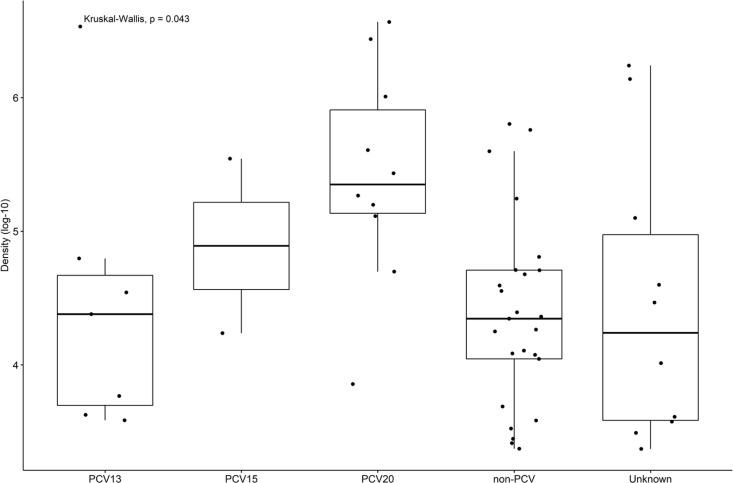
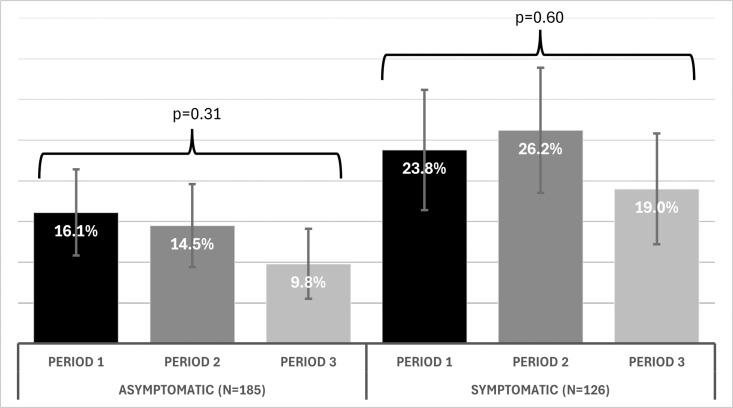
A total of 311 children met inclusion criteria (126 symptomatic and 185 asymptomatic). The overall pneumococcal colonization (23% vs. 13%, p = 0.03) and SARS-CoV-2 positivity (34.1% vs. 17.8%, p = 0.001) rates were higher in symptomatic children than in asymptomatic children. The odds of pneumococcal colonization of symptomatic (Period 2: OR 1.09; 95% CI 0.33-3.64, and Period 3: OR 0.46; 95% CI 0.13-1.59) and asymptomatic (Period 2: OR 0.55; 95% CI 0.18-1.7, and Period 3: OR 0.37; 95% CI 0.11-1.2) children did not statistically differ across study periods. Pneumococcal colonization density was also not different across study periods among study groups. Overall, non-PCV15, non-PCV20 serotypes were the most frequently identified serotypes (56.8%).
CONCLUSIONS
Pneumococcal colonization rates and density did not significantly change across study periods as adherence to non-pharmaceutical interventions gradually relaxed during the first year of the SARS-CoV-2 pandemic.
背景
2020年美国各地实施了非药物干预措施以减轻SARS-CoV-2的传播。这些公共卫生措施可能会影响年幼儿童的肺炎球菌定植及其随后发生侵袭性肺炎球菌疾病的风险。我们的目的是评估在SARS-CoV-2大流行的前12个月(2020年4月至2021年3月)有和无呼吸道症状的5岁及以下儿童的肺炎球菌定植率。
研究设计
这是一项回顾性横断面研究,评估了密苏里州堪萨斯城实施非药物干预措施后的三个研究时期(4月至7月[时期1]、8月至11月[时期2]和12月至3月[时期3])的肺炎球菌定植率、密度和血清型分布。纳入了在堪萨斯城儿童医院系统就诊的有和无呼吸道症状的5岁及以下儿童,并采集了残留标准护理的鼻中鼻甲样本。使用多变量逻辑回归计算各研究时期肺炎球菌定植的几率。
结果
共有311名儿童符合纳入标准(126名有症状,185名无症状)。有症状儿童的总体肺炎球菌定植率(23%对13%,p = 0.03)和SARS-CoV-2阳性率(34.1%对17.8%,p = 0.001)高于无症状儿童。有症状儿童(时期2:OR 1.09;95%CI 0.33 - 3.64,时期3:OR 0.46;95%CI 0.13 - 1.59)和无症状儿童(时期2:OR 0.55;95%CI 0.18 - 1.7,时期3:OR 0.37;95%CI 0.11 - 1.2)在各研究时期的肺炎球菌定植几率在统计学上无差异。各研究组在不同研究时期的肺炎球菌定植密度也无差异。总体而言,非PCV15、非PCV20血清型是最常鉴定出的血清型(56.8%)。
结论
在SARS-CoV-2大流行的第一年,随着对非药物干预措施的依从性逐渐放松,各研究时期的肺炎球菌定植率和密度没有显著变化。


 Zotero 插件