
利用1990年至2021年全球疾病负担数据集比较中国与全球数据中肌肉骨骼疾病的负担。
Comparison of the burden of musculoskeletal disorders between China and worldwide data using the global burden of disease dataset from 1990 to 2021.
作者信息
Nie Zhongbiao, Zhang Ran, Guo Yaoyao, Wang Xiang, Zhang Kai, Zhao Haoliang
机构信息
Department of Pharmaceutical, Shanxi Bethune Hospital, Shanxi Academy of Medical Sciences, Tongji Shanxi Hospital, Third Hospital of Shanxi Medical University, Taiyuan, China.
Nephrology Department, Affiliated Hospital of Shanxi University of Chinese Medicine, Taiyuan, China.
出版信息
Ann Med. 2025 Dec;57(1):2529578. doi: 10.1080/07853890.2025.2529578. Epub 2025 Jul 13.
OBJECTIVES
This study was to compare the worldwide burden of musculoskeletal (MSK) disorders with the age and gender-specific trends of MSK disorders in China and globally between 1990 and 2021.
METHODS
Using publicly available data from the Global Burden of Disease (GBD) database from 1990 to 2021. Examined the features of the burden of MSK disorders in China and globally, including age and gender-specific trends in incidence, prevalence, mortality, disability-adjusted life years (DALYs), and related age-standardized measures of MSK disorders. To represent the trends in the burden of MSK disorders, the average annual percentage change (AAPC) was computed using Joinpoint. Age, gender were important parameters that were used a comparative study of the disparities in the burden of MSK disorders between China and the global.
RESULTS
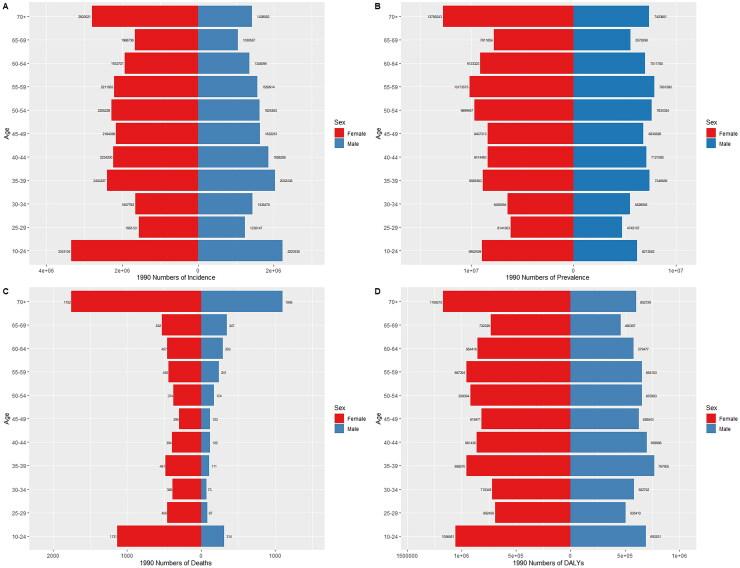
The worldwide ASIR of MSK disorders rose from 4641.50 to 4358.54 between 1990 and 2021, and China fell from 4039.13 to 3634.09 per 100,000. The worldwide ASPR rose from 19178.47 to 19836.76, China, went from 16966.24 to 17358.70 per 100,000. The ASMR in China declined from 1.22 to 1.10, while the worldwide decreased from 1.55 to 1.47 per 100,000. The ASDR in China declined from 1615.73 to 1578.71, while the worldwide ASDR decreased from 1886.22 to 1916.21 per 100,000. The worldwide AAPC of ASIR, ASPR, ASMR, and ASDR was -0.21%, 0.11%, -0.25%, and 0.04%, respectively. China was -0.34%, 0.09%, -0.41%, and -0.07%, respectively. The burden of MSK disorders was influenced similarly by age and gender.
CONCLUSION
The burden of MSK disorders rose in China and globally between 1990 and 2021, and it varies with age. Women are more prone than men to acquire MSK disorders. Because of its vast and aging population, MSK disorders continue to be a major public health concern in China and globally.
目的
本研究旨在比较1990年至2021年期间中国和全球肌肉骨骼疾病(MSK)的全球负担以及MSK疾病的年龄和性别特异性趋势。
方法
使用1990年至2021年全球疾病负担(GBD)数据库中的公开数据。研究了中国和全球MSK疾病负担的特征,包括MSK疾病发病率、患病率、死亡率、伤残调整生命年(DALY)以及相关年龄标准化指标的年龄和性别特异性趋势。为了呈现MSK疾病负担的趋势,使用Joinpoint计算平均年度百分比变化(AAPC)。年龄、性别是用于比较中国和全球MSK疾病负担差异的重要参数。
结果
1990年至2021年期间,全球MSK疾病的年龄标准化发病率(ASIR)从每10万人4641.50降至4358.54,中国从每10万人4039.13降至3634.09。全球年龄标准化患病率(ASPR)从每10万人19178.47升至19836.76,中国从每10万人16966.24升至17358.70。中国的年龄标准化死亡率(ASMR)从每10万人1.22降至1.10,全球从每10万人1.55降至1.47。中国的年龄标准化伤残调整率(ASDR)从每10万人1615.73降至1578.71,全球ASDR从每10万人1886.22降至1916.21。全球ASIR、ASPR、ASMR和ASDR的AAPC分别为-0.21%、0.11%、-0.25%和0.04%。中国分别为-0.34%、0.09%、-0.41%和-0.07%。MSK疾病负担受年龄和性别的影响相似。
结论
1990年至2021年期间,中国和全球MSK疾病负担均有所上升,且因年龄而异。女性比男性更容易患MSK疾病。由于中国人口众多且老龄化,MSK疾病在中国和全球仍然是一个主要的公共卫生问题。



 Zotero 插件