
水热合成的CuVO/g-CN纳米复合材料用于高效去除Co(II):响应面法优化、吸附机理及可重复使用性研究
Hydrothermally Synthesized CuVO/g‑CN Nanocomposite for Efficient Co(II) Removal: RSM Optimization, Adsorption Mechanism, and Reusability Study.
作者信息
Korsa Hailemariam Assefa, Bekele Endrias Adane
机构信息
Materials Science and Engineering, Jimma, Jimma University Institute of Technology, Jimma, Oromia, Ethiopia 378.
出版信息
ACS Omega. 2025 Jul 25;10(30):33558-33569. doi: 10.1021/acsomega.5c04126. eCollection 2025 Aug 5.
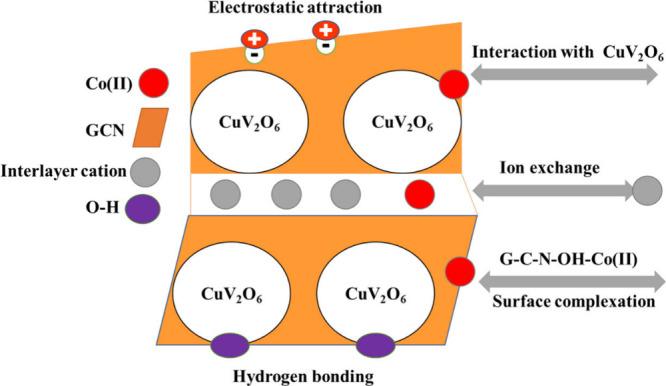
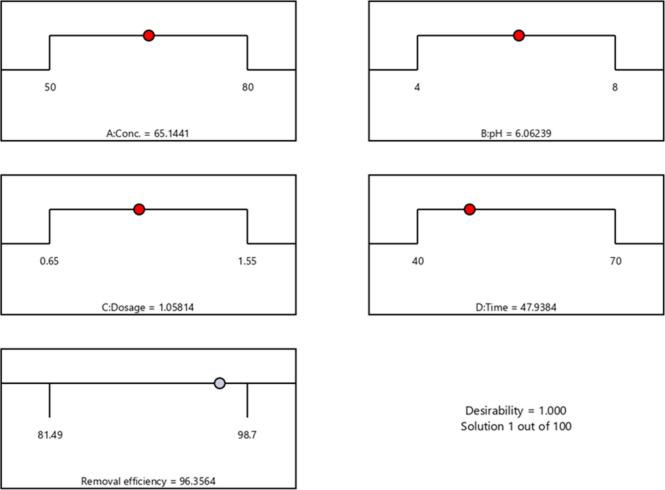
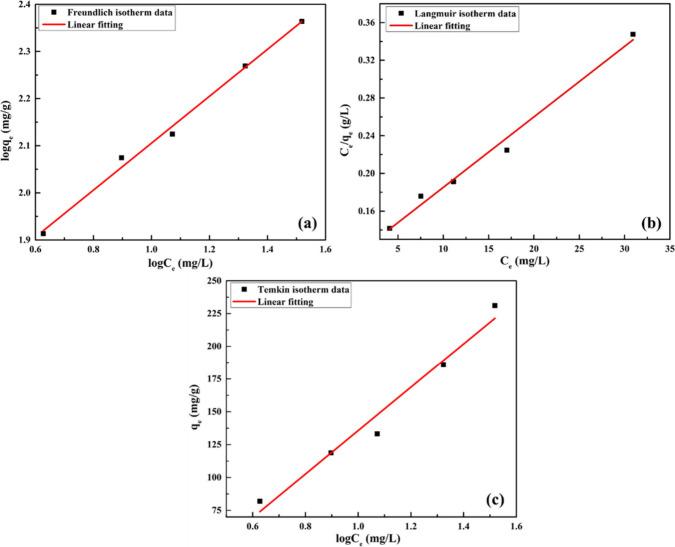
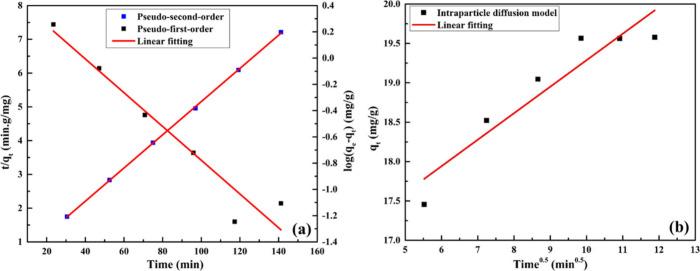
Co-(II)-ion-polluted water has become a significant global environmental issue recently. This study synthesized a CuVO/g-CN nanocomposite through a hydrothermal method. The nanocomposite was analyzed using various techniques, including X-ray diffraction (XRD), Fourier transform infrared spectrometry (FTIR), scanning electron microscopy (SEM), and the Brunauer-Emmet-Teller (BET) method. RSM-CCD was utilized to model and optimize the adsorption of Co-(II) in aqueous solutions, subsequently examining the isotherm and kinetic models. The maximum adsorption (905.22) was achieved at an initial Co-(II) concentration of 65.144 mg/L, a solution pH of 6.02, an adsorbent dosage of 1.058 g/L, and a contact time of 47.958 min. The removal efficiency was obtained to be 96.356%. The kinetic adsorption results were accurately fitted using the pseudo-second-order model, and the equilibrium data were well described using the Freundlich isotherm behavior. The adsorbent exhibited excellent reusability, maintaining high recovery efficiencies of 97.86% in KOH and 89.7% in HNO during the first cycle. The adsorption of Co-(II) is governed by electrostatic attraction, hydrogen bonding, ion exchange, and surface complexation with a functional group on the nanocomposite surface. This study highlights the potential of the CuVO/g-CN nanocomposite in addressing water pollution challenges.
近年来,钴(II)离子污染的水已成为一个重大的全球环境问题。本研究通过水热法合成了CuVO/g-CN纳米复合材料。使用各种技术对该纳米复合材料进行了分析,包括X射线衍射(XRD)、傅里叶变换红外光谱(FTIR)、扫描电子显微镜(SEM)和布鲁诺尔-埃米特-泰勒(BET)法。利用响应曲面法-中心复合设计(RSM-CCD)对水溶液中Co(II)的吸附进行建模和优化,随后研究等温线和动力学模型。在初始Co(II)浓度为65.144 mg/L、溶液pH值为6.02、吸附剂用量为1.058 g/L和接触时间为47.958 min的条件下,实现了最大吸附量(905.22)。去除效率达到96.356%。动力学吸附结果用准二级模型准确拟合,平衡数据用弗伦德利希等温线行为很好地描述。该吸附剂表现出优异的可重复使用性,在第一个循环中,在KOH中的回收率高达97.86%,在HNO中的回收率高达89.7%。Co(II)的吸附受静电吸引、氢键、离子交换以及与纳米复合材料表面官能团的表面络合作用控制。本研究突出了CuVO/g-CN纳米复合材料在应对水污染挑战方面的潜力。


 Zotero 插件