
渗漏或极化免疫:非马尔可夫模型突出了免疫记忆假设的影响。
Leaky or polarised immunity: Non-Markovian modelling highlights the impact of immune memory assumptions.
作者信息
Reyné Bastien, Kamiya Tsukushi, Djidjou-Demasse Ramsès, Alizon Samuel, Sofonea Mircea T
机构信息
Univ. Bordeaux, INSERM, INRIA, BPH, U1219, Bordeaux, France.
Vaccine Research Institute, Créteil, France.
出版信息
PLoS Comput Biol. 2025 Aug 19;21(8):e1013399. doi: 10.1371/journal.pcbi.1013399. eCollection 2025 Aug.
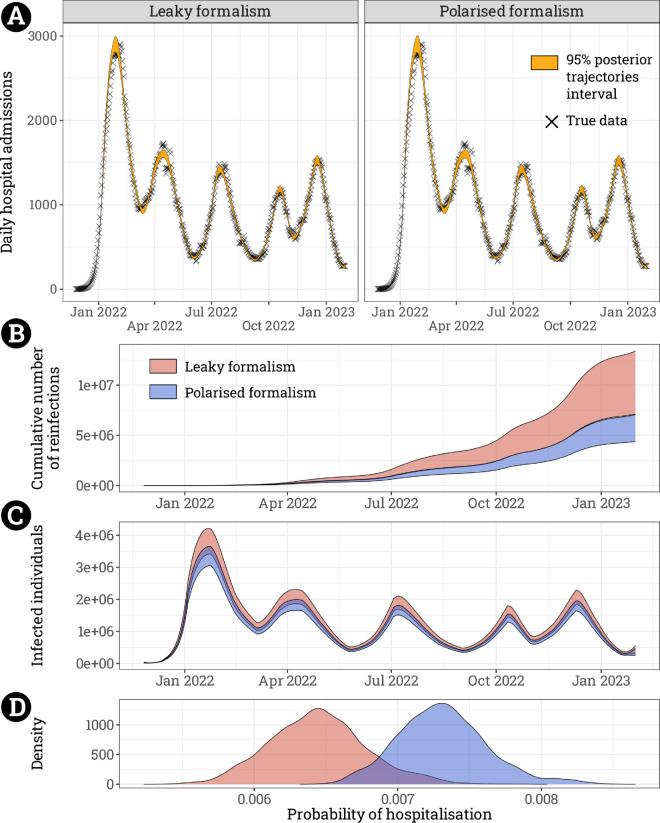
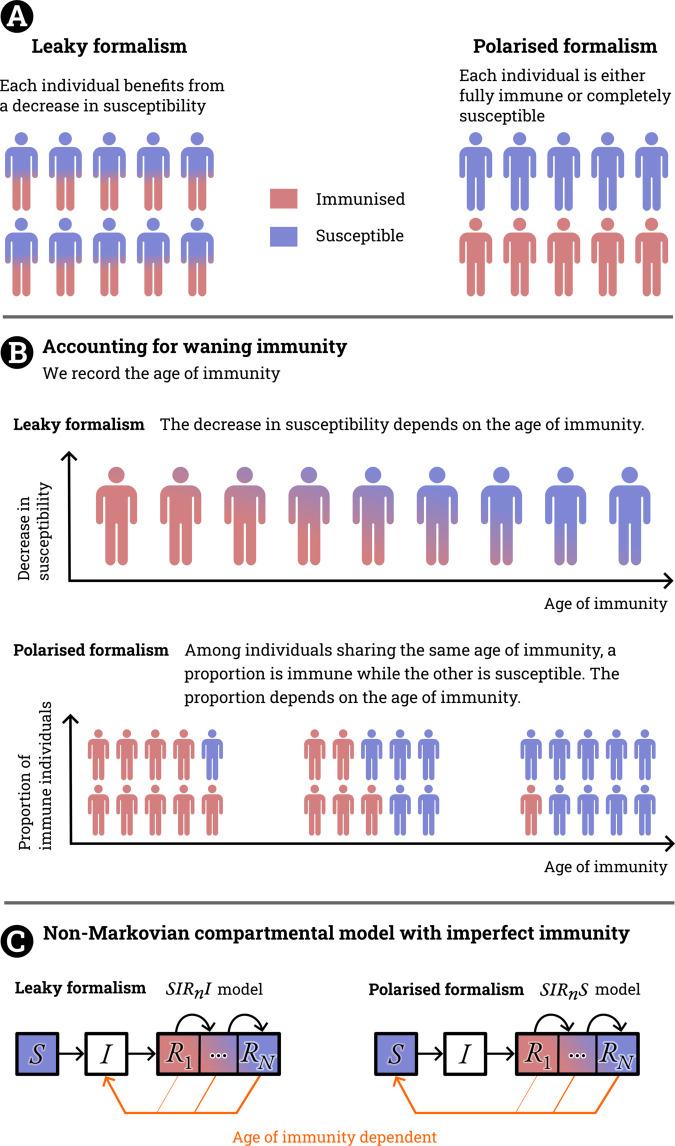
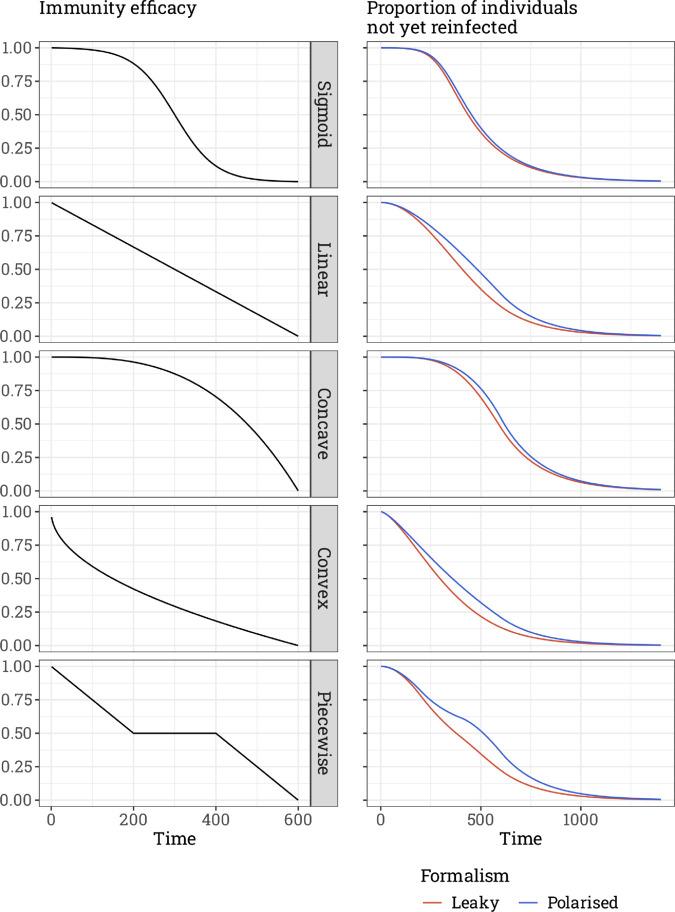
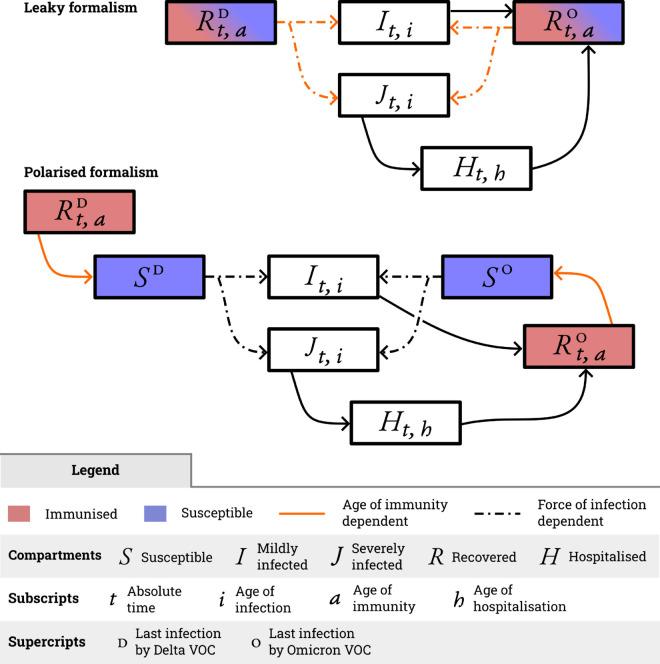
Mathematical models tend to oversimplify the biological details of vaccine or infection-derived immunity effectiveness. Yet, epidemiological outcomes may diverge when assuming polarised immunity-individuals are either fully susceptible or completely immune-compared to leaky immunity-where all individuals are partially protected. We explore the differences between the two by taking advantage of a non-Markovian framework, which allows us to explicitly record the 'age' of the immunity and vary its effectiveness accordingly. A basic scenario reveals that leaky immunity leads to a shorter time between reinfections. A more data-driven scenario based on SARS-CoV-2 data finds that leaky immunity yields substantially more reinfections than polarised immunity and a higher number of infected individuals, yet with a lower probability of hospitalisation. Our findings emphasize the critical role of immune memory modelling assumptions, especially for long-term epidemiological dynamics and public health policies.
数学模型往往会过度简化疫苗或感染衍生免疫效力的生物学细节。然而,与有漏洞的免疫情况(即所有个体都有部分保护)相比,当假设免疫极化(个体要么完全易感要么完全免疫)时,流行病学结果可能会有所不同。我们利用一个非马尔可夫框架来探索两者之间的差异,该框架使我们能够明确记录免疫的“年龄”并相应地改变其效力。一个基本情景表明,有漏洞的免疫会导致再次感染之间的时间更短。一个基于新冠病毒数据的更由数据驱动的情景发现,有漏洞的免疫比极化免疫产生的再次感染要多得多,感染个体数量也更多,但住院概率更低。我们的研究结果强调了免疫记忆建模假设的关键作用,特别是对于长期流行病学动态和公共卫生政策而言。
 Zotero 插件