
中国和全球的唐氏综合征负担:基于全球疾病负担研究(GBD)2021数据库对1990 - 2021年趋势及未来预测的比较分析
Down syndrome burden in China and globally: a comparative analysis of 1990-2021 trends and future projections based on GBD 2021 database.
作者信息
Tu Xiangwen, Zhang Feng, Chen Junkun, Tang Manmei
机构信息
Laboratory of Eugenics Genetics, Ganzhou Women and Children's Health Care Hospital, Ganzhou, Jiangxi, China.
Department of Pediatric Neurological Rehabilitation, Ganzhou Women and Children's Health Care Hospital, Ganzhou, Jiangxi, China.
出版信息
Front Public Health. 2025 Aug 11;13:1632250. doi: 10.3389/fpubh.2025.1632250. eCollection 2025.
BACKGROUND
Down syndrome (DS), a neurodevelopmental disorder caused by a chromosomal abnormality, poses a major burden on global health. Analyzing the disease burden of DS, both in China and globally, is crucial for refining public health strategies.
METHODS
Using the Global Burden of Disease (GBD) 2021 database, we examined age-standardized incidence rate (ASIR), age-standardized prevalence rate (ASPR), age-standardized mortality rate (ASMR), and age-standardized disability-adjusted life year rate (ASDR) for DS in China and globally from 1990 to 2021. Joinpoint regression analysis was applied to identify temporal trends by calculating the annual percent change (APC) and average annual percent change (AAPC). A bayesian age-period-cohort (BAPC) model was further employed to project prevalence changes from 2022 to 2036.
RESULTS
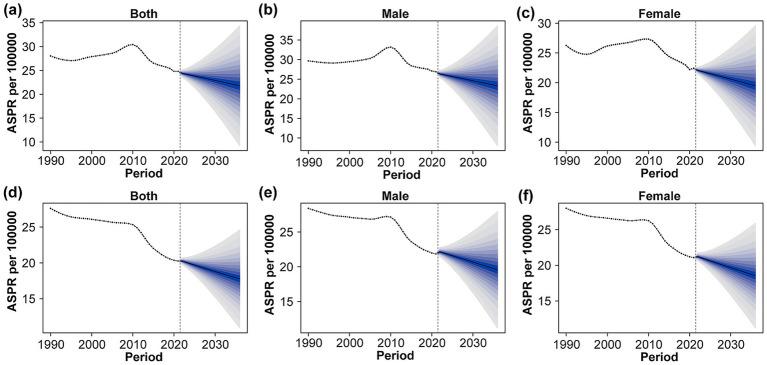
From 1990 to 2021, China's ASIR decreased from 1.68 per 100,000 to 1.18 per 100,000, compared to a global reduction from 1.27 per 100,000 to 0.97 per 100,000. Similarly, ASPR in China fell from 28.01 per 100,000 to 24.8 per 100,000, while globally it dropped from 27.98 per 100,000 to 21.07 per 100,000. Notably, China experienced steeper declines in ASMR (EAPC = -4.18%) and ASDR (EAPC = -3.87%) compared to the global averages (-0.44% and -0.69%, respectively). Joinpoint regression analysis shows that from 1990 to 2021, China's ASIR (AAPC = -1.15, < 0.001), ASPR (AAPC = -0.39, 0.001), ASDR (AAPC = -2.87, < 0.001), and ASMR (AAPC = -3.08, < 0.001) for DS all decreased. The SDI was negatively correlated with ASMR ( = -0.68, 0.001) and ASDR ( = -0.66, < 0.001) but positively associated with ASIR ( = 0.55, < 0.001) and ASPR ( = 0.80, < 0.001). Projections from the BAPC model suggest that the ASPR of DS will continue to decline both in China and globally through 2036.
CONCLUSION
From 1990 to 2021, the disease burden of DS declined in China and globally. China's decline in ASMR and ASDR outpaced the global level, though ASIR and ASPR remained higher. To further reduce DS burden, future efforts should prioritize early identification, counseling for informed decision-making, and equitable access to quality lifelong multidisciplinary support for affected individuals.
背景
唐氏综合征(DS)是一种由染色体异常引起的神经发育障碍,给全球健康带来了重大负担。分析中国和全球范围内DS的疾病负担,对于完善公共卫生策略至关重要。
方法
利用全球疾病负担(GBD)2021数据库,我们研究了1990年至2021年中国和全球范围内DS的年龄标准化发病率(ASIR)、年龄标准化患病率(ASPR)、年龄标准化死亡率(ASMR)和年龄标准化伤残调整生命年率(ASDR)。应用Joinpoint回归分析,通过计算年度百分比变化(APC)和平均年度百分比变化(AAPC)来确定时间趋势。进一步采用贝叶斯年龄-时期-队列(BAPC)模型预测2022年至2036年的患病率变化。
结果
1990年至2021年,中国的ASIR从每10万人1.68例降至每10万人1.18例,而全球范围从每10万人1.27例降至每10万人0.97例。同样,中国的ASPR从每10万人28.01例降至每10万人24.8例,全球则从每10万人27.98例降至每10万人21.07例。值得注意的是,与全球平均水平(分别为-0.44%和-0.69%)相比,中国的ASMR(EAPC = -4.18%)和ASDR(EAPC = -3.87%)下降幅度更大。Joinpoint回归分析表明,1990年至2021年,中国DS的ASIR(AAPC = -1.15,<0.001)、ASPR(AAPC = -0.39,0.001)、ASDR(AAPC = -2.87,<0.001)和ASMR(AAPC = -3.08,<0.001)均有所下降。社会人口指数(SDI)与ASMR(ρ = -0.68,<0.001)和ASDR(ρ = -0.66,<0.001)呈负相关,但与ASIR(ρ = 0.55,<0.001)和ASPR(ρ = 0.80,<0.001)呈正相关。BAPC模型预测表明,到2036年,中国和全球范围内DS的ASPR将继续下降。
结论
1990年至2021年,中国和全球范围内DS的疾病负担均有所下降。中国ASMR和ASDR的下降速度超过全球水平,尽管ASIR和ASPR仍较高。为进一步减轻DS负担,未来应优先进行早期识别、提供咨询以促进知情决策,并为受影响个体公平提供优质的终身多学科支持。


 Zotero 插件