
基于移动应用程序的干预措施与血糖控制不佳的2型糖尿病患者心血管危险因素:一项随机临床试验
Mobile App-Based Intervention and Cardiovascular Risk Factors in Patients With Uncontrolled Type 2 Diabetes: A Randomized Clinical Trial.
作者信息
Zhang Pei-Zhen, Guo Dan, Liu Chang-Qin, Chen Ning, Liu Jian-Fang, Lei Xu-Zhen, Yang Lin-Jie, Liu Ya-Ting, Li Xu, Huang Jun-Feng, Du Chun-Min, Wang Kai, Mo Wei, Lin Jia-Yang, Huang Chen-Si-Han, Xu Bing-Yan, Wei Xue-Yun, Liu De-Ying, Huang Jun-Lin, Huang Yan, Xue Yao-Ming, Zeng Yan-Mei, Liu Shi-Qun, Ma Zhi-Min, Zhang Hui-Jie
机构信息
Department of Endocrinology and Metabolism, Nanfang Hospital, Southern Medical University, Guangzhou, China.
Department of Endocrinology and Diabetes, The First Affiliated Hospital of Xiamen University, School of Medicine, Xiamen University, Xiamen, China.
出版信息
JAMA Netw Open. 2025 Sep 2;8(9):e2529762. doi: 10.1001/jamanetworkopen.2025.29762.
IMPORTANCE
Controlling modifiable cardiovascular risk factors is important but underused for patients with type 2 diabetes (T2D). Mobile message-based intervention strategies could address this gap but lack evidence of benefit on multiple risk factors.
OBJECTIVE
To evaluate the effectiveness of a mobile message-based intervention in controlling cardiovascular risk factors in patients with T2D.
DESIGN, SETTING, AND PARTICIPANTS: In this randomized clinical trial, adults with uncontrolled T2D comorbid with cardiovascular disease (CVD) risk factors were recruited from 5 clinical centers in China. Data were collected from November 2018 to March 2022 and analyzed from January to June 2023.
INTERVENTION
Participants were randomized to receive either usual care or a mobile message-based intervention of 6 text messages per week from different modules designed to remind, encourage, and motivate them to participate in the behaviors needed for improving glycemic control and CVD risk factor management for 12 months.
MAIN OUTCOMES AND MEASURES
The primary outcome included mean changes in hemoglobin A1c (HbA1c), low-density lipoprotein cholesterol (LDL-C), and systolic blood pressure (SBP) levels across 12 months. The secondary outcomes included the percentage of participants with controlled HbA1c at 12 months. Data were analyzed using the intention-to-treat principle.
RESULTS
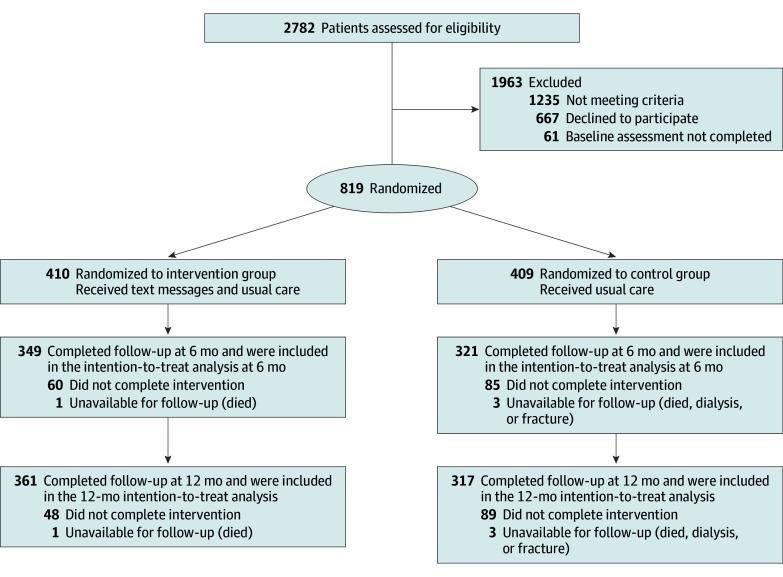
A total of 819 participants (552 men [67.4%]; mean [SD] age, 50.1 [11.9] years; mean [SD] HbA1c level, 10.2% [2.1%]) were enrolled, of whom 410 were randomized to the intervention group and 409 to the control group. During the 12-month intervention, significant reductions in the mobile message-based intervention group were observed for HbA1c levels by -2.8% (95% CI, -2.9% to -2.6%), LDL-C by -11.1 mg/dL (95% CI, -14.7 to -7.4 mg/dL), and SBP by -2.5 mm Hg (95% CI, -3.9 to -1.2 mm Hg), and in the usual care group, by -2.5% (95% CI, -2.7% to -2.3%) for HbA1c, -11.9 mg/dL (95% CI, -15.8 to -8.0 mg/dL) for LDL-C, and -0.1 mm Hg (95% CI, -1.6 to 1.3 mm Hg) for SBP. The net group differences were -0.3% (95% CI, -0.5% to -0.0%) for HbA1c, 0.9 mg/dL (95% CI, -4.5 to 6.2 mg/dL) for LDL-C, and -2.4 mm Hg (95% CI, -4.3 to -0.4 mm Hg) for SBP (P = .001 for the combined overall effect). The percentage of participants with controlled HbA1c among all participants was significantly higher in the intervention group than in the control group at 12 months (195 participants [54.0%] vs 146 participants [46.1%]; P = .04).
CONCLUSIONS AND RELEVANCE
In this randomized clinical trial of adults with uncontrolled T2D in China, a mobile message-based intervention resulted in a modest improvement in HbA1c and SBP in patients with diabetes compared with usual care. These results suggest that mobile message-based strategies for improving glycemic control and CVD risk factors should be considered for adults with T2D.
TRIAL REGISTRATION
ClinicalTrials.gov Identifier: NCT03724526.
重要性
控制可改变的心血管危险因素很重要,但在2型糖尿病(T2D)患者中未得到充分利用。基于手机短信的干预策略可以弥补这一差距,但缺乏对多种危险因素有益的证据。
目的
评估基于手机短信的干预对T2D患者控制心血管危险因素的有效性。
设计、设置和参与者:在这项随机临床试验中,从中国5个临床中心招募了患有未控制的T2D且合并心血管疾病(CVD)危险因素的成年人。数据收集于2018年11月至2022年3月,并于2023年1月至6月进行分析。
干预措施
参与者被随机分为两组,一组接受常规护理,另一组接受基于手机短信的干预,每周从不同模块发送6条短信,旨在提醒、鼓励并激励他们参与改善血糖控制和CVD危险因素管理所需的行为,为期12个月。
主要结局和测量指标
主要结局包括12个月期间糖化血红蛋白(HbA1c)、低密度脂蛋白胆固醇(LDL-C)和收缩压(SBP)水平的平均变化。次要结局包括12个月时HbA1c得到控制的参与者百分比。数据采用意向性分析原则进行分析。
结果
共纳入819名参与者(552名男性[67.4%];平均[标准差]年龄为50.1[11.9]岁;平均[标准差]HbA1c水平为10.2%[2.1%]),其中410名被随机分配到干预组,409名被随机分配到对照组。在12个月的干预期间,基于手机短信的干预组的HbA1c水平显著降低了2.8%(95%置信区间,-2.9%至-2.6%),LDL-C降低了11.1mg/dL(95%置信区间,-14.7至-7.4mg/dL),SBP降低了2.5mmHg(95%置信区间,-3.9至-1.2mmHg);常规护理组的HbA1c降低了2.5%(95%置信区间,-2.7%至-2.3%),LDL-C降低了11.9mg/dL(95%置信区间,-15.8至-8.0mg/dL),SBP降低了0.1mmHg(95%置信区间,-1.6至1.3mmHg)。两组之间的净差异为:HbA1c为-0.3%(95%置信区间,-0.5%至-0.0%),LDL-C为0.9mg/dL(95%置信区间,-4.5至6.2mg/dL),SBP为-2.4mmHg(95%置信区间,-4.3至-0.4mmHg)(综合总体效应P = 0.001)。在12个月时,干预组所有参与者中HbA1c得到控制的参与者百分比显著高于对照组(195名参与者[54.0%]对146名参与者[46.1%];P = 0.04)。
结论和相关性
在这项针对中国未控制T2D成年人的随机临床试验中,与常规护理相比,基于手机短信的干预使糖尿病患者的HbA1c和SBP略有改善。这些结果表明,对于T2D成年人,应考虑采用基于手机短信的策略来改善血糖控制和CVD危险因素。
试验注册
ClinicalTrials.gov标识符:NCT03724526。

 Zotero 插件