
输注前风险因素可预测儿童和成人B-ALL患者CAR-T细胞治疗的严重感染并发症。
Pre-infusion risk factors predict severe infectious complications of CAR T-cell therapy in pediatric and adult patients with B-ALL.
作者信息
Culbert August A, Gava Flavia, Valtis Yannis K, Satta Toshihisa, Vora Surabhi, Rocco Joseph M, Nussenblatt Veronique, Silbert Sara K, Shalabi Haneen, Yates Bonnie, Park Jae H, Lamble Adam J, Rejeski Kai, Shah Nirali N
机构信息
Pediatric Oncology Branch, National Cancer Institute Center for Cancer Research, Bethesda, Maryland, USA.
Cleveland Clinic Lerner College of Medicine of Case Western Reserve University, Cleveland, Ohio, USA.
出版信息
J Immunother Cancer. 2025 Sep 14;13(9):e012436. doi: 10.1136/jitc-2025-012436.
BACKGROUND
Despite the curative potential for chimeric antigen receptor (CAR) T-cells in B-cell acute lymphoblastic leukemia (B-ALL), efficacy can be limited by life-threatening adverse events such as severe infections. As immune effector cell-associated hematotoxicity and secondary immunodeficiency may be particularly profound in B-ALL, understanding pre-infusion risk of severe infection is imperative. The ALL-HEMATOTOX (ALL-HT) score is a recently validated tool designed to predict CAR-associated hematotoxicity in B-ALL, but the relationship between ALL-HT and severe infections post-infusion has not yet been comprehensively assessed.
METHODS
In this multicenter, retrospective analysis, we evaluated ALL-HT and other pre-infusion variables for an association with severe infection through day+60 (D+60) in patients with B-ALL treated with CD19 and CD22-based CAR T-cell constructs across three institutions. Infections were identified by microbiology, histopathology, or as a clinical syndrome and graded by CTCAE (Common Terminology Criteria for Adverse Events) V.5.0. Severe infections were defined as grade≥3. Multivariable logistic regression and Cox proportional hazard models were constructed to identify independent risk factors for infection.
RESULTS
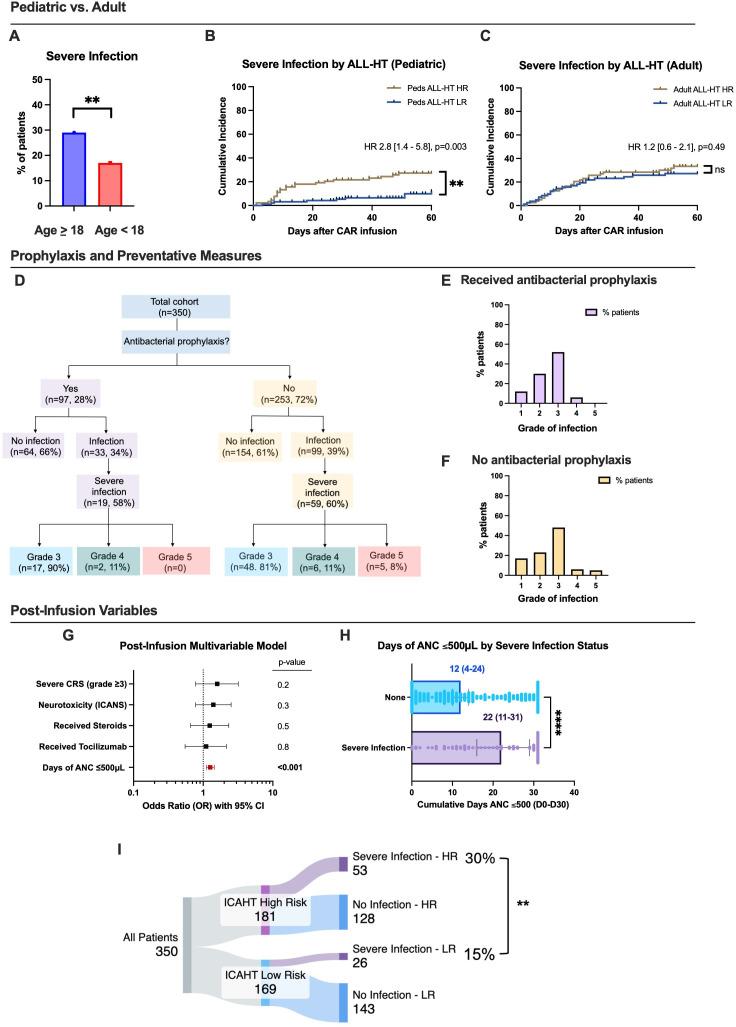
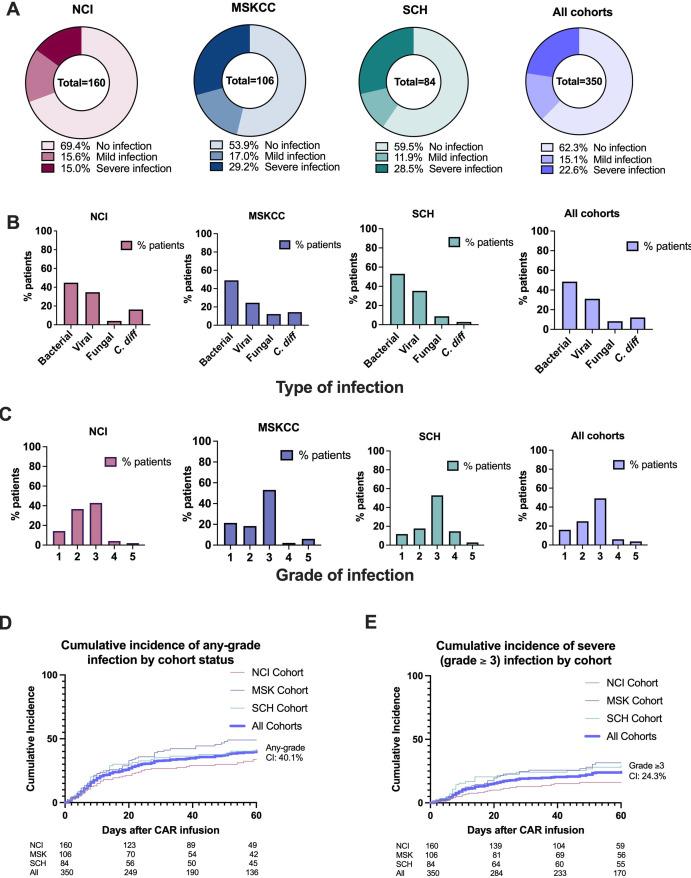
Across 350 patients receiving CAR T-cells, 79 (23%) developed a severe infection within day+60 post-CAR, including 8 patients with grade 4 (life-threatening) infection and 5 patients with grade 5 (fatal) infections. Bloodstream infections were the most common, comprising 67% of those with severe infections. In multivariable analysis, pre-infusion factors associated with severe infection included older age (OR 1.35 (1.1-1.6), p=0.002), prior severe infection (OR 2.1 (1.2-3.7), p=0.009), and a higher ALL-HT score (OR 1.15 (1.01-1.31), p=0.04). Patients classified as high-risk (HR) by ALL-HT had a greater risk of infection compared with low-risk patients (HR 1.4 (1.1-2.7), p=0.014).Multiple severe infections occurred in 24 patients (7%). In a subanalysis, ALL-HT risk of infection was primarily driven by baseline thrombocytopenia, with a cut-off of≤50 000 platelets/µL strongly predicting risk of infection (HR 2.2 (1.3-3.6), p=0.002). Post-infusion infection risk was driven by a longer duration of neutropenia (OR 1.26 (1.1-1.4), p<0.001).
CONCLUSIONS
Older age, prior infection history, baseline thrombocytopenia, and higher ALL-HT scores are strong independent risk factors for severe infection among patients with B-ALL receiving CAR T-cells. These factors may guide individualized risk mitigation to prevent severe infections in this high-risk patient population.
TRIAL REGISTRATION NUMBER
NCT03827343.
背景
尽管嵌合抗原受体(CAR)T细胞对B细胞急性淋巴细胞白血病(B-ALL)具有治愈潜力,但其疗效可能会受到严重感染等危及生命的不良事件的限制。由于免疫效应细胞相关的血液毒性和继发性免疫缺陷在B-ALL中可能尤为严重,因此了解输注前严重感染的风险至关重要。ALL-HEMATOTOX(ALL-HT)评分是一种最近经过验证的工具,旨在预测B-ALL中与CAR相关的血液毒性,但ALL-HT与输注后严重感染之间的关系尚未得到全面评估。
方法
在这项多中心回顾性分析中,我们评估了三个机构中接受基于CD19和CD22的CAR T细胞构建体治疗的B-ALL患者在第60天(D+60)前的ALL-HT和其他输注前变量与严重感染的相关性。通过微生物学、组织病理学或作为临床综合征来识别感染,并根据《不良事件通用术语标准》(CTCAE)V.5.0进行分级。严重感染定义为≥3级。构建多变量逻辑回归和Cox比例风险模型以识别感染的独立危险因素。
结果
在350例接受CAR T细胞治疗的患者中,79例(23%)在CAR治疗后第60天内发生了严重感染,包括8例4级(危及生命)感染患者和5例5级(致命)感染患者。血流感染最为常见,占严重感染患者的67%。在多变量分析中,与严重感染相关的输注前因素包括年龄较大(比值比[OR] 1.35[1.1-1.6],p=0.002)、既往严重感染(OR 2.1[1.2-3.7],p=0.009)和较高的ALL-HT评分(OR 1.15[1.01-1.31],p=0.04)。与低风险患者相比,ALL-HT分类为高风险(HR)的患者感染风险更高(HR 1.4[1.1-2.7],p=0.014)。24例患者(7%)发生了多次严重感染。在亚组分析中,ALL-HT感染风险主要由基线血小板减少驱动,血小板计数≤50000/µL强烈预测感染风险(HR 2.2[1.3-3.6],p=0.002)。输注后感染风险由较长时间的中性粒细胞减少驱动(OR 1.26[1.1-1.4],p<0.001)。
结论
年龄较大、既往感染史、基线血小板减少和较高的ALL-HT评分是接受CAR T细胞治疗的B-ALL患者发生严重感染的强有力独立危险因素。这些因素可能指导个体化的风险降低措施,以预防这一高风险患者群体中的严重感染。
试验注册号
NCT03827343。



 Zotero 插件